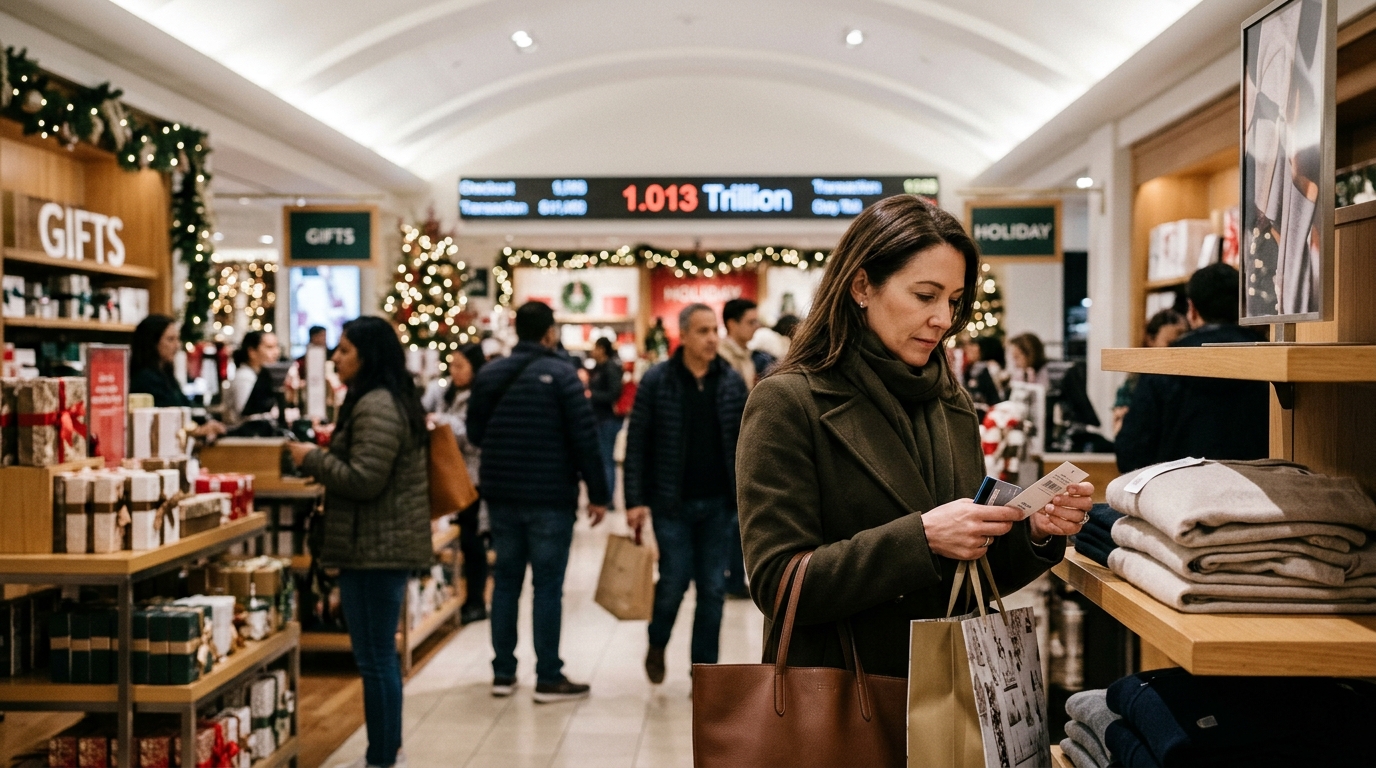
The headline is historic. $1.013 trillion in November and December retail sales would mark the first holiday season to clear $1 trillion, and three separate forecasters are pointing in roughly the same direction. The National Retail Federation projects 4.2% growth to $1.013 trillion, the first time the season tops $1 trillion. Visa Business and Economic Insights puts holiday retail sales growth at 4.5% year-over-year, calling it the strongest since 2021. The Mastercard Economics Institute expects 5.5% growth, measured as retail sales excluding gas and autos between November 1 and December 24.
So the season opens with real momentum, and a real asterisk.
The Price Problem
Peel back the numbers and the picture changes. Roughly half of NRF’s projected 4.2% holiday growth is expected to come from real consumer spending rather than price increases, according to NRF Chief Economist Mark Mathews. The rest is inflation. Visa estimates prices for holiday-related goods will rise approximately 3.4%, leaving inflation-adjusted spending up just 1.1%. Mastercard says the same: nearly half of the gain in holiday spending can be explained by higher prices, a function of elevated energy costs and the AI buildout.
That matters enormously for investors. When nominal sales growth barely clears inflation, what retailers are selling is fewer units at higher prices. Volume is thin. Margin pressure follows.
Private-label strategy is where that margin pressure gets absorbed or passed on. Retailers engineering higher private-label penetration are capturing the spread that national brands are losing to inflation.
The macroeconomic backdrop is uneven. The U.S. economy added 165,000 jobs in October, and average hourly earnings rose 3.1% year-over-year. That is real income growth, but it is probably not enough to keep pace with rising prices. The 30-year mortgage rate sits at 7.18%. Housing costs that high keep household balance sheets stretched for the half of America that is not comfortably employed in a high-wage sector.
The Divided Consumer
Which brings us to the structural question that retail earnings will answer over the next ten days: who is actually spending?
Visa found that households earning more than $200,000 were the only income group to increase both holiday airfare bookings and spending in September, while lower-income groups pulled back. This is consistent with what Walmart itself flagged earlier this year. CEO John Furner said the majority of share gains came from households making more than $100,000, while for households earning below $50,000, wallets are stretched, and in some cases people are managing spending paycheck to paycheck.
That split defines which retailers win this season. Walmart (WMT) captures both ends, trading-down value shoppers and an expanding cohort of higher-income customers choosing its private label and delivery convenience. Amazon (AMZN) benefits from price comparison behavior: when budgets tighten, consumers research harder and buy online. Online sales are expected to grow 11%, while in-store sales are forecast to rise just 3.6%.
Target (TGT) is the more complicated case. At Walmart, executives are talking about lowering prices to protect lower-income shoppers; at Target, the team is highlighting sharp gains in discretionary categories like beauty, toys and electronics. That discretionary tilt works in a confident consumer environment. It is a vulnerability if the lower half of the K-shaped economy pulls back further in November.
Where the Opportunity Sits
For long-term investors, the trillion-dollar milestone is not the signal. The signal is the composition. A season where roughly half of nominal growth is price-driven rewards retailers with pricing power and lean cost structures, not those chasing volume. It also rewards the payments networks. The Mastercard Economics Institute is forecasting this year’s holiday season to be the strongest in four years, with 5.5% spending growth. Every dollar, inflated or not, runs through Visa (V) or Mastercard (MA) rails. Volume in dollars, not units, is what drives interchange revenue.
If realized, 2026’s growth rate would be the fastest since 2021, when Visa’s measure of holiday sales growth hit 12.6%. That framing flatters the headline. But 2021 was a demand surge coming off pandemic lows. This season, the growth is slower, narrower by income cohort, and partially borrowed from the price level rather than earned through real consumption.
The Wealth Takeaway
The first trillion-dollar holiday season belongs to investors who understand what drives it. Payments networks collect a percentage of every dollar spent regardless of whether the consumer bought more or just paid more. Retailers with genuine pricing power and cost discipline convert inflated sales into real earnings. Those without that combination will post impressive top-line numbers in November and disappoint on margins in January. Watch the retail earnings calls starting next week for gross margin guidance. That is where this season will actually be settled.