October 15, 2026
Bonus Content: Union Pacific’s Intermodal Machine Is Running Hotter Than Wall Street Realizes
Everybody wants to know.
How does Tim Sykes profit over the weekend?
It sounds impossible.
But when I show you how I’m making thousands of dollars almost every weekend like clockwork…
By just placing one simple trade around 2:59 pm on Friday…
You’re going to be SHOCKED.
Click here to discover my best trading secret
You are receiving this email because you opted in to receive financial news and updates.
Union Pacific’s Intermodal Machine Is Running Hotter Than Wall Street Realizes
Domestic intermodal freight revenue at Union Pacific surged 26% in the second quarter of 2026, setting a fourth consecutive record and signaling that demand for cross-modal shipping is not merely cyclical. Management also lifted its full-year 2026 outlook to reported earnings-per-share growth in the high-single-digit range on the back of it. Those numbers are drawing attention to what most investors still treat as a boring railroad story. It is not.
The real opportunity sits at the intersection of two accelerating forces: automated ports and the software layer Union Pacific has quietly built to exploit them.
The Port of Long Beach processed a record roughly 9.9 million TEUs in 2025 and is rolling out new systems to handle similar volumes in 2026, including CargoNav, a digital platform designed to help shippers track cargo movements. CargoNav, developed under the port’s Supply Chain Information Highway initiative, is slated to incorporate a universal trucking appointment system that would let motor carriers schedule pickups across the Port of Long Beach’s six marine terminals from a single interface. That is not a minor upgrade. It is a structural change in how freight flows off the dock and onto a train.
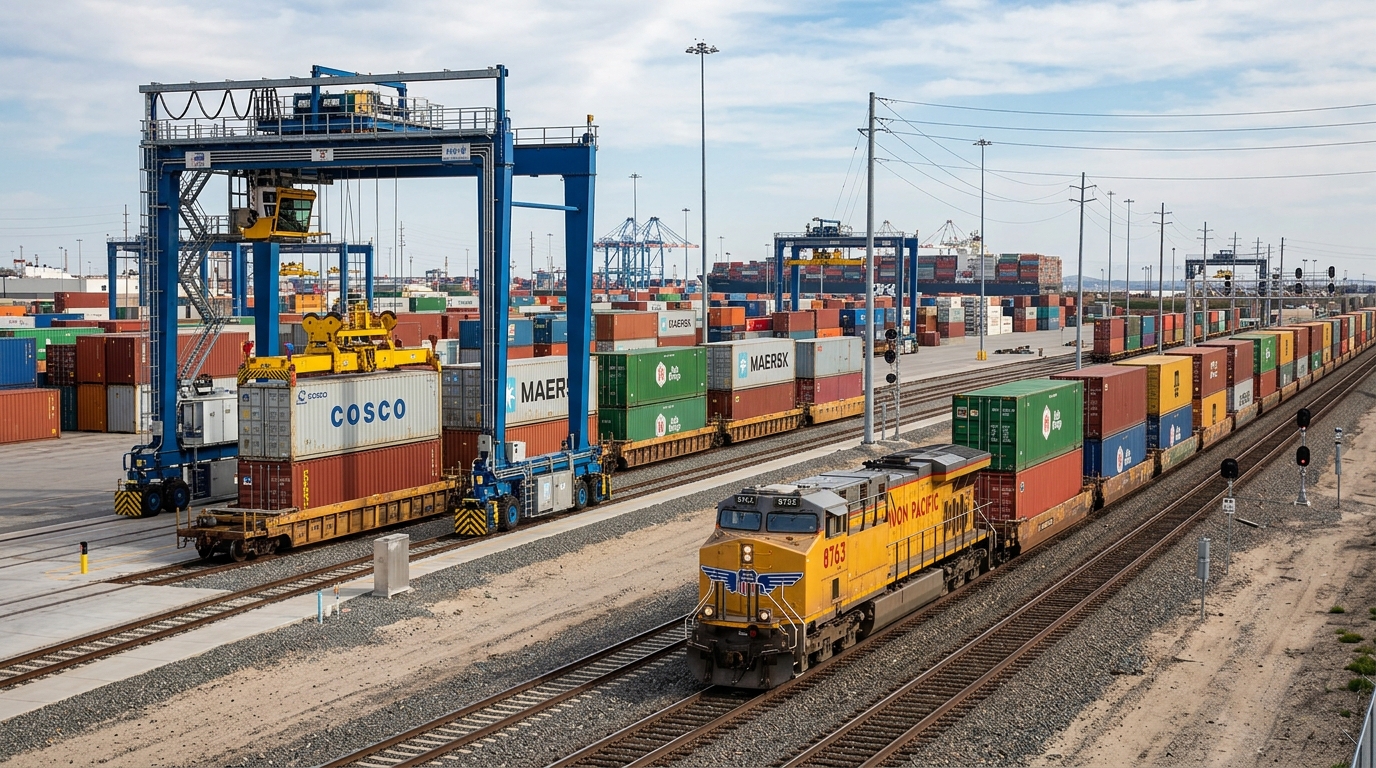
Union Pacific is positioned to capture that flow better than any competitor. Its NetControl platform is Union Pacific’s transportation management system, providing real-time operational visibility across the network. Union Pacific also offers SmartETA to provide more accurate estimated delivery times and shipment location data. The logic here is compounding: the better UNP can promise an arrival window, the more shippers choose rail over truck for long-haul legs.
The software advantage compounds only if underlying freight demand holds. Trucking capacity destruction and two consecutive months of volume growth signal the freight cycle is turning in rail’s favor.
Under its 2050 vision, the Port of Long Beach has laid out plans to modernize facilities and target roughly 20 million TEUs by 2050. One mechanism is Union Pacific’s Phoenix Intermodal Terminal, which transfers containers between railcars and trucks, giving shippers a corridor between San Pedro Bay and Arizona. For 2026, third-party estimates tied to the port’s Phoenix rail service put the potential emissions reduction at more than 30,000 metric tons, and port-to-Phoenix rail is often described as cutting greenhouse gases by as much as 75% versus all-truck alternatives. Sustainability mandates are nudging more shippers toward rail before the economics even demand it.
The risk investors should weigh is that international intermodal volume was down 14% year-over-year in Q2 2026, a drag that management linked to import softness and shifting lanes. Management expects volumes to turn positive in the second half as comps normalize, but that assumption depends on trade policy remaining stable. It may not.
Trade policy is the variable management cannot control. North American tariff divergence between Mexico and Canada is already reshaping cross-border rail lane economics.
Still, the longer thesis holds. Union Pacific serves the San Pedro port complex alongside BNSF, and its pending proposed merger with Norfolk Southern would extend its reach into Midwestern and East Coast markets if approved. Each automated crane added at Long Beach, each predictive berth-scheduling system deployed, makes UNP’s software integration more valuable. The port is becoming a digital facility. Union Pacific built the plumbing to connect with it. That is the trade.