Dow Inc. reports Q3 earnings on October 22. Investors scanning the balance sheet will find a company still carrying $17.2 billion in long-term debt as of June 30, 2026. What they may miss is that Dow is, quietly and without much fanfare, rewriting how one of the world’s largest plastics businesses sources its raw materials.
The angle worth examining is not the corn stover headline itself, which has circulated since Dow’s 2023 partnership with Iowa-based New Energy Blue. Construction of the Mason City facility was expected to begin in 2024, with commissioning and start-up scheduled by end of 2026. That deadline is now. The question investors have not adequately priced is what happens if it hits.
The Feedstock Architecture
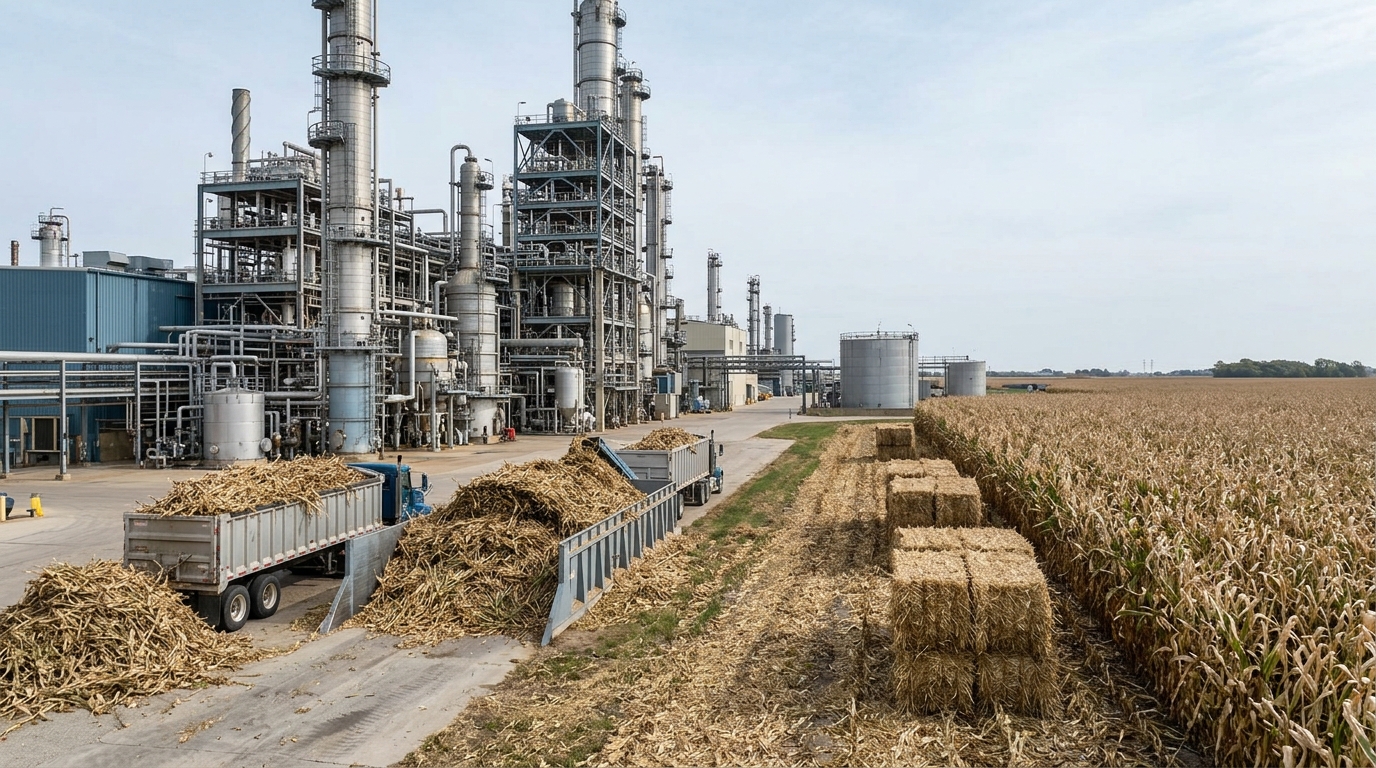
Dow will support New Energy Blue’s new facility in Mason City, Iowa, expected to process 275 kilotons of corn stover annually to produce ethanol, about half of which will become ethylene feedstock for Dow bio-based plastic products. The first of five planned processing facilities will source leftover corn stover from farms near the site, and Dow holds supply options for bio-ethylene from the next four future New Energy Blue projects.
Together, the five projects are expected to displace more than one million tons of greenhouse gas emissions each year. That is a meaningful carbon claim for a company whose core product, polyethylene, has for a century been inseparable from petroleum.
Dow’s approach to incorporating bio-based feedstocks is a mass-balance method, combining new feedstocks with existing ones, with the bio-based content certified through ISCC PLUS, a widely used certification across the industry. Mass-balance is worth understanding: it does not mean every molecule in a given resin came from a corn stalk. It means the volume of renewable feedstock entering the system is tracked and allocated across output. Drop-in chemistry, existing processing lines, no retooling cost. The efficiency play is real.
The Hidden Constraint
Here is what the bio-circular story glosses over. The entire PHA market, the most ecologically ambitious branch of microbial bioplastics, is projected to reach only about $141 million globally in 2026. The drop-in bio-polyethylene segment Dow is pursuing is further along commercially, but still nascent relative to the company’s overall scale. Dow’s Packaging and Specialty Plastics division generated $6.4 billion in net sales in Q2 2026 alone.
At Colombiaplast 2026 in October, Dow laid out its circular plastics roadmap: by 2035, everything it sells into packaging must be reusable or recyclable; by 2030, it aims to commercialize 500,000 metric tons a year of circular and renewable solutions; and by 2050, it intends to be carbon neutral. Five hundred thousand metric tons against an addressable PE market that S&P Global estimates at 150 to 175 million metric tons by 2030. The ambition is genuine. The scale gap is also genuine.
Why the Timing Still Matters
Dow’s Q2 2026 net sales reached $10.9 billion, up 14% year-over-year, led by gains in Packaging and Specialty Plastics, with higher polyethylene prices in all regions. The polyethylene recovery is doing the heavy lifting right now, but it is cyclical. The bio-circular infrastructure is structural.
Dow stock at roughly $30 sits well below its 2023 peak above $42. The current bull thesis centers on litigation cash, advantaged feedstock exposure, and energy projects, not eco-polymers. That may be the opportunity. If the Mason City facility commissions on schedule before year-end, Dow crosses a threshold few commodity chemical companies have reached: commercially verified, agricultural-waste-to-packaging-grade-resin supply, certified and scalable. That is not a 2030 story. It is a Q4 2026 catalyst the market has not yet built into a roughly $21 billion market cap.