October 15, 2026
Bonus Content: Nvidia Still Leads China’s AI Chip Market. The Gap Is Closing.
Below is an important message from one of our highly valued sponsors. Please read it carefully as they have some special information to share with you.
Dear Reader,
You have until December 8th.
That’s when this all comes to a head.
And I believe the days before it may be the most important of your investing life.
I’ve compiled proof that Elon Musk is about to launch the biggest project of his career.
For the first time ever, Elon isn’t trying to make headlines. He’s trying to avoid them.
Forget PayPal. Forget Tesla. Forget SpaceX.
I believe this dwarfs everything he’s ever done…
And a 100x move could create 1,806,000 new millionaires over the next decade, starting December 8th.
Will you be one of them?
That’s the decision in front of you today.
Because my NEW MILLIONAIRE MAKER MASTERCLASS is live and completely FREE.
Inside, I will show you exactly what Elon filed with the government…
Why he’s working so hard to keep it quiet…
And the one move I believe you need to make before December 8th.
PLUS there’s a $1,000 gift waiting to be claimed inside for a limited number of people who act fast.
But move now.
December 8th is quickly approaching, and this masterclass is for action takers only.
If that’s you, click here.
Sincerely,
James Altucher
Nvidia Still Leads China’s AI Chip Market. The Gap Is Closing.
Before you decide what Huawei’s rise in China means for Nvidia as a long-term holding, get the numbers right. They are striking enough without embellishment.
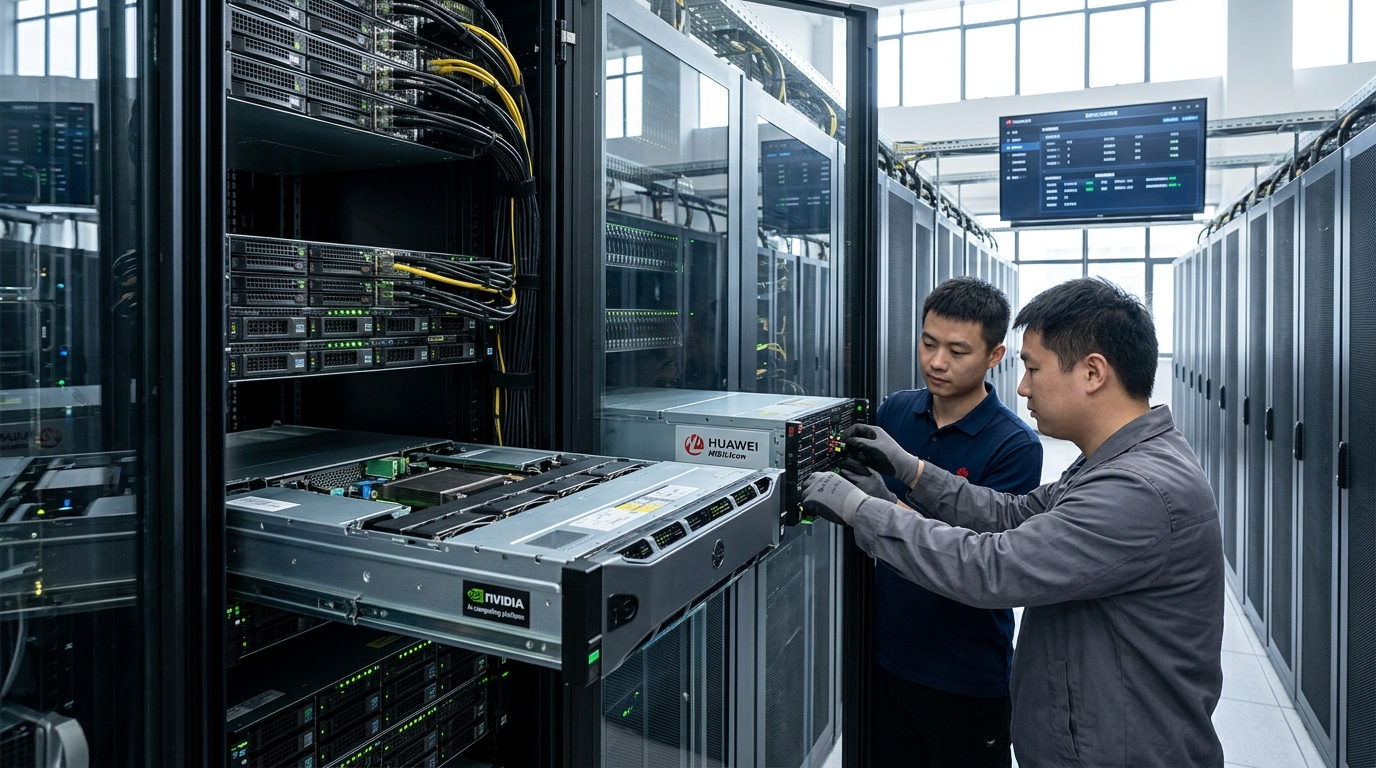
Nvidia’s share of China’s data-center AI chip market fell to 34% in the first half of 2026 as U.S. export restrictions limited supplies and domestic competitors, led by Huawei, gained ground, according to IDC data seen by Reuters. Nvidia shipped 678,000 AI accelerators in China between January and June, down 44% from a year earlier. One year ago, Nvidia held a commanding position and the gap between the two companies stood at 31 percentage points. It is now six.
Huawei shipped 572,000 AI accelerators in the period, up from more than 300,000 a year earlier, capturing 28% of the overall market. That near-doubling of unit volume, achieved entirely inside one calendar year, is what makes this more than a Washington policy story. It is a product story. Huawei is building and deploying at scale.
What the Market Is Missing
Most coverage of this IDC report focuses on the export control angle, and that framing lets Nvidia investors off the hook too easily. The more important question is whether Huawei’s gain is permanent or temporary.
IDC noted that competition is shifting from the performance of a single chip to system-level capabilities. That shift matters enormously for Nvidia’s long-term positioning. CUDA, Nvidia’s software ecosystem, has been the real moat, not the silicon alone. But as Nvidia acknowledged in its fiscal year 2026 annual filing, its effective foreclosure from the China market has helped competitors build larger developer and customer ecosystems to challenge it worldwide. That last phrase deserves attention. The risk is not confined to China revenue.
IDC expects total AI accelerator shipments in China to grow 19% this year, even as GPU shipments fall 9%. Shipments of non-GPU AI accelerators rose nearly 80% in the first half, overtaking GPUs by volume. China’s AI infrastructure is scaling up, just not around Nvidia’s architecture. The developers, the integrators, and the cloud operators building on Huawei’s Ascend platform today are not obvious candidates to switch back if controls ever loosen.
How to Think About This as a Portfolio Position
Nvidia still dominates AI chip demand outside China. Its order book for Blackwell systems in the U.S., Europe, and across Southeast Asia remains deep, and nothing in this IDC report changes that near-term picture. Long-term holders should treat China not as a near-term revenue question but as an ecosystem risk developing on a multi-year timeline.
Among the 11 Chinese chip manufacturers tracked by IDC, nine saw positive growth in the first half of the year. Alibaba’s chip-design unit T-Head held a 7% share, followed by Cambricon with 5%, Baidu’s Kunlunxin at 4% and Hygon at 3%. The domestic ecosystem is not one competitor. It is an industry forming around the assumption that Nvidia will not return.
The domestic Chinese ecosystem forming around Huawei’s Ascend platform is not the only sign that AI infrastructure spending is diversifying away from a single architecture. Custom AI accelerators designed for individual hyperscaler workloads are gaining ground on general-purpose GPUs across the global market.
Position sizing should reflect that. Nvidia remains a high-quality business with genuine competitive advantages in software, systems, and global data-center relationships. But any portfolio weight assigned on the assumption that China is a recoverable market needs revisiting. CEO Jensen Huang has repeatedly criticized Washington’s export curbs, saying the policy forced a U.S. company to cede China’s $50 billion AI chip market to Huawei. The IDC data now quantifies exactly how much of that market has moved.
The Wealth Builder Takeaway
Competitive advantages erode slowly, then quickly. Nvidia’s 31-point lead in China collapsed to six in twelve months. That does not make the stock uninvestable, but it does mean the thesis requires an honest accounting of where the moat actually holds and where it no longer does.