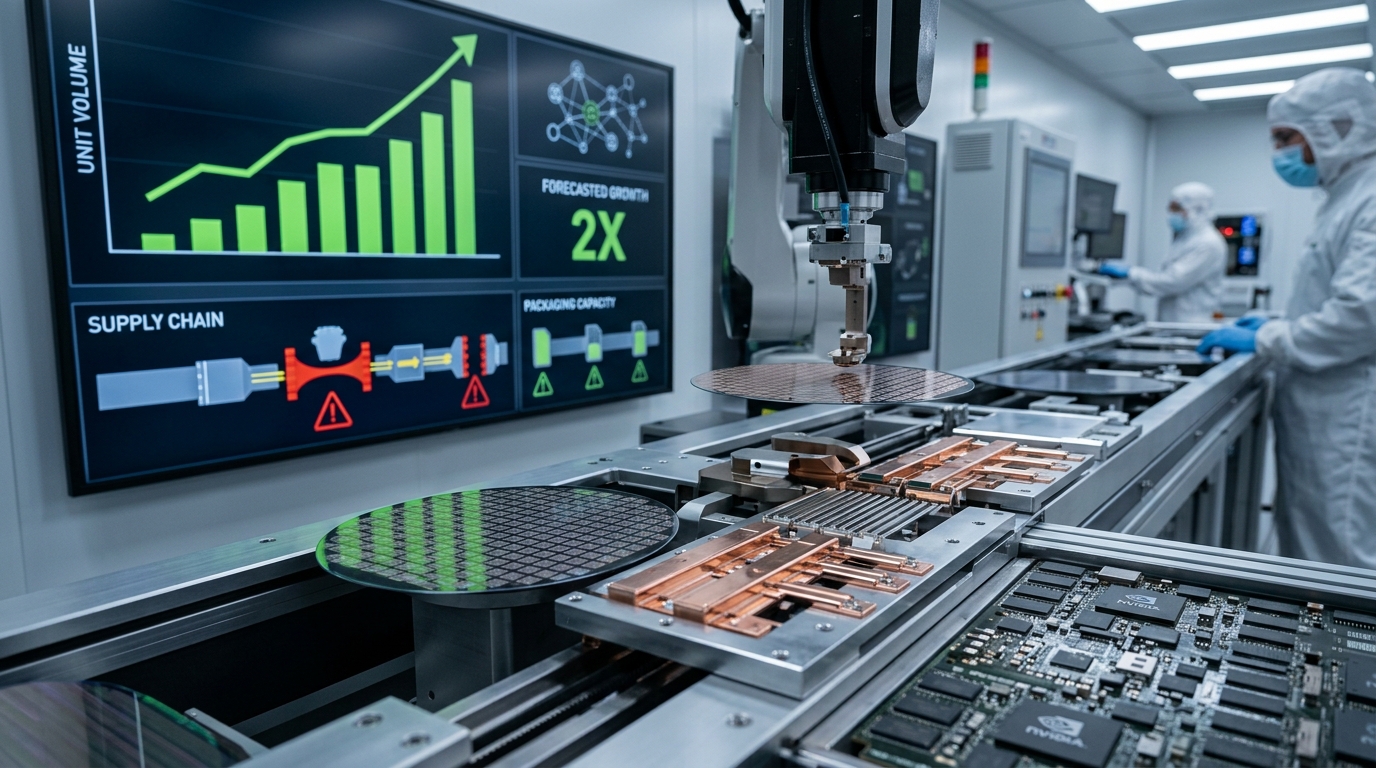
Here is the number that reshuffled the entire semiconductor sector on Thursday: two. Jensen Huang told reporters on the sidelines of a summit convened by King Charles III in Scotland that he expects Nvidia to sell twice as many chips next year as it does this year. That is a unit-volume pledge, not a revenue guide, and the distinction matters more than most coverage has acknowledged.
Selling twice as many chips does not necessarily mean Nvidia’s revenue will double. Product mix, pricing, and the transition between Blackwell and Vera Rubin systems can all affect how shipment growth translates into sales. Huang already told investors Nvidia expects roughly 70% revenue growth in the fiscal year ending January 2028, a supply-constrained outlook. That figure is a percentage, not a revenue number. Some coverage has translated it into around $673 billion by applying the 70% target to Wall Street’s fiscal-2027 consensus. The volume commitment sits on top of that, suggesting the physical footprint of Nvidia’s AI hardware expands faster than its own revenue line.
The company reported $96.2 billion in fiscal second-quarter revenue, up 106% year over year, while Data Center revenue surged 117% to $89.0 billion. Starting from that base and doubling unit output requires a supply chain that is already stretched to its structural limits to stretch further. That is where the real analysis begins.
The Packaging Wall
Every high-end Nvidia GPU requires CoWoS advanced packaging from TSMC, a process that bonds the logic die to multiple stacks of high-bandwidth memory on a single substrate. As of late 2025, both of TSMC’s 2.5D packaging families were widely reported fully booked, with lead times often cited in the range of roughly a year. Demand estimates also point to a sharp ramp, with 2026 industry demand commonly pegged around one million 12-inch equivalent CoWoS wafers, roughly triple 2024 levels.
Nvidia is widely estimated to be the largest single CoWoS customer, at roughly 60% of allocated capacity in 2026 by some industry tallies. TSMC has targeted major CoWoS expansion into 2026, with multiple reports placing its 2026 monthly capacity goal around 120,000 to 140,000 wafers per month. Targets beyond 2026 vary by source, but the core point is consistent: advanced packaging is the gating factor, and even aggressive expansion plans are chasing demand. Doubling Nvidia’s unit shipments by calendar 2027 would require packaging output to grow at a pace the industry has not demonstrated it can sustain.
The Memory Constraint
CoWoS is only half the problem. SK Hynix, Micron, and Samsung are integral parts of the CoWoS ecosystem, and because HBM must be physically integrated during the advanced packaging flow, these companies must coordinate their production cycles with TSMC’s ramp.
SK hynix has said its entire 2026 output of HBM, DRAM, and NAND is already sold out, with tightness expected to extend into 2027. To address supply, Nvidia has also disclosed in filings that it may provide deposits and other advance payments to secure future supply and capacity, and supply-chain reporting has pegged those advance payments to key HBM suppliers in the hundreds of millions of dollars per supplier. Even so, packaging constraints remain the most binding variable through 2027, not transistor scarcity. A customer with access to leading-edge wafer starts can still face long delays if packaging and memory are unavailable.
Who Else Benefits
The supply chain pressure creates investment angles beyond NVDA itself. Broadcom and Marvell, which design custom AI accelerators competing for the same advanced packaging lines, face tighter allocations as Nvidia’s dominance of the packaging queue crowds out rivals. Coherent and Lumentum, supplying optical interconnects for the networking layer that scales alongside GPU clusters, benefit regardless of which chip generation ships. Vertiv, powering the data centers that house the hardware, sees demand grow with every GPU Nvidia places.
Bull and Bear
The bull case is straightforward: Huang has unusually direct visibility into hyperscaler procurement pipelines, and AWS has publicly said it plans to deploy two million additional Nvidia GPUs across 2027 and 2028. If advanced packaging capacity ramps as projected and next-generation HBM qualifications go cleanly, the volume forecast is achievable and the stock has more room.
The bear case is equally concrete. Packaging constraints will remain the most binding variable through 2027 in much of the supply-chain commentary. Any yield problem on the Vera Rubin transition, any slip in TSMC’s CoWoS ramp, or any qualification delay in the HBM supply chain would compress deliveries fast. The forecast is a unit-volume promise from a CEO who does not control the factories that make it possible.
Watch TSMC’s quarterly advanced-packaging commentary, memory makers’ HBM shipment updates, and Nvidia’s next earnings call for whether Huang converts Thursday’s headline into hard quarterly guidance.