Start with the law, not the stock.
In December 2025, the BIOSECURE Act was signed into the National Defense Authorization Act for Fiscal Year 2026. The BIOSECURE Act restricts U.S. government agencies from procuring biotechnology equipment or services from, or entering into contracts with, entities that use biotechnology equipment or services from, designated “biotechnology companies of concern.” The legislation was written with WuXi AppTec and WuXi Biologics explicitly in mind.
Here is what that means in plain terms.
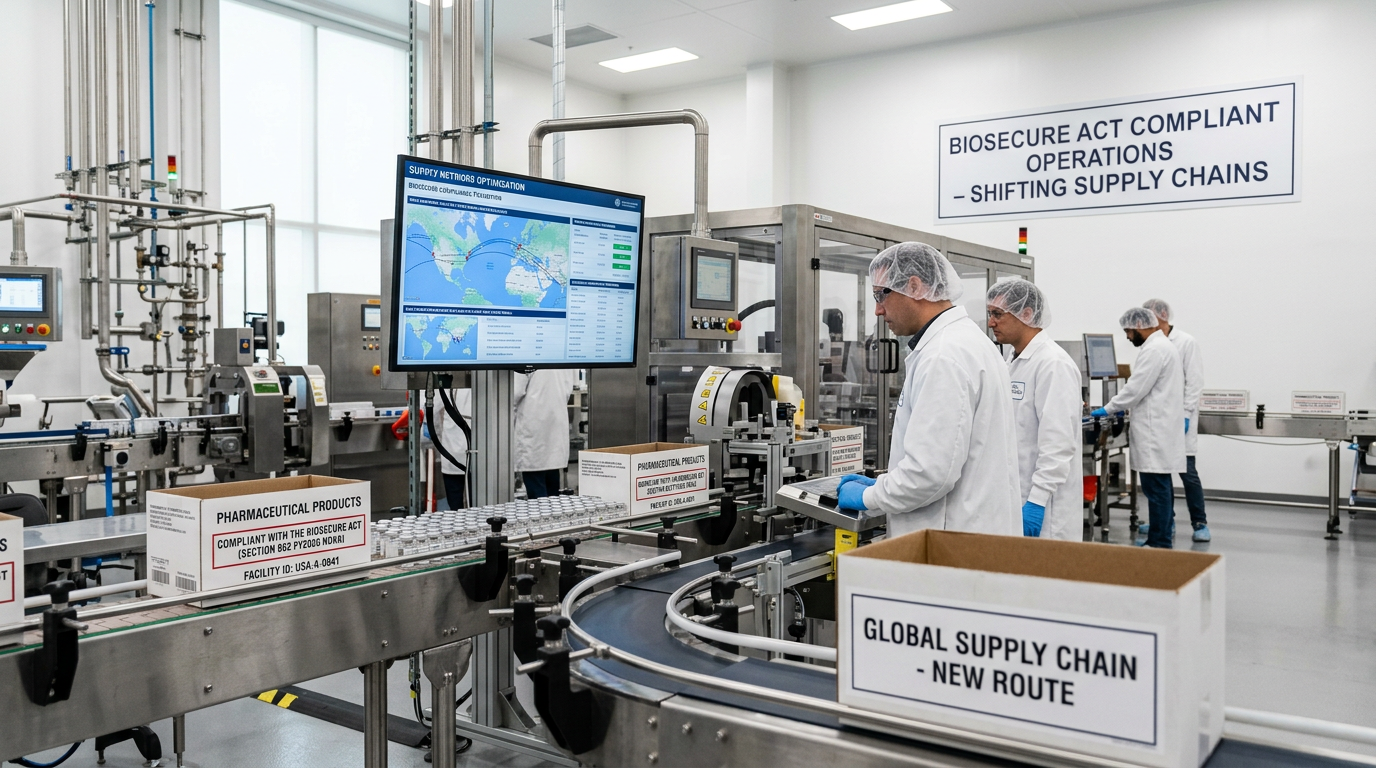
Two of the top six CDMOs are Chinese — WuXi Biologics and WuXi AppTec — and together they represent roughly $7 billion in annual CDMO revenue, serving as manufacturing partners for a significant portion of the global drug pipeline. A survey by the Biotechnology Innovation Organization found that 79% of U.S. biopharmaceutical companies have a product or contract with a Chinese CDMO. Now those two companies are effectively being legislated out of the Western pharmaceutical supply chain. Every drug company that relied on them has the same problem at the same time: find alternative manufacturing capacity, immediately, for some of the most complex biological drugs ever made.
This is not a small inconvenience. This is a structural rupture in how global drug manufacturing works.
The global CDMO market now exceeds $200 billion in annual revenue and reached approximately $210 billion in 2025. Growth has been driven by three structural forces: increasing outsourcing penetration (now approximately 40% of total pharmaceutical manufacturing, up from 30% in 2018), the rising complexity of novel modalities that require specialized manufacturing expertise, and the expansion of the biologics pipeline. The biologics CDMO segment is growing at approximately 12–15% annually — nearly double the overall market growth rate — driven by the expansion of monoclonal antibody manufacturing, the emergence of ADC and bispecific antibody programs, and the buildout of cell and gene therapy manufacturing capacity.
Layering a forced supply chain rerouting on top of that already stretched capacity is the part most investors have not fully thought through.
Capacity crunches — especially in biologics and cell therapy — can create 12–18 month wait times. The BIOSECURE Act and broader supply chain resilience concerns are driving companies to diversify manufacturing across multiple geographies. This “dual-sourcing” trend effectively doubles CDMO demand for companies that previously relied on a single supplier. India’s CDMO market is projected to grow from $7 billion to $20 billion by 2030, driven substantially by BIOSECURE-related demand. Sai Life Sciences has reported “unprecedented demand” from Big Pharma clients diversifying away from China. Lonza is considered best positioned to capture share from WuXi AppTec and WuXi Biologics due to significant service overlap in biologics and cell and gene therapy manufacturing. Samsung’s capacity buildout in Songdo and an expanded offering that now includes high-value modalities such as antibody-drug conjugates positions the company to capture additional share through 2030.
Wall Street is paying attention to the CDMOs themselves. That part is already being priced in.
What is not being priced in is one level deeper.
The Picks and Shovels Nobody Is Talking About
Every new biologics factory being built to absorb displaced WuXi volume runs on the same fundamental infrastructure: single-use bioprocessing systems. These are the disposable bags, filtration assemblies, chromatography columns, tubing sets, and fluid management components that make up the inside of a modern bioreactor. They are the consumables that get replaced with every single manufacturing batch.
This is not a one-time purchase. It is a recurring revenue stream with no meaningful substitute.
The single-use bioreactor bags market alone is projected to rise from $2.57 billion in 2025 to $3.03 billion in 2026, registering an 18% compound annual growth rate. The broader single-use bioprocessing market was valued at $37.94 billion in 2025 and is expected to reach approximately $114.96 billion by 2035. Every new CDMO facility built to replace Chinese capacity — every greenfield biologics plant in Europe, the U.S., India, or South Korea — requires a full complement of these disposable systems to operate.
Slight tangent, but it matters: the shift from stainless steel bioreactors to single-use systems is itself a structural transition happening independent of BIOSECURE. Disposable assemblies turn the bioreactor into a plug-and-play engine, slashing changeover times from weeks to hours and boosting titers 5–10x. This surge is driven by an increasing shift from stainless steel to single-use technologies, higher biopharmaceutical production, and expanding contract manufacturing activities. CDMOs are choosing single-use not because they have to, but because the economics are better. BIOSECURE is accelerating a buildout that was already inevitable.
Now think about who supplies those disposable systems to every one of these new facilities.
Sartorius. Cytiva (owned by Danaher). Thermo Fisher. Merck KGaA. And a mid-cap company called Repligen that most equity investors have never had a real conversation about.
The Company Three Layers Removed
Repligen Corporation sits at the third or fourth derivative of the BIOSECURE trade.
The first derivative is the law itself.
The second derivative is the CDMOs gaining market share.
The third derivative is the bioprocessing equipment and consumables those CDMOs must buy to operate.
Repligen is the component and consumable supplier to the suppliers.
Repligen has become a strong player in single-use bioprocessing through innovative filtration, chromatography, and process intensification technologies. It does not manufacture drugs. It manufactures the filtration, chromatography, process analytics, and fluid management components that go inside every batch of every biologic. Those components get used once and discarded. Every new CDMO facility that comes online to replace WuXi’s displaced capacity becomes a new recurring revenue customer for Repligen — for as long as that facility runs.
The numbers are already confirming the acceleration. Repligen reported Q1 2026 revenue of $194 million, representing 15% reported growth and 11% organic growth, while adjusted earnings per share reached $0.48, surpassing the $0.38 consensus forecast by more than 26%. Adjusted gross margin expanded 180 basis points year-over-year to 55.5%, driven by volume leverage, favorable pricing, and product mix. The company guided full-year 2026 revenue at $810 million to $840 million, representing 10% to 14% reported revenue growth.
The results highlighted significant margin expansion and geographic diversification, with particular strength in the Asia-Pacific region where China revenue nearly doubled year-over-year. That detail matters. What it shows is that Repligen sells to every geography because biologics manufacturing is expanding everywhere simultaneously. New capacity is being added in South Korea, India, Europe, and the U.S., all at once, and all of it runs on single-use components.
The part investors are still figuring out is that Repligen is not just a pure bioprocessing recovery story. It is a structural beneficiary of a geopolitical reorientation of pharmaceutical manufacturing that has a multi-year runway. Capacity constraints are expected to intensify in 2026, especially as a greater number of complex products enter the market. Compounding these pressures is the upcoming patent cliff for major drug products, which will unleash a torrent of demand for the manufacturing of biosimilars. The biosimilar wave — driven by patent cliffs on major biologics including Keytruda in 2028 and Opdivo in 2028 — is creating additional demand for CDMO biologics manufacturing capacity. More CDMOs running more batches. More Repligen consumables consumed per batch. Every year.
Repligen’s projections point to $1.1 billion in revenue by 2029. The stock is not cheap on traditional metrics, but the earnings leverage is real. Each new CDMO facility that comes online creates recurring consumable demand that compounds with every batch run, indefinitely.
What Wall Street Is Missing
CNBC is covering the BIOSECURE Act as a China risk story, not as a demand acceleration story for Western bioprocessing infrastructure. Bloomberg is focused on the CDMOs themselves. The second-order beneficiary of those companies growing is the consumables they must buy to operate. That link is not being made clearly in the coverage.
The assumption that is wrong: that BIOSECURE will disrupt the biopharma industry. The reality is that BIOSECURE will accelerate a capacity buildout that was already underway. The U.S. and European CDMO markets are experiencing their largest capacity expansion cycle in two decades. That buildout has a single-use consumables requirement that compounds annually with every new bioreactor that spins up.
One more thing worth watching: the dual-sourcing trend. The BIOSECURE Act and broader supply chain resilience concerns are driving companies to diversify manufacturing across multiple geographies. This dual-sourcing trend effectively doubles CDMO demand for companies that previously relied on a single supplier. More facilities running more batches means more consumable replacement cycles. Repligen sits at the intersection of all of it.
The biosimilar wave, the BIOSECURE Act, the shift from stainless to single-use, the CDMO capacity expansion in Western markets — these are not four separate stories. They are one story converging on the same infrastructure layer. Most of the market is watching the headline names. The more interesting trade is the company selling consumables to every single one of them.
The patent cliff arrives in 2028. The BIOSECURE enforcement timeline intensifies through 2026 and 2027. The new CDMO facilities being built now will run on single-use systems for the next decade. The revenue from those facilities starts recurring the moment the first batch runs.
That clock is already running.