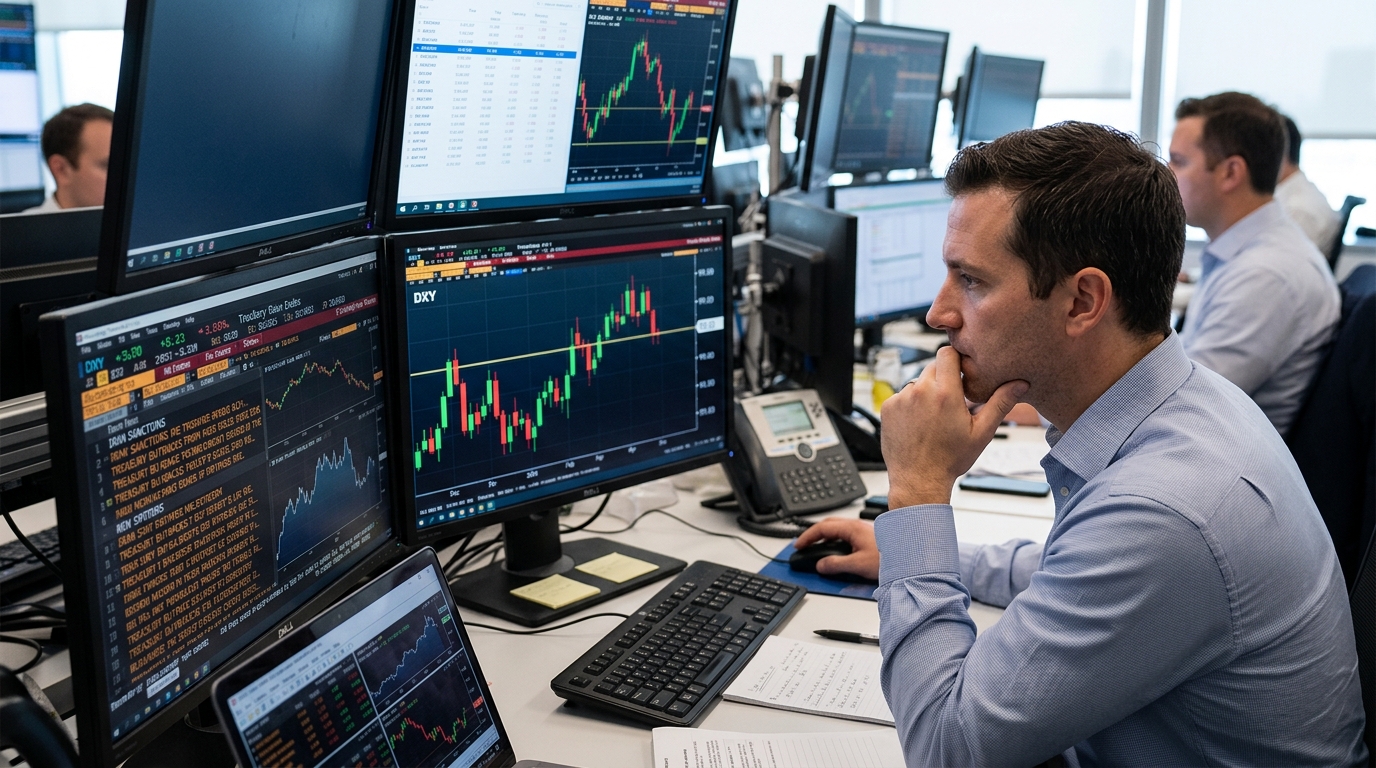
The U.S. dollar is caught between two structural forces that both matter and directly contradict each other. That tension is the trade.
The dollar regained some strength on Tuesday as investors parsed Washington’s expanded sanctions against Iran and renewed efforts to ease pressure on longer-dated Treasury yields. By Wednesday morning, DXY had slipped back to 98.990, down 0.03% in the past 24 hours, illustrating the problem precisely: the geopolitical bid keeps showing up and keeps failing to hold above 99.
The Sanctions Leg
Treasury Secretary Scott Bessent announced a new round of sanctions aimed at Iran on Monday and warned every country doing business with the Islamic Republic to sever those financial ties or face retaliation from the United States. The rial responded immediately. It dropped to 2.02 million to the U.S. dollar as trading opened on currency markets, a record low. Iran’s official Central Bank rate stood at around 1.5 million rials to the dollar, but the market rate is what most Iranians pay.
The war has devolved into a fight over who controls the Strait of Hormuz, through which a fifth of the world’s traded oil and gas transited before the conflict. Iran is now refusing to fully reopen it unless it can charge ships. That threat keeps an energy premium in crude and a geopolitical premium in dollar positioning. Ray Attrill, head of FX strategy at National Australia Bank, called the sanctions announcement one source of a slight reversal of the dollar weakness from last week. Slight. Not sustained.
The Buyback Leg
The opposing force is Bessent’s own bond desk. The U.S. Treasury announced it is increasing the maximum size of its liquidity support buyback operations for longer-dated nominal coupon securities by at least double, from $2 billion per operation to at least $4 billion per operation, covering the 10-to-20-year and 20-to-30-year sectors, effective September 9 through November 4, 2026.
The greenback had stumbled late last week after Bessent said Treasury would double the size of bond repurchases, sparking concerns that a more direct strategy to mitigate the rise in borrowing costs could lead to debasement of the dollar. Falling long-term yields are USD-negative in theory: lower yields reduce the return on holding dollar-denominated assets relative to alternatives, cutting the dollar’s interest rate appeal. Strategists say buybacks may temper the rise in yields but do not resolve underlying fiscal and inflation concerns, which means the debasement fear is not going away.
The net result: sanctions give traders a reason to buy dollars, and the buyback gives them a reason to sell. Neither force is dominant. DXY sits pinned around 99, oscillating without conviction.
Friday Is the Real Catalyst
Fed Chair Kevin Warsh will deliver his first keynote address at Jackson Hole on Friday, August 28, just three weeks before the September FOMC meeting. Markets are pricing in roughly one-in-three odds of a September rate hike, making Warsh’s twenty minutes at the podium potentially the tiebreaker for monetary policy direction in the months ahead.
The risk profile of Friday’s speech is asymmetric: a genuinely neutral address moves little; a speech that reads as hawkish could trigger a rapid shift in expectations for rate-sensitive equities and long bonds; a speech perceived as dovish could produce a sharp dollar decline and a yield drop that would embarrass Bessent’s already-questioned intervention. Under Warsh, the Fed has signaled a preference for less forward guidance, so a major speech from this chair can carry genuine information value.
EUR/USD and gold both tend to move on shifts in U.S. rate expectations, so a surprise in tone Friday could ripple well beyond the dollar itself.
The Trading Plan
The levels are straightforward. Price is consolidating below the 98.65 resistance zone, while the 98.85 to 99.00 area may act as resistance. A daily close above 99.20 that holds into the Thursday session would suggest the sanctions bid is outweighing the yield-suppression signal, and DXY-sensitive commodities, particularly oil and gold, would face near-term headwinds.
A break below 98.55 reopens the three-month lows. DXY fell to 98.55 on August 20, its lowest level since May, and that is the line that distinguishes a range trade from a trend break. Warsh Friday is the event that resolves the standoff. Position sizing should reflect that: moderate exposure now, with defined levels, and the flexibility to move aggressively in either direction after 10 a.m. Eastern on August 28.