Dear Income Seeker,
If you’re struggling to find high-probability income trades…
Or think you’ve found them…
Only to be frustrated – and disappointed – with the money you’re bringing in…
You owe it to yourself to check out this website.
Because it will give you the opportunity to get your hands on a little-known 1-hour trading secret… 100% free of charge.
Do your future self a big favor and claim a copy now.
Because at some point soon, it won’t be free.
To better trading,
– Drew Day
Partner
Base Camp Trading
Perovskite Solar Cells Are Shattering Efficiency Records. Owning the Winners Is Harder Than It Looks.
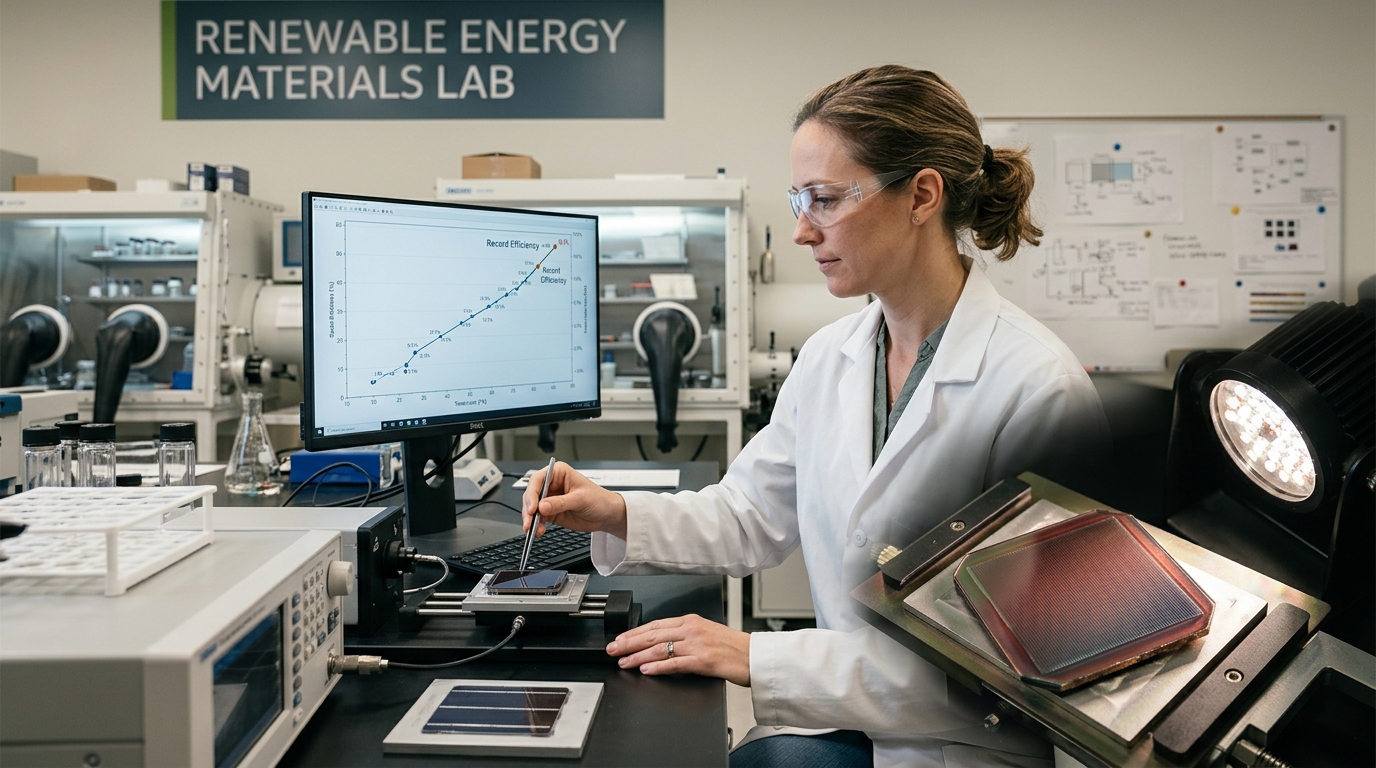
The record board for solar efficiency has been rewritten so many times in 2026 that it barely registers as news anymore. In July, LONGi announced its crystalline silicon-perovskite tandem cell had reached 35.5% conversion efficiency, certified by the European Solar Test Installation. Before that, researchers at Nanjing University published a healing-intervention technique applied to industrial textured silicon that produced a certified stabilized tandem efficiency of 30.77%. The breakthroughs are real. The investable opportunity is narrower than the headlines suggest.
Here is the core tension every investor needs to understand. Crystalline silicon-perovskite tandem cells carry a theoretical efficiency ceiling of about 43%, well above the roughly 33.7% Shockley-Queisser limit often cited for an ideal single-junction cell under standard assumptions. But the world-record efficiency figures are achieved on cells roughly 1 cm² in area. A commercial solar module uses many much larger cells wired together, and as perovskite cell area grows, maintaining uniformity in the deposited film becomes harder and efficiency drops. That lab-to-factory gap is precisely where most of the investment risk lives.
Production is still pilot-scale and stability remains the key hurdle, though encapsulation advances have materially narrowed the gap with silicon. The most commercially advanced player today is Oxford PV, which has been producing tandem cells at its Brandenburg, Germany facility and has made initial commercial shipments of tandem panels, with module efficiencies described publicly in the mid-20% range rather than 28%-plus. That figure, while impressive, is only modestly above what the best conventional silicon modules already deliver to utility buyers.
For investors who want exposure now, the clearest publicly traded path is through companies positioned across the supply chain rather than on a single manufacturer’s commercialization timeline. LONGi Green Energy, which has reported a world-record tandem cell efficiency of 34.85% in its filings, is one of the industry’s largest manufacturers, particularly in wafers, and a top-tier module shipper. It has not yet shipped tandem modules, but its scale means that when it does, the production ramp could dwarf smaller competitors’. Hanwha Solutions, through its Qcells division, has reported 28.6% efficiency on an M10-sized perovskite-silicon tandem cell as independently verified by Fraunhofer ISE’s CalLab, using processes it describes as compatible with mass production. Timelines for commercial and mass production remain targets and should be treated as execution risk until products are shipping at scale.
The broader market context rewards patience. Market-research estimates for perovskite solar vary widely, but the direction is consistent: the category is small today and expected to grow rapidly if modules prove durable and manufacturable at scale. That growth rate sounds extraordinary until you recognize that most of those dollars remain contingent on solving the same durability and scale challenges the industry has been working on for a decade. Long-term resistance to moisture, heat, and UV exposure is still improving.
The wealth-building takeaway here is structural: transformative energy technologies rarely reward investors who buy the breakthrough headlines. They reward investors who correctly identify which companies control the manufacturing process, the intellectual property, or the installation relationships once technology crosses from pilot to mass production. The efficiency records matter. The question worth answering is which balance sheets survive long enough to collect the revenue.