October 11, 2026
Bonus Content: Nvidia’s $1 Billion Quantum Pledge: What IonQ, Rigetti, and D-Wave Are Actually Worth
Editor’s Note: Dr. Ron Paul served 12 terms as a U.S. Congressman. He predicted the 2008 banking crisis and warned the Iraq war would be a disaster – though Congress ignored both of his warnings. Today, at the age of 91, he’s stepping forward alongside our corporate affiliate Altimetry with what could be his most important message yet.
Dear Reader,
A sinister new ideology is spreading like wildfire in Washington, D.C…
And it’s far more dangerous than anything socialists like Zohran Mamdani or Bernie Sanders are planning.
Because this threat doesn’t begin with higher taxes or more welfare – it goes straight after your money.
It involves more than $20 billion that belongs to the American people … dozens of stocks… and a radical experiment that I predict will have huge consequences. (Some folks have already lost 50% of their money.)
That’s why I’m stepping forward today to warn as many Americans as I can about the new, growing threat I consider more dangerous than socialism.
I want to show you what’s happening… and explain the three steps I believe you need to take immediately with your money, before it’s too late.
Everything you need to know is laid out free of charge in this presentation.
A word of warning…
There are a lot of people in D.C. who won’t like the warning I’m sharing today, or the three specific money moves I’m suggesting.
Some folks may even call it “un-American.”
But they’re wrong. I’m certain of it. In fact, I think the Founding Fathers would have been terrified about the ideas spreading in Washington today.
So just as when I spoke out against the Iraq war… or when I tried to warn Congress about the banking collapse… I’m stepping forward today to do what’s right, and expose the truth…
My most important ever warning: WAKE UP, AMERICA.
Regards,
Dr. Ron Paul
Former U.S. Congressman and Presidential Candidate
P.S. I believe every American family needs to seriously consider taking three financial steps today. One of them could already have doubled your money several times.
You can hear about all three of them, free of charge, by clicking right here.
Nvidia’s $1 Billion Quantum Pledge: What IonQ, Rigetti, and D-Wave Are Actually Worth
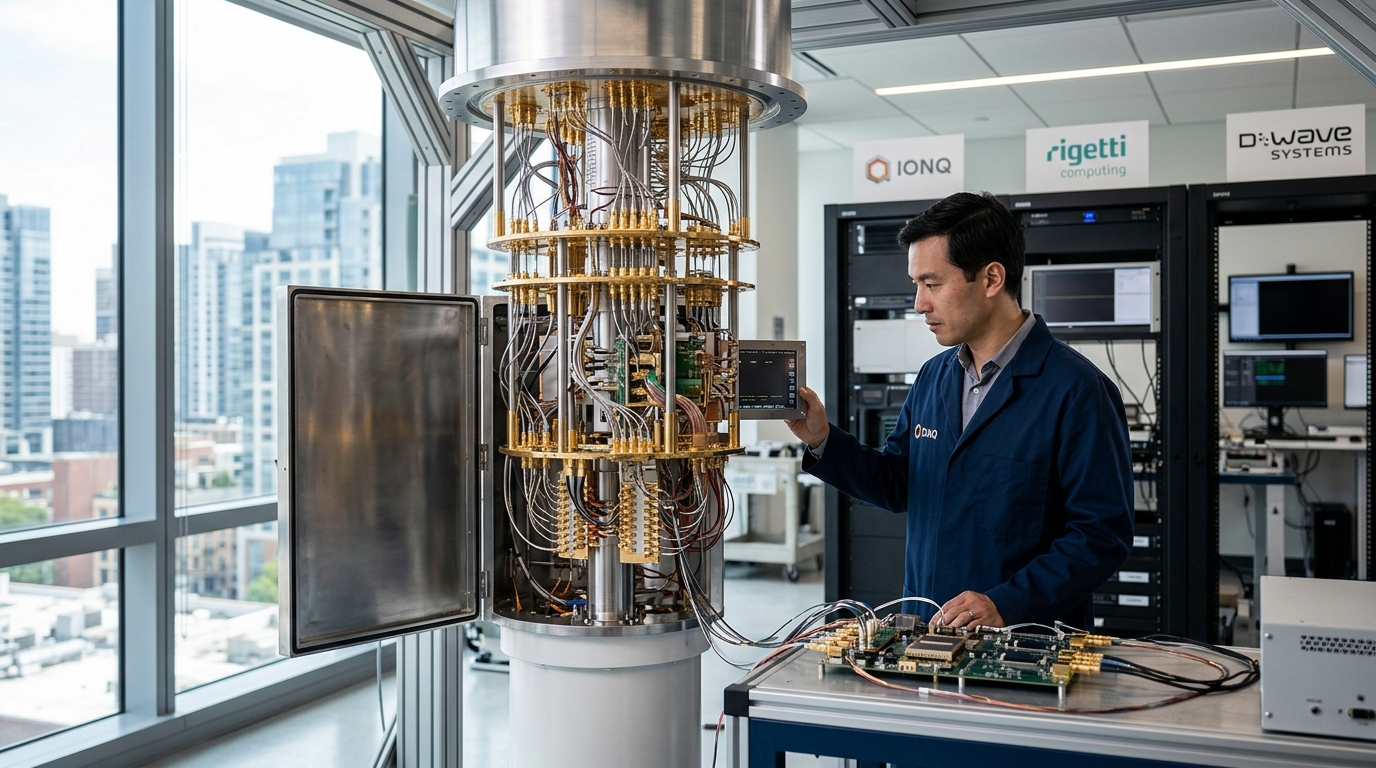
On October 8, Nvidia announced commitments valued at $1 billion over five years to advance U.S. scientific research spanning quantum computing, healthcare, and energy security, tied to the federal Genesis Mission. Within 48 hours, IonQ (IONQ), Rigetti (RGTI), and D-Wave (QBTS) were on every trading watch list in circulation. That is exactly the moment to slow down and compare what each company earns with what its shares already cost.
What Nvidia Actually Committed
The $1 billion is framed by Nvidia as commitments over the next five years across three areas: support for higher-education research institutions, investments aimed at accelerating American quantum leadership, and support for cloud service providers serving U.S. government mission needs. Nvidia did not specify how the $1 billion will be divided among the three. The announcement also does not itemize how much is cash versus in-kind contributions, or the delivery schedule within the five years. Most of the announced federal dollars sit in a separate budget: on October 8, the Department of Energy announced 12 Genesis Mission Phase II awards totaling $159 million, and that federal funding is not part of Nvidia’s $1 billion pledge.
That distinction matters. Readers chasing listed quantum names on this headline are betting on derivative exposure to a program whose flow of funds is still largely unquantified.
IonQ: The Revenue Leader, at a Price
IonQ is unambiguously the strongest fundamental story in the group. The company reported Q2 2026 recognized revenue of $80.1 million, up 287% year over year, and raised its full-year 2026 revenue outlook to $280–$290 million. Remaining Performance Obligations reached $485 million, up from $470 million in Q1 and $122 million a year earlier. The backlog growth is the number that matters most: it means contracted revenue continues to outrun what IonQ can recognize. The company also announced that its Superion 256 quantum computer will be the first quantum processor deployed at Nvidia’s Accelerated Quantum Research Center, connecting to Nvidia infrastructure in a hybrid environment.
The valuation, though, is not modest. As of the October 9 close, IonQ traded around $39.89 per share, and the 52-week range ran from $25.89 to $84.64. A stock that has already halved from its peak still needs the backlog to keep compounding at current rates. Any deceleration will be punished.
Rigetti: Government Optionality, Minimal Revenue
Rigetti has the most direct government funding story in the group. The company signed a letter of intent with the U.S. Department of Commerce for an award of up to $100 million in funding to accelerate superconducting quantum computing research and development. Multi-year government and defense-related work, including a $5.8 million three-year U.S. Air Force Research Laboratory contract for superconducting quantum networking, ties Rigetti to long-term public sector quantum programs.
But the commercial revenue base remains thin. Rigetti reported Q2 2026 revenue of $5.1 million, up from $1.8 million a year ago. As of October 10, Rigetti’s market cap was about $4.68 billion, while its net loss for the first half of 2026 was $19.5 million and its accumulated deficit stood at $790.5 million. At roughly 350x trailing revenues, Rigetti is priced for a government funding scenario that has not yet converted into contracted income. The letter of intent is not a signed contract.
D-Wave: Cheapest Relative to Bookings, Still Small
D-Wave occupies the most complicated position. In Q2 2026, revenue of about $3.08 million declined year over year and missed consensus estimates, but commercial indicators were stronger. First-half 2026 bookings reached $35.5 million, up 1,120%, including a $20 million system sale to Florida Atlantic University, with the revenue expected to be recognized in subsequent quarters. The Department of Commerce also finalized a CHIPS and Science Act award with D-Wave of up to $100 million for quantum computing-related R&D.
D-Wave’s market cap is approximately $5.40 billion, against trailing twelve-month revenue of roughly $12.4 million. The bookings surge is encouraging, but recognized revenue has not caught up. Investors are paying for a conversion that could take years.
The Wealth-Building Takeaway
Nvidia’s pledge is real, but its direct financial benefit to listed quantum companies is speculative and unscheduled. IonQ offers the clearest path from contracted revenue to commercial scale, but at a multiple that leaves no margin for error. Rigetti and D-Wave carry government funding optionality against revenue bases measured in single-digit millions. Sizing matters here. If quantum computing belongs in a portfolio, a small, deliberately sized position in IonQ, where the contract backlog is verified and growing, is a sounder entry than chasing Rigetti or D-Wave on a headline whose financial flow remains undefined.