July 28, 2026
Apple (AAPL): Stock Insight
Back on top at $4.94 trillion. Here is the full investment case.
First a note from Banyan Hill Research
Dear Reader,
They declared a ceasefire!
Until they didn’t.
Then Trump said we were about to sign a deal.
Until we started shooting at each other again.
According to one source, Trump has said an Iran deal is “close” 38 times since the war began.
In the time between writing this message and you reading it, who knows whether we’ll be hearing about an imminent deal… or more bombing.
And it doesn’t matter.
This is all a distraction.
Here’s the REAL reason why Trump may NEVER end this war.
To your future,

Addison Wiggin
Founder, Grey Swan Investment Fraternity
Apple (AAPL): Stock Report
Apple (AAPL): The Stock Report
Here is a question worth sitting with before earnings Thursday.
What does it mean when the world’s most valuable company — at nearly $5 trillion — is also the one that spent the least on artificial intelligence?
Because that is exactly what is happening with Apple right now. And understanding that contradiction is the key to understanding why this stock is up 24% year to date while Nvidia, the company that just surrendered the #1 spot, has gained roughly 4%.
Why This Stock Matters Right Now
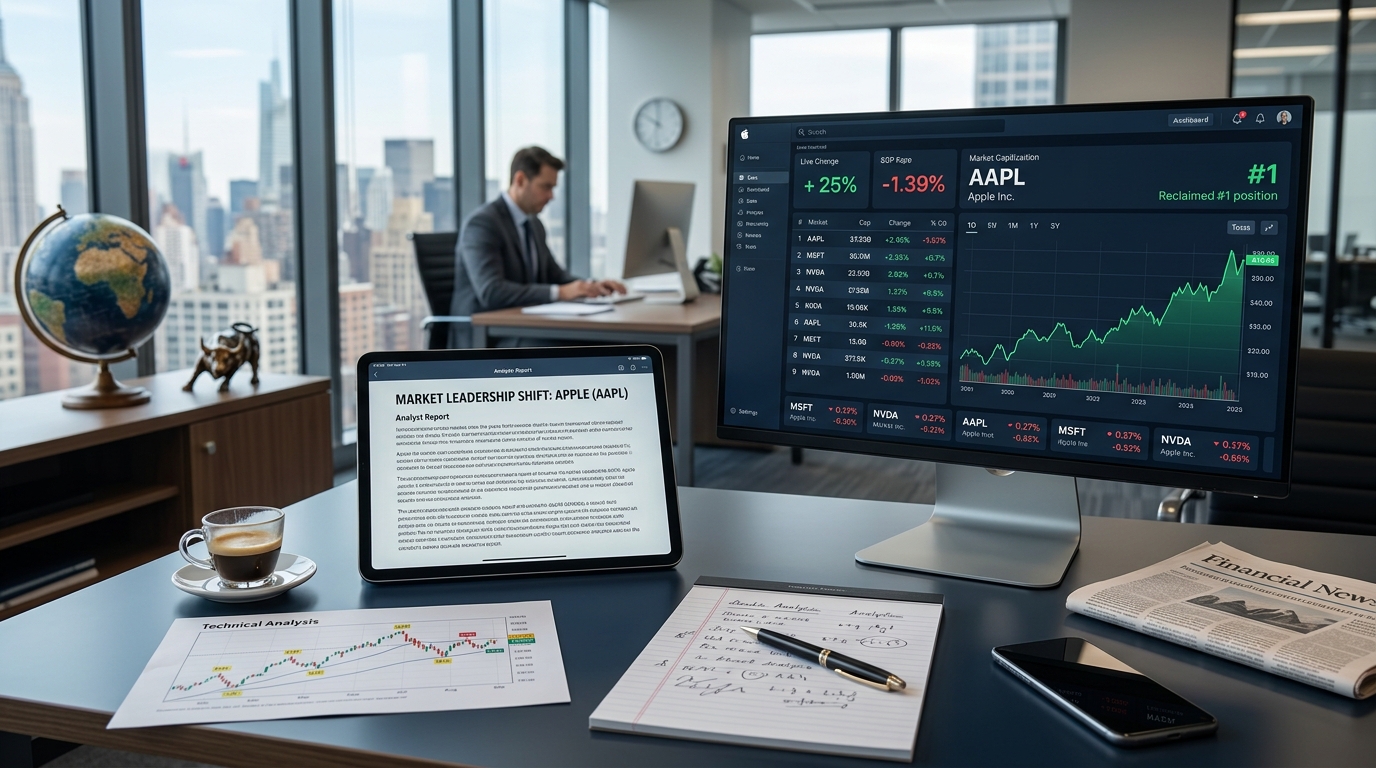
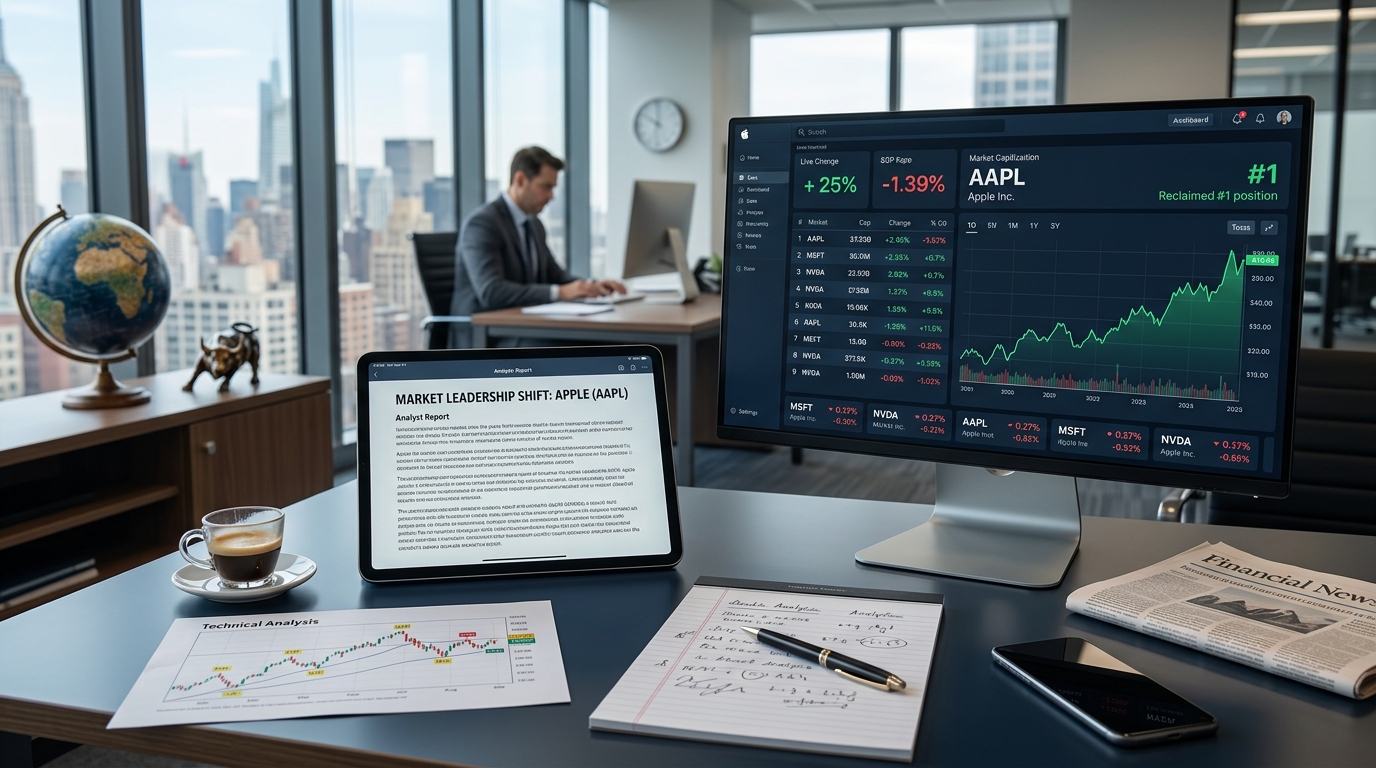
Apple passed Nvidia on Monday for the title of world’s most valuable company, with its market cap climbing to roughly $4.94 trillion at market close — the first time it has held the top spot since April 2025. Nvidia, which had led global market cap rankings since June 2025 and briefly crossed the $5 trillion threshold in October, has seen its year-to-date gain narrow to roughly 4% as investors rotate away from pure AI infrastructure plays.
Three things are converging at once: a major earnings report due Thursday (July 30), a CEO transition that takes effect September 1, and a memory chip shortage that has already forced Apple to raise prices on Macs, iPads, and other devices. That combination makes this the most consequential moment for Apple stock in years — in both directions.
The one-sentence thesis: Apple is the most cash-generative consumer technology business ever built, its services engine is accelerating, and the market is paying a premium for earnings durability rather than speculative AI upside — but the margin of safety at current prices is thin and the next six weeks carry real execution risk.
The 4-hurdle engine finding under-the-radar trades before the smart money moves in
Discover how to tap into the market’s most profitable under-the-radar opportunities before the smart money can even figure out their first move. Claim your front row seat for our exclusive trading webinar and unlock instant access to a FREE report detailing the exact 4-hurdle evaluation engine behind it all.
How Apple Actually Makes Money
Apple operates across two broad buckets: hardware and services. The hardware side — iPhone, Mac, iPad, Wearables — still represents about 75% of revenue. But the profit story has shifted.
Services (App Store, iCloud, Apple Music, Apple Pay, AppleCare, advertising) reached a record $30.9 billion in fiscal Q2 2026, up from $26.6 billion in the same quarter a year ago. That segment now carries gross margins above 70%, compared to roughly 37% for the products business. For the first time in Apple’s history, Services has overtaken iPhone as the largest single profit contributor.
The trailing 12 months as of the most recent quarter show $451 billion in total revenue, $122.6 billion in net income, and a return on invested capital above 104%. Free cash flow: $129 billion. Operating cash flow: $140 billion. These are not abstract numbers — they are the foundation of an 18-year uninterrupted share buyback program that has reduced the share count by more than 2.39% in just the last year alone.
What holds the machine together is an installed base of over 2.5 billion active devices. Every iPhone sold is a potential lifetime subscriber to services. The switching costs are structural, not contractual. That is pricing power that does not show up cleanly in a single quarter.
What Is Changing
Three developments are actively reshaping Apple’s near-term story.
1. The AI spending reversal. For two years, Apple was criticized for not spending aggressively enough on artificial intelligence. No massive model development, no data center arms race. As Jay Woods, chief market strategist at Freedom Capital Markets, put it: Apple was able to avoid some of the capital expenditure pitfalls that have started weighing on higher-spending peers. Apple’s capex has actually declined over the past three quarters while Alphabet and others have accelerated theirs. The market has now rewarded that restraint — but it raises a real question about whether Apple is behind on AI execution, or simply behind on AI hype.
2. The memory shortage. This is the newest and most underappreciated risk in the Apple story. In June 2026, Apple raised prices across its entire Mac, iPad, home device, and Vision Pro lineup — citing what it called an “unprecedented challenge” from AI data center demand consuming global DRAM supply. The MacBook Neo went from $599 to $699; the MacBook Air from $1,099 to $1,299 for the 512GB model. DRAM prices surged 98% in Q1 2026, with another 58 to 63% increase projected for Q2. Cook called the situation a “hundred-year flood.” The iPhone was spared — for now. The company has hinted that more product adjustments could follow. This is not a resolved issue. Thursday’s earnings call will be the first time Apple reveals the financial impact in detail.
3. The CEO transition. On September 1, Tim Cook hands the reins to John Ternus, currently SVP of Hardware Engineering, who joined Apple in 2001. Cook, 65, becomes executive chairman. The transition was announced April 20, approved unanimously by the board, and has been described as a long-planned succession. Ternus joined briefly during the Q2 earnings call to signal continuity, saying he plans to maintain Cook’s “deep thoughtfulness, deliberateness and discipline” in financial decision-making. But Ternus has never run a public company. Cook will be on Thursday’s call for what is expected to be his last earnings conference as CEO. That handoff — coming just weeks before the traditional September iPhone launch window — introduces a layer of uncertainty that Wall Street has not fully modeled.
Millionaire Trader: The REAL Opportunities Are in Phase 2
Millionaire trader Tim Bohen says that as millions of people pile into SPCX, they’re going to miss the REAL opportunities as Elon launches into Phase 2 – and ignites an explosive new wave of stock winners.
Thursday’s Earnings: What Investors Are Watching
Apple reports fiscal Q3 2026 results after the close on July 30. This is Tim Cook’s final earnings call as CEO.
Consensus estimates: revenue of approximately $108.9 billion (up roughly 14 to 16% year over year from $94 billion in Q3 2025), with diluted EPS around $1.89. Apple guided for 14 to 17% revenue growth and gross margin of 47.5 to 48.5% — a range it provided in April and has since reaffirmed. It has beaten EPS estimates in each of the last four quarters.
The single most important line item Thursday is Services. Analysts are projecting approximately $31.4 billion for the quarter. After back-to-back records of $30 billion (Q1) and $30.9 billion (Q2), the question is whether the Services growth rate sustains above 15% or begins to moderate. That number, more than iPhone revenue, determines how the market re-rates the stock in the days after the call.
The second critical data point: gross margin guidance for Q4. The memory shortage has already compressed product margins. Management’s willingness to hold the 47.5 to 48.5% range through the fall — or its guidance for anything below that — will signal whether pricing power is holding up under the component cost pressure.
Valuation: What You Are Paying
At roughly $333 to $338 per share as of Monday’s close, Apple’s valuation metrics look like this:
- Trailing P/E: approximately 40x (TTM EPS of $8.26)
- Forward P/E: approximately 34 to 36x (GuruFocus: 34.16 as of July 26)
- EV/EBITDA: approximately 30x
- EV/FCF: approximately 37x
- 15-year average P/E: 28x — the stock trades at a meaningful premium to its own history
- Wall Street consensus price target: approximately $318 to $327 — below current trading price
- One independent fair value model (GuruFocus GF Value): $269.26 — implying the stock trades roughly 24% above estimated intrinsic value
The forward P/E of 34x sits 61% above the hardware industry median, which sounds alarming until you consider that Apple’s blended gross margin of roughly 48% and services gross margin above 70% bear no resemblance to a typical hardware business. The market is paying for a software and services compounder that happens to distribute its products through physical devices.
Worth noting: the consensus 2027 P/E estimate sits around 34x with an analyst average target near $337 — implying roughly 3.5% implied return from current levels on a one-year forward basis. That is not a margin of safety. That is a bet on continued momentum and upside surprise.
Bull vs. Bear
- Bull case: Services sustains 15%+ growth through fiscal 2027 as Apple Intelligence features drive a meaningful iPhone 18 upgrade cycle. Ternus executes a clean transition and doubles down on hardware-software integration. Gross margins hold at the guided 47.5 to 48.5% range despite memory pressure. Apple closes its AI product gap with a materially improved Siri. The $5 trillion market cap threshold is crossed and sustained.
- Bear case: Thursday’s gross margin guidance disappoints. The memory shortage worsens through fall 2026, forcing iPhone price increases that dampen upgrade demand. Siri and Apple Intelligence features underdeliver against a market that has already re-rated the stock on AI optionality. The CEO transition introduces strategic ambiguity at the worst possible time. The 40x trailing multiple compresses toward the 15-year average of 28x on any combination of these developments — implying meaningful downside from current levels.
- What would change the thesis: On the bull side — Services growth accelerating past 17% year over year, or a product announcement that signals genuine AI differentiation. On the bear side — gross margin guidance below 47%, iPhone price increases, or any sign of a stumble in the Ternus transition during the September iPhone event.
Beyond the Headlines
The memory shortage angle is worth sitting with longer than most investors have. This is not a tariff story or a trade war story — it is a structural supply constraint driven by AI data centers consuming DRAM capacity that used to flow to consumer electronics. Micron, SK Hynix, and Samsung collectively control roughly 95% of global DRAM production, and Nvidia has signed long-term supply agreements that effectively moved those manufacturers’ priority queues. Apple — and every other consumer hardware company — is buying at spot prices on whatever capacity remains.
IDC projects the global PC market will contract 11.3% in 2026. The global smartphone market is expected to fall nearly 14% over the same period. Apple’s ability to absorb these headwinds better than peers is a genuine competitive advantage — its scale and brand loyalty allow it to pass costs through in a way most manufacturers cannot. But it is not immune. The Q3 earnings call will clarify how much of that pressure is already baked in, and how much is still ahead.
The second-order question for investors: which companies benefit from Apple’s memory cost problem? Suppliers with long-term agreements, memory-efficient chip architects, and companies in Apple’s services orbit that do not depend on hardware margin all look more interesting in this context than they did six months ago.
What to Watch Next
- July 30 — Fiscal Q3 2026 earnings: Services revenue vs. the $31.4 billion consensus. Gross margin guidance for Q4. Any update on iPhone pricing or memory shortage duration. Cook’s remarks on the Ternus transition.
- September 1: John Ternus officially becomes CEO. How the market reacts to his first public statements as chief executive will set the tone for the fall product cycle.
- Mid-September: iPhone 18 launch event. Pricing is the critical variable — any indication of iPhone price increases due to memory costs would be a significant market-moving data point.
- Siri and Apple Intelligence: The fall iOS update is the first real test of whether Apple’s on-device AI strategy produces experiences users will pay for. Underwhelm here and the AI premium embedded in the current multiple is at risk.
- Memory shortage trajectory: IDC and TrendForce project the shortage persisting well into 2027. Monitor DRAM spot prices and any Micron or SK Hynix commentary on consumer electronics allocation.
Bottom Line
Apple at $4.94 trillion is not a hidden gem. The market knows exactly what this business is. What it may be underweighting is the complexity of the next 90 days: a CEO transition, a memory crisis that has not peaked, an earnings call that lands in 72 hours, and an AI product story that remains largely promise rather than proven revenue.
The business is exceptional. The free cash flow generation is among the best in corporate history. The services engine is accelerating. None of that is in dispute.
What is in dispute is whether 40 times trailing earnings is the right price to own all of it — especially when the consensus analyst target sits below where the stock already trades, and one credible valuation model pegs fair value roughly 24% lower at $269.
For investors already holding Apple: the compounding machine is intact. The thesis has not broken.
For new money looking at this stock today: the entry point matters more than it has in years. Thursday’s call is not just a routine quarterly update. It is the first major datapoint on whether Apple can hold a near-$5 trillion valuation through one of the most operationally demanding periods in its history. The answer to that question is worth waiting for.
In at 9:35 AM. Out by 10.
I call it the “Opening Bell Breakout.” It’s the same setup I used to catch moves like 113% on GOOGL and 240% on META. I trade one simple 15-minute window each morning – and I’m usually done by 10 AM.
— Stock Report Editorial Team