September 13, 2026
Bonus Content: Corn and Soybeans Are Squeezing Your Grocery Bill. Three Stocks Benefit.
Below is an important message from one of our highly valued sponsors. Please read it carefully as they have some special information to share with you.
Did you see this?

At 12:34 in the morning, the President of the United States shared a video on Truth Social.
Along with just three words:
“The Midterm Meltdown”
By sunrise, the national press had picked it up – and they were not happy about it.
Because if this video proves correct?
They along with the most corrupt politicians in DC could soon be in serious trouble.
I can’t say how much longer this video will be online…
But I can tell you, if its creator is even half right…
This summer could mark the most serious turn in American history since the Civil War.
And for investors who aren’t prepared, it will be a bloodbath.
For the full story, click here.
Regards,
Aaron Gentzler
VP of Research, Paradigm Press
Corn and Soybeans Are Squeezing Your Grocery Bill. Three Stocks Benefit.
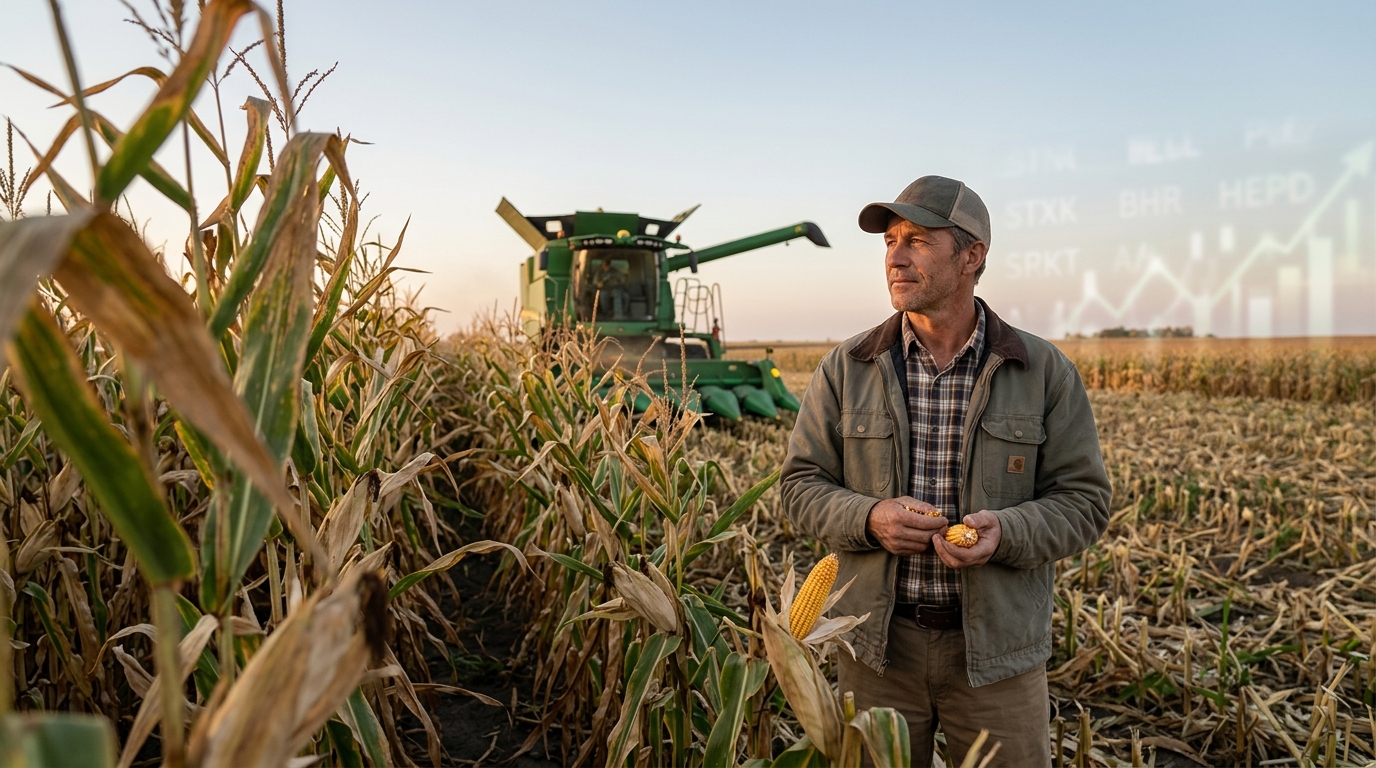
The USDA’s September World Agricultural Supply and Demand Estimates, released Friday, delivered a one-two punch to the grain market that most investors are still processing as a farming story rather than an investment one. Corn production fell 213 million bushels to 15.8 billion after yield dropped 2.2 bushels per acre to 178.5, pushing ending stocks down to about 1.57 billion bushels while the season-average farm price rose 30 cents to $4.80. Soybean production increased about 16 million bushels to roughly 4.54 billion, with exports rising 25 million bushels; ending stocks were projected at 310 million bushels and the farm price rose 60 cents to $12.00.
The futures market had already been running ahead of USDA. November 2026 soybean futures were trading above $13 ahead of the report. That is roughly 26 percent above where the contract sat a year ago. Meanwhile, the FAO Food Price Index averaged 133.3 points in August 2026, up 2.5 points from its revised July level, pushing the measure higher as wars and weather impact supplies. Every major food category rose.
Layered beneath the price moves is a cost problem that will shape the 2027 growing season. U.S. farmers harvesting corn and soybeans are facing record diesel prices above $6 a gallon in September, with diesel up roughly 58 percent since late February as the U.S. war with Iran disrupted global fuel flows. Diesel is embedded in fertilizer delivery, grain hauling, and nearly every stage of agricultural logistics, when diesel prices rise, farmers can pay twice: first through their own equipment and again through higher freight and supplier charges. Farmers deciding what to plant next spring are staring at a cost structure that makes every acre an expensive proposition.
Where the Opportunity Sits
This is the moment to think carefully about which companies collect when grain prices are high and input costs are rising, rather than which ones are hurt by the squeeze.
Fertilizer producers are the clearest beneficiaries. CF Industries (CF) is up 62.7 percent year-to-date, and Nutrien has gained 19.2 percent, leading an agriculture-sector comeback measured by the Invesco DB Agriculture Fund’s 12.2 percent YTD gain. CF trades at about 9x earnings. NOAA has put the odds of a very strong El Niño late in 2026 at 81 percent. For Mosaic (MOS), structurally tight phosphate markets, inventory advantages, and an attractive valuation offer upside even amid volatility.
For grain merchandisers, the picture is more nuanced. ADM (ADM) and Bunge (BG) thrive on high throughput and crush margins, the spread between raw materials and finished products like meal and oil, and higher raw material costs coupled with lower export volumes can compress those margins. That said, Bunge’s expanded platform following the Viterra transaction provides exposure to oilseeds, grains, food, feed, and fuel, which broadens its ability to capture value across the supply chain even when processing margins are tighter.
Deere (DE) offers a different kind of leverage. Higher crop prices translate historically to higher capital expenditures on precision agriculture machinery, and if farmers lock in elevated prices for their remaining inventories, Deere’s order books for the late 2026 season could see a significant boost.
Building This Into a Portfolio
None of these positions should be treated as a short-term grain trade. The structural argument is about 2027 crop economics: high input costs at record diesel prices compress margins for farmers now, and that creates inelastic fertilizer demand as growers fight to protect yield on every acre they plant next spring. CF and MOS are the most direct expression of that thesis. A position in Deere captures the equipment-spending cycle that follows sustained high commodity prices. Bunge provides the broadest exposure if you want the full supply-chain angle without concentrating in fertilizer alone.
Size positions accordingly. The Iran war has pushed fuel prices sharply higher, and fertilizer prices can move quickly on geopolitical risk. Geopolitical resolution, or a larger-than-expected South American crop, could reverse part of the move quickly.
The Wealth Builder Takeaway
Rising grain prices feel like a cost problem. They are also a signal about where money flows next. The farmers who plant the 2027 crop will need more fertilizer, more fuel-efficient equipment, and better margins per bushel to justify the acreage. The companies supplying those inputs are the quiet beneficiaries of a food-price surge that is showing up in the FAO index, in the WASDE report, and shortly on grocery receipts everywhere. Identify the toll-road assets in any commodity cycle, the companies that get paid regardless of which direction the weather turns, and own them before the headlines catch up.