September 9, 2026
Bonus Content: Pfizer Is Spending Its Way Past a $17 Billion Patent Cliff
Copper is at record highs. Gold just blasted to $5K.
And while most juniors are forced to repeatedly raise money to keep the drills turning… this sub – $1 copper-gold explorer has one of the world’s largest gold producers funding the work.
That’s a huge advantage.
Meanwhile, shares still trade below $1.
And major-company-funded drilling is only the beginning.
Across two premier Australian mineral belts, drills are turning with plenty of firepower for what comes next:
✔ Major-company-funded exploration Down Under
✔ An aggressive new multi-project drill campaign
✔ Multiple paths to copper-gold discovery
✔ A strong treasury and tight share structure
✔ BONUS: Our exclusive interview with the CEO
That’s a lot of upside packed into a sub – $1 stock.
Click here to access our FREE online report… and discover why this under-the-radar copper-gold explorer has all the ingredients for a major breakout as the drills turn Down Under.
Pfizer Is Spending Its Way Past a $17 Billion Patent Cliff
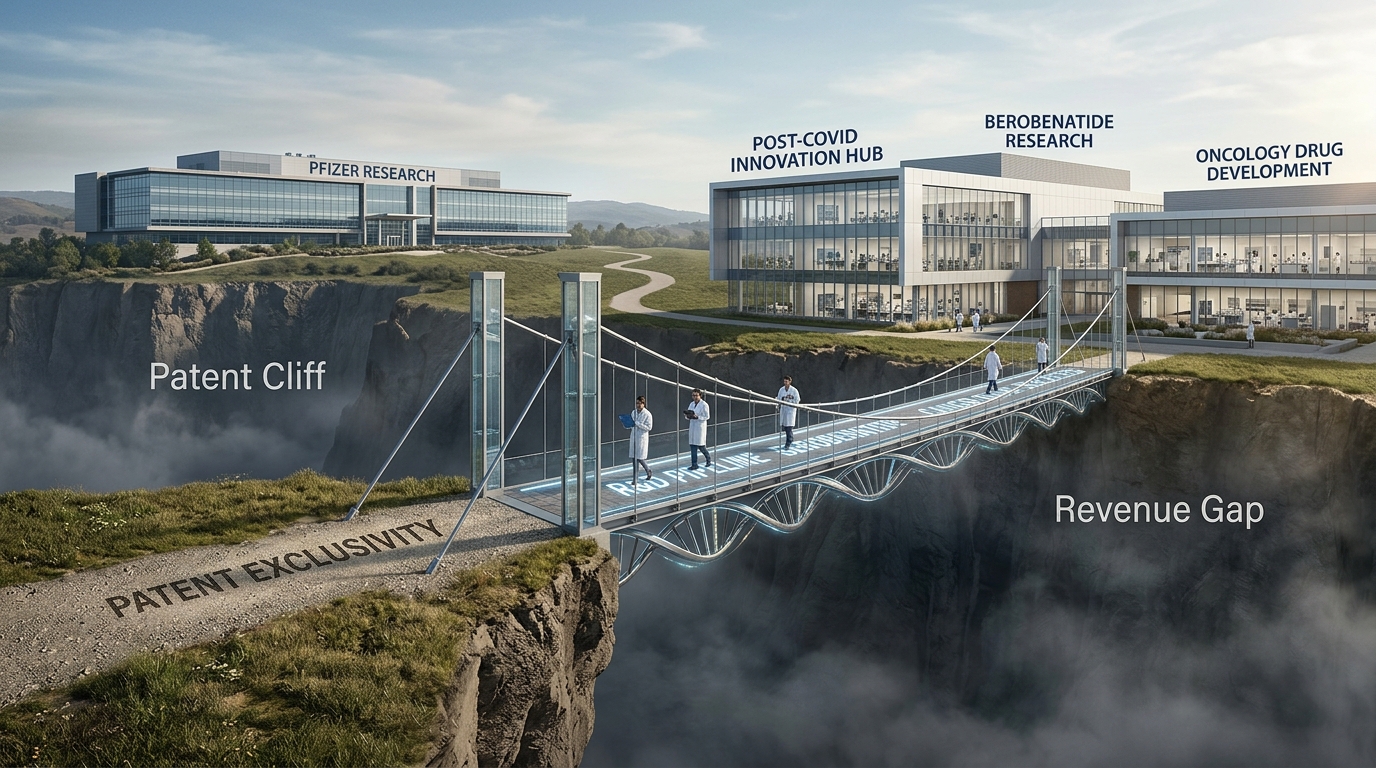
Pfizer’s revenue problem is not subtle. The company has said it expects about $17 billion of product revenue to be at risk from loss of exclusivity between 2025 and 2030. U.S. Eliquis pricing has already been pressured by Medicare’s negotiated price starting January 1, 2026, and Pfizer has said it still expects an unfavorable revenue impact from patent-based or regulatory exclusivity expiries of approximately $1.5 billion in 2026. That is a steep cliff, and Pfizer’s answer is to spend aggressively on two fronts: obesity and oncology.
The Obesity Bet
The November 2025 acquisition of obesity drugmaker Metsera brought Pfizer back into the obesity space after it scrapped the development of danuglipron in April 2025. The replacement drug is berobenatide, and it has a structural advantage the market is not yet fully pricing. Berobenatide is a long-acting injectable peptide GLP-1, whereas the failed danuglipron was an oral small-molecule GLP-1. The currently dominant weight-loss therapies from Eli Lilly and Novo Nordisk are weekly injections. Berobenatide is designed to support a transition to monthly maintenance dosing, which would be a real convenience edge if approval arrives.
In the phase IIb VESPER-3 study, berobenatide achieved up to 12.3% placebo-adjusted weight loss at 28 weeks, with continued weight loss reported as patients transitioned from weekly to monthly dosing. Pfizer has indicated its Phase 3 program is now underway, which puts any first approval later this decade rather than in the near term. That means berobenatide does nothing to fill the 2027 earnings gap. Investors holding PFE for this catalyst need patience measured in years, not quarters.
The Cancer Offensive
On the oncology side, Pfizer is not relying solely on the Seagen antibody-drug conjugate portfolio it acquired in 2023. Pfizer has in-licensed exclusive global rights outside Mainland China to PF-08634404, a PD-1 and VEGF bispecific antibody originating at China’s 3SBio. Dual PD-1/VEGF approaches aim to improve outcomes versus PD-1 alone, and are being tested in large studies across multiple tumor types. Global phase III studies are ongoing in treatment-naive metastatic colorectal cancer and in first-line metastatic non-small cell lung cancer.
CEO Albert Bourla has said Pfizer now directs more than 40% of annual R&D spend toward oncology. That is a meaningful commitment, and it explains why the company is highlighting a busy 2026 pipeline calendar, including numerous study starts and multiple key data readouts and regulatory decisions, with a significant portion concentrated in obesity and oncology.
What the Valuation Already Reflects
Pfizer stock has risen about the mid-teens year to date. From a valuation standpoint, the commonly cited point is that shares trade at a single-digit forward earnings multiple, well below broad pharma peers. That discount is the patent cliff, priced in. The upside case requires berobenatide and PF-08634404 to deliver Phase III data that moves timelines forward, not back.
Management has laid out an ambition for a risk-adjusted high single-digit revenue CAGR from year-end 2028 through year-end 2033, but analysts remain cautious. For investors who can tolerate a multi-year gap between today’s headlines and actual cash flows, the beaten-down valuation may be fair compensation. For those who cannot, the patent wall arrives well before the pipeline does.