Arm Holdings is down more than 11% in today’s session, touching a six-month low near $167 after a quarter the numbers suggest should have held the stock up. The disconnect between the fundamental result and the price action is sharp enough to demand a closer look at what traders are actually selling, and what they may be missing.
The Gap the Market Priced Today
Revenue climbed 27% year over year to $1.443 billion, with licensing and other revenue jumping 50% to $773 million. Royalties rose a slower 8% to $670 million, even as data-center royalties doubled. That royalty deceleration is the number the session is trading. Royalty revenue growth came in at 8% year over year, significantly lower than license growth, due to weakness in smartphone demand and a tough year-over-year comparison. CFO Jason Child stated that higher memory prices continue to pressure smartphone unit sales, particularly in the mid and lower-tier segments.
Barclays lowered its price target from $360 to $325, while Goldman Sachs reiterated a sell rating with a $160 target, both citing the same royalty concern. With the stock trading near that Goldman floor, the debate is no longer whether the quarter disappointed; it is whether that disappointment is structural or cyclical.
Why the Royalty Slowdown Is Temporary
The architecture mix says it is cyclical. Arm has said it has essentially doubled royalty rates from Armv8 to Armv9, and again to CSS, but it does not disclose a standard percentage schedule by architecture. Arm-based server market share at the top hyperscalers has more than tripled, from 15% in calendar 2024 to more than 50% in calendar 2025. Every percentage point of additional hyperscaler share shifts volume toward higher-rate designs.
For the first time, partners reported more than 10 billion Arm-based chips shipped during the quarter, an increase of 1.5 billion chips year over year. At 10 billion chips, even a modest mix shift toward Armv9 and CSS can generate meaningful royalty dollar expansion without any unit volume gain. The smartphone drag is real, but it is not permanent.
The AGI CPU: A New Revenue Line the Market Has Not Fully Priced
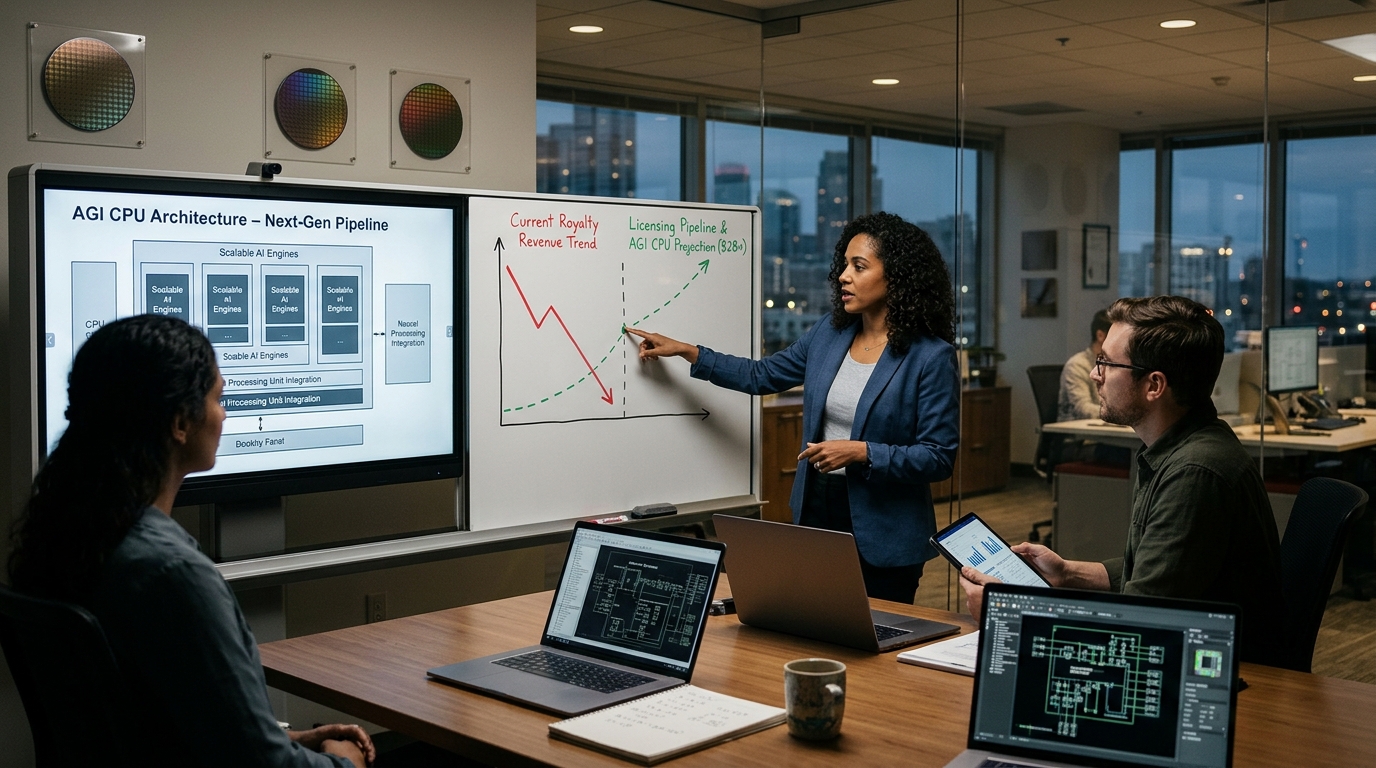
CEO Rene Haas said that customer orders and improved supply have strengthened confidence in generating up to $2 billion of AGI CPU revenues across fiscal 2027 and 2028, with shipments targeted for fiscal Q4 2027. Purchase orders from multiple customers and agreements with suppliers support that target; Arm had previously expressed confidence in achieving about $1 billion over that period. Meta is the principal customer named, but management confirmed additional buyers.
This is a category shift. Arm has positioned the AGI CPU as its first offering in a new data center silicon product line, moving beyond pure IP licensing toward selling production silicon. If shipments begin in Q4 fiscal 2027 as guided, the revenue recognition profile changes substantially from the current IP-and-royalty model.
Technical Framework
The stock exhibits a short-term downside bias, breaking below key support levels with an RSI near oversold territory at 32.7. Immediate downside risk targets $180, while overhead resistance clusters in the $190 to $200 range. With the session now trading below that $180 level, the next structural floor to monitor is near $160, which aligns with the Goldman target and the 52-week range low near $100 as a longer-term anchor.
Scenario Modeling
Bull Case: Smartphone memory pricing normalizes by Q1 fiscal 2028, royalty growth re-accelerates to mid-teens year over year, and AGI CPU deliveries begin on schedule in Q4 fiscal 2027. Stock reclaims $200 and targets prior resistance near $230.
Base Case: Royalties grow low single digits year over year through Q3 fiscal 2027 as guided, licensing momentum holds above 50% growth, and AGI CPU revenue begins contributing in Q4. Stock consolidates between $160 and $190 through year-end.
Bear Case: Smartphone demand deteriorates further, AGI CPU shipments slip past fiscal Q4 2027, and valuation compression at 105x forward earnings continues. Stock tests $140, near its trailing twelve-month support cluster.
Active Trader Framework
The divergence between licensing momentum and royalty growth creates a bifurcated risk profile. Traders watching for a base should monitor the $160 level as the first structural test, with position sizing calibrated to the stock’s recent daily range of 10% or more. The AGI CPU shipment date, fiscal Q4 2027, is the most concrete catalyst on the calendar. Any incremental order disclosure between now and that quarter is a potential sentiment reset. Traders with longer holding periods should weigh the royalty rate expansion math against current multiples: at $167, the stock trades well below its peak but still at a premium that requires the AGI CPU transition to execute on time.
Preparation here means knowing your time horizon before the position, not after. The business case is intact. The near-term royalty guide is not.