October 14, 2026
Bonus Content: Nvidia Is Pouring $10 Billion Into Europe. What It Says About Demand.
Dear Reader,
Weiss Ratings recently flagged three stocks in the same sector that are now up 37%, 55% and 264%.
If our prediction is true – and most times, historically, it has been – this could just be the beginning.
A new development is coming that could light a fire under this entire sector and send some little-known stocks surging higher.
The good news for you is most investors still have no clue what’s happening.
We’ve put the full story together in our new presentation.
Click here to see what’s coming and which stocks could benefit most.
Sincerely,
Eliza Lasky
Weiss Advocate
Nvidia Is Pouring $10 Billion Into Europe. What It Says About Demand.
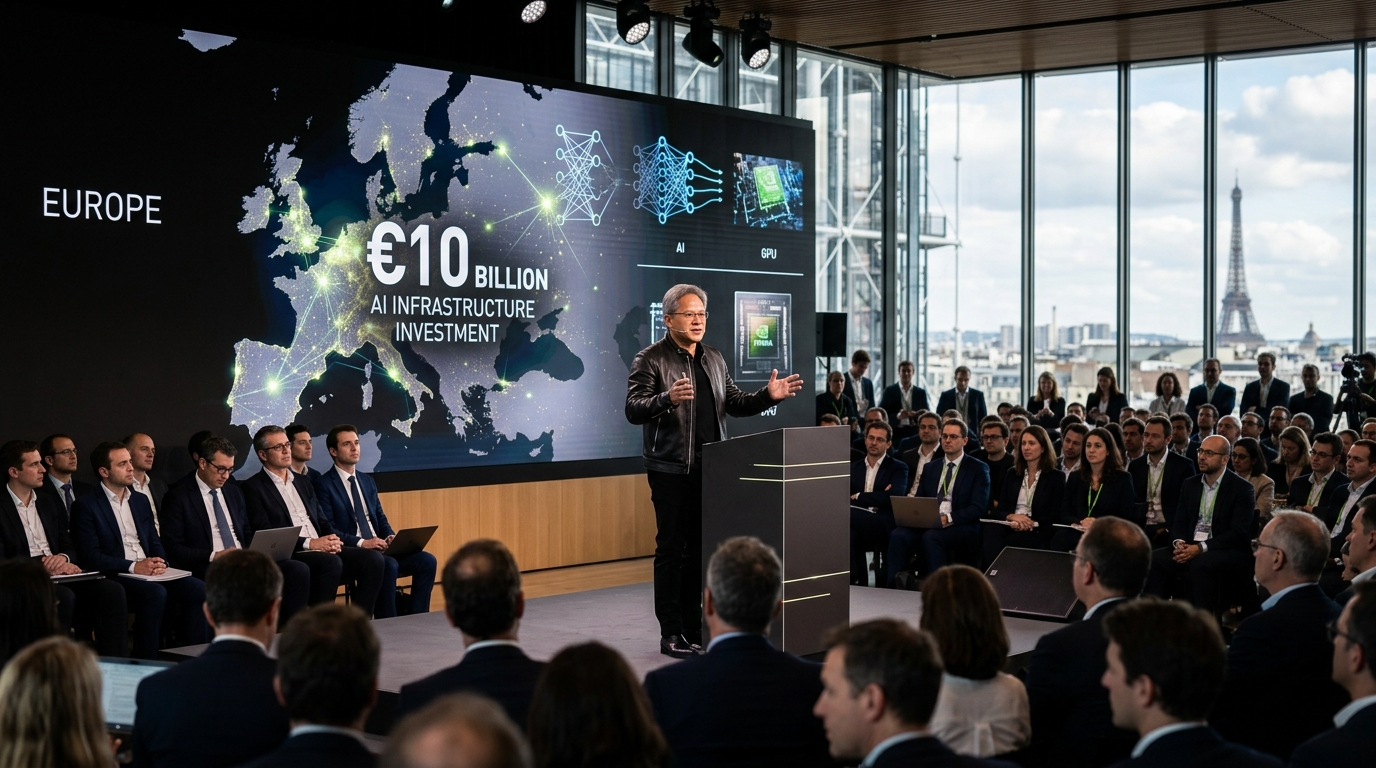
Jensen Huang landed in Paris on October 13 and did what he does best: he wrote very large checks. The new $2 billion investment pledge adds to the $8 billion Nvidia has already committed to Europe over the past year. That brings the company’s European total to roughly $10 billion in about twelve months. The tour continues through Berlin, where Nvidia’s GTC Berlin conference is scheduled for October 20 to 22.
The Paris stop was not purely ceremonial. Nvidia took minority stakes in four French AI startups: Genesis AI, Pigment, Entalpic, and Doctolib, with Huang announcing the deals on October 13 while visiting Paris. The four companies span very different industries. The investments target Doctolib, Entalpic, Genesis AI, and Pigment, expanding Nvidia’s commitments in France across healthcare, materials discovery, robotics, and enterprise software. Neither Nvidia nor the startups disclosed how much money is involved or how large the stakes are.
The breadth of those bets is itself the signal. Nvidia is not positioning in one vertical. It is seeding the entire stack of industries that will eventually run on its chips, from robots navigating factory floors to financial planning software replacing spreadsheets. Critics note that open-source models still require Nvidia hardware, keeping the chip bill with Nvidia regardless. That observation cuts in favor of the bull case rather than against it.
Why the Numbers Still Matter
Skeptics of AI demand have a simple argument: the spending cannot last. Huang’s European commitment is evidence to weigh against that view. Nvidia reported revenue of $96.2 billion for the second quarter ended July 26, 2026, up 106% from a year earlier, with data center revenue of $89.0 billion, up 117% year over year. Gross margins held at 75.0% for the quarter. Those are not the numbers of a company whose customers are reconsidering purchases.
This time last year, one lab alone was driving the buildout. Today, multiple frontier labs are scaling in parallel, a thriving open-model ecosystem is maturing, and physical AI is coming online, with momentum across the U.S. and around the world. Europe is now joining that list. The U.S. and China have produced 59 and 35 notable AI models respectively, while France and the UK have produced one each, per the Stanford AI Index. That gap represents runway, not saturation.
The Infrastructure Chain Beyond Nvidia
Huang’s European spending also illuminates opportunity for the companies that supply what AI factories physically require. The era of AI factories is here, and Schneider Electric is helping make it possible. At GTC Berlin, the company will showcase AI-ready data center infrastructure including liquid cooling, high-density power, and advanced 800 VDC architectures. Across Europe, each AI factory or gigafactory becomes an opportunity to build the entire physical layer: the electrical power, cooling, and software stack on top. Siemens and Legrand sit in a similar position. As Nvidia commits capital, the downstream order books for power and cooling infrastructure fill behind it.
Schneider, Siemens, and Legrand are not the only names filling that order book. Eaton has been winning data center power and cooling contracts at a pace its Q2 numbers make hard to ignore.
Risks Worth Watching
Europe arrives late and faces real structural headwinds. Public concern about autonomous AI agents and data-center energy demand is genuine, not marginal, and could translate into regulatory friction that slows deployment timelines. The availability of data centers, energy, and capital is crucial to the AI infrastructure buildout, and expanding energy capacity is a complex, multi-year process involving significant regulatory, technical, and construction challenges. Nvidia itself flags this in its filings. If permitting stalls data centers in Germany or France, the $10 billion committed to Europe converts to revenue more slowly than investors might expect.
There is also the open-source dynamic. Huang promoted open-source models, arguing their lower costs and greater flexibility could help Europe close the gap with the U.S. Nvidia is already a major partner of Mistral AI, which develops open-weight models. Open models lower the barrier to entry for European companies, which expands the customer base but also increases competitive pressure over time.
The Wealth Builder Takeaway
The single most durable insight from Huang’s European tour is this: demand is wide, not narrow. When one company deploys $10 billion across a single continent in a single year, seeding healthcare platforms, robotics firms, and materials science startups simultaneously, it is demonstrating that the market for AI compute is not concentrated in a handful of hyperscalers. It is distributing across industries, geographies, and company sizes. That breadth is what sustains a multi-year growth cycle, and it is what separates a structural opportunity from a crowded trade.