October 13, 2026
Bonus Content: The Valve Suppliers Quietly Winning the sCO2 Boom
Below is an important message from one of our highly valued sponsors. Please read it carefully as they have some special information to share with you.
Dear reader,
After correctly predicting the 2008 and 2020 stock market meltdowns…
Look, I’m not the only one warning.
The research firm Bernstein Research said this AI company “has the power to crash the global economy for a decade.”
The CEO of this AI company also just issued a CODE RED in an internal memo…
Warning his employees that they’re dealing with a critical situation.
Another company executive even implied they might need a government bailout.
The last time I saw something like this was in 2008…
When I predicted a stock market meltdown…
Just three weeks before Lehman went under.
Make no mistake…
The stage is set for a meltdown of historic proportions.
So please click here and I’ll show you why I believe this is a $1.4 trillion ticking time bomb…
That will destroy the foundations of the entire AI economy…
And ruin the retirement of millions of unprepared Americans.
The good news is you don’t have to be a victim.
In fact, I’m recommending you take these five simple steps to prepare, before it’s too late.
Regards,
Jim Rickards
The Valve Suppliers Quietly Winning the sCO2 Boom
Most investors looking at the supercritical CO2 power cycle story focus on turbine makers and energy developers. The more durable advantage may sit one level deeper, with the handful of industrial companies capable of supplying the valves that keep pressurized CO2 from becoming catastrophic.
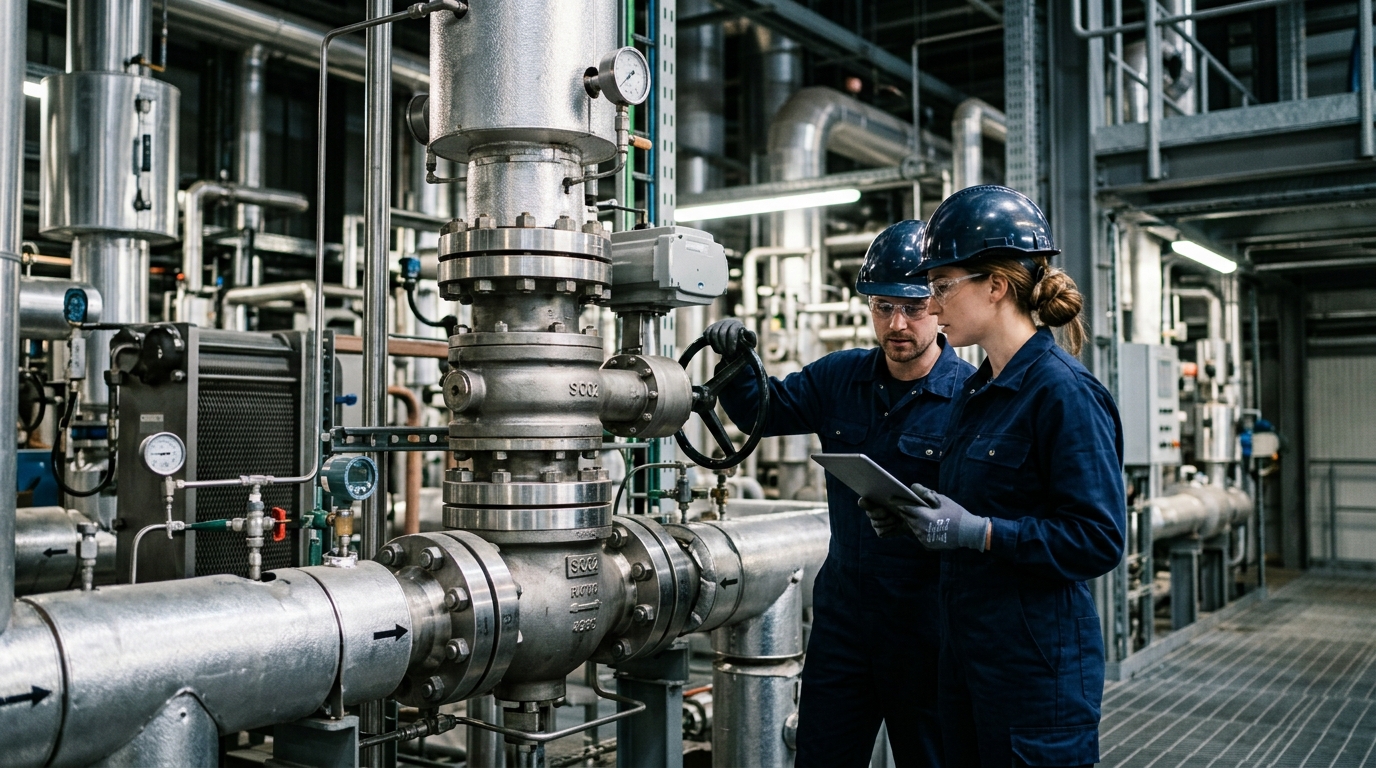
The engineering challenge is not trivial. The supercritical state of CO2 is achieved above about 31°C and 7.38 MPa (about 73.8 bar), roughly 1,070 psi. Commercial systems push well beyond that threshold. The U.S. Department of Energy’s STEP Demo facility in San Antonio, Texas has targeted and demonstrated simple-cycle operation at a turbine inlet temperature of up to 500°C, and public STEP Demo materials describe pressures around 250 bar. At those conditions, a standard industrial valve fails. The metallurgy, sealing, and actuation all require rethinking from the ground up.
Among the engineering hurdles addressed during the STEP Demo effort was the need for specialized turbine stop and control valve designs. Public STEP Demo technical updates describe a very large turbine stop valve casting (about 9,250 lbs) and note that the turbine control valve was adapted from a commercial steam-turbine valve design to accommodate sCO2 and high temperatures. Engineers also had to learn how to produce large-scale components in high-temperature alloys such as Haynes 282, and STEP Demo publications describe design elements leveraged from commercial designs used by Baker Hughes.
That last detail matters for investors. Baker Hughes is not just a bystander. The company has publicly described designing turbomachinery (including a turbine expander) for supercritical CO2 cycle development work, and in its July 26, 2026 second-quarter release it reported record Industrial and Energy Technology orders of $7.1 billion, up sharply year-over-year. In the same earnings materials and prepared remarks, Baker Hughes highlighted $2.6 billion of Power Systems orders during the quarter.
Flowserve is the other name worth watching. In June 2026, Flowserve closed its all-cash acquisition of Trillium Flow Technologies’ Valves Division for $490 million plus working-capital adjustments, strengthening its position as a leading flow control provider to the global nuclear and power generation markets. The company said the acquisition expands Flowserve’s reach in both conventional and emerging markets by integrating Trillium Flow’s specialized valve and actuation portfolio, differentiated power and nuclear technology, and scalable service offerings. Supercritical CO2 is not nuclear, but the materials science and pressure tolerances overlap closely enough that Trillium’s legacy gives Flowserve a credible head start.
Flowserve is not the only industrial supplier quietly absorbing demand from next-generation power infrastructure. Eaton has been building a parallel position in high-specification electrical equipment for the same power buildout, with record quarterly sales and raised full-year guidance reflecting the same order acceleration.
The market growing underneath these suppliers may be meaningful, but the specific market-sizing figures often quoted for “sCO2 power cycle market” vary widely by source and definition, and this draft’s $1.2 billion (2024) to $7.6 billion (2033) estimate could not be verified to a reliable primary source. One data point that is verifiable: American Supercritical emerged from stealth on September 23, 2026 with $8 million in pre-seed funding, and said it was founded by veterans of Sandia National Laboratories, Kairos Power, and Exowatt to commercialize supercritical CO2 power blocks.
New entrants drive new demand for certified hardware. Every sCO2 power block that ships needs valves that can close in an emergency under conditions that most industrial suppliers have never tested. That is a long-term order backlog for the two or three companies that have already done the work. Investors looking for a durable position in the sCO2 transition do not have to bet on which developer wins. They can own the valve suppliers every developer needs.