June 26, 2026
Apple’s Price Hike Hit Different
The AI memory crunch just landed on the consumer’s doorstep.
Thursday felt like one of those days where something abstract finally becomes real.
Apple took its store offline in the morning. When it came back, prices were higher across most of the lineup — MacBooks, iPads, Apple TV, HomePod, Vision Pro. Not a little higher. Meaningfully higher. The MacBook Pro 14-inch base jumped $300. The MacBook Air climbed $200. Apple TV, somehow, went up 54%. iPhone, Apple Watch, and AirPods were left alone, but that almost made it more conspicuous. The message was hard to miss: the cost of memory has gotten bad enough that Apple could no longer quietly eat it.
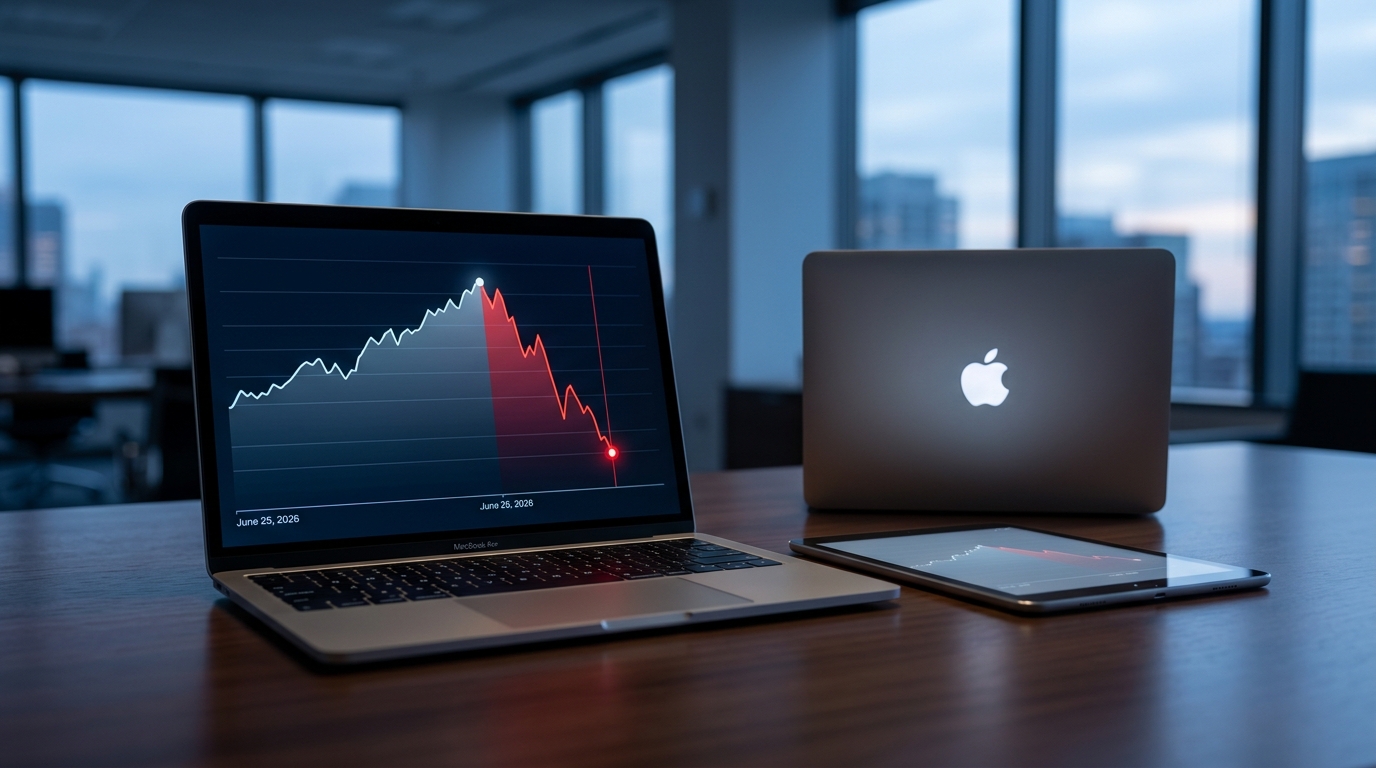
AAPL closed at $275.15. Down 6.12%. Roughly $265 billion in market value gone by the closing bell.
The full list of what moved:
- MacBook Neo: $599 to $699 (+$100)
- MacBook Air 13-inch M5: $1,099 to $1,299 (+$200)
- MacBook Pro 14-inch: $1,699 to $1,999 (+$300)
- MacBook Pro 16-inch: $2,699 to $2,999 (+$300)
- iPad Air 11-inch (128GB): $599 to $749 (+$150)
- iPad Pro 11-inch (256GB): $999 to $1,199 (+$200)
- Apple TV: $129 to $199 (+$70)
Evercore’s Amit Daryanani framed the core Mac and iPad increases at +17% to +25%. That is not a rounding error.
Here is where it gets interesting. Tim Cook told the Wall Street Journal on June 17 that price increases had become “unavoidable” — and that he had “never seen anything like it in any area in over 40 years.” That quote landed without much fanfare at the time. In hindsight it was a warning shot. The company had been absorbing the cost surge internally for months. Thursday was the moment that cushion ran out and the bill got passed forward.
Apple is not the only one. Hours later, Microsoft said Xbox console prices would rise starting August 1, citing memory and storage costs that have, by Microsoft’s own account, already more than doubled. That detail matters. This is not an Apple-specific problem.
This Elon-Backed Startup is Growing Like Crazy
Time magazine called this startup that’s backed by Elon Musk (click here to get the name)…
“The Most Disruptive Company in the World…”
And said that it “holds the keys to perhaps the most powerful technology of all time.”
No wonder its CEO is projecting growth of up to 8,000% for this year.
It just filed the paperwork to go public in what’s set to be the next hot IPO on Wall Street. But you do NOT have to wait until the IPO.
Click here and Jeff Brown will show you how to claim your pre-IPO stake for as little as $50.
Slight tangent, but it matters: HP’s CFO disclosed recently that memory and storage had climbed from roughly 15-18% of its PC bill of materials all the way to about 35% in 2026. That single data point explains more about what is happening across the hardware industry than most analyst notes I have read this month. When memory goes from a line item to the dominant cost driver, pricing decisions stop being optional.
The mechanics of why this is happening are not complicated, they are just easy to ignore when they live in a data center earnings call. TrendForce put Q1 2026 conventional DRAM contract prices up 90-95% quarter-over-quarter — the largest quarterly jump ever recorded. NAND Flash rose 55-60% in that same window. Q2 2026 showed no relief: DRAM still running +58-63% QoQ, NAND accelerating to +70-75%. Gartner is projecting a full-year 2026 DRAM price increase of 130% year-on-year. The cause is straightforward. AI data centers are consuming extraordinary volumes of high-bandwidth memory. That pulls capacity away from the conventional DRAM and NAND that ends up in your laptop. Samsung and SK Hynix control about 70% of global DRAM supply between them. Neither has signaled a major expansion push. Meaningful new fab capacity is not expected until late 2027 at the earliest, and analysts tracking the cycle think the shortage extends well into 2028. There is no quick fix here. The shortage was years in the making and the resolution timeline reflects that.
What the market is really reacting to is not the sticker prices themselves.
It is the signal embedded in the timing. Apple raised prices on existing products mid-cycle — not at a new product launch, not tied to a chip upgrade or a redesign. Just: these cost more now. Analysts called that nearly unprecedented for the company. The implication is that cost pressure had exceeded what Apple’s margins could absorb quietly and the move to pass it through happened faster than expected. That raises a harder question about demand. Apple’s customer base skews premium. Some portion will pay without flinching. But the entry-level MacBook Air buyer, the student buying an iPad, the household picking up an Apple TV — those are more price-sensitive segments. Volume in those categories could soften, and that matters for the unit numbers that show up in the next earnings report.
Then there is the iPhone. Counterpoint Research estimates the memory cost surge could add $150 to $200 per device to Apple’s component costs, weighted toward higher-memory configurations. More on-device AI means more memory. That is not speculation — it follows directly from where Apple Intelligence is heading. The fall iPhone cycle is when this question gets answered for real. If Apple holds iPhone pricing near current levels, the franchise looks resilient. If the iPhone gets a meaningful bump too, the conversation about demand elasticity gets a lot louder.
The AI memory squeeze did not start on Thursday. It has been running for over a year in hyperscaler capex budgets and HBM supply chains. What changed Thursday is that it crossed the line between enterprise infrastructure and the price tag on a laptop a student buys for school. That is a different kind of visible. And the iPhone decision this fall will tell us how much further it has left to go.
Investors are watching this fast-growing tech company
No, it’s not Nvidia… It’s Mode Mobile, 2023’s fastest-growing software company according to Deloitte.
Their EarnPhone has helped users earn and save over $1B, driving $115M+ in revenue and an eye-popping 32,481% revenue growth. And having secured partnerships with Walmart and Best Buy, Mode’s not stopping there…
Like Uber turned vehicles into income-generating assets, Mode is turning smartphones into an easy passive income source. The difference is, investors like you still have a chance to invest in Mode’s pre-IPO offering at $0.52/share.
They’ve just been granted the stock ticker $MODE by the Nasdaq and over 59,000 investors participated in their previous rounds.
$71M+ already invested – claim your stake at $0.52/share and earn up to a 20% bonus
Please read the offering circular at invest.modemobile.com. This is a paid advertisement for Mode Mobile’s Regulation A Offering.