August 5, 2026
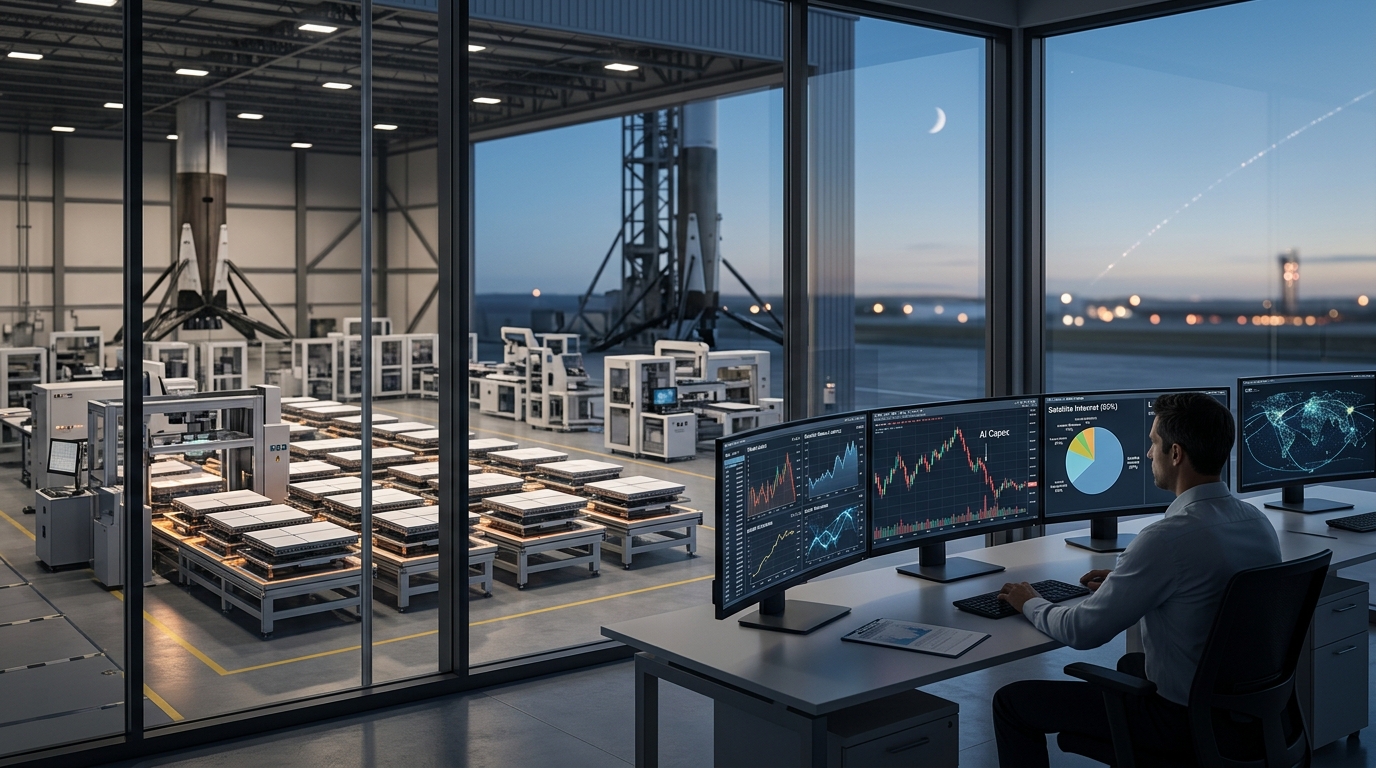
SpaceX Is No Longer a Rocket Company
Its first earnings report confirmed it. Now the lockup begins.
First a note from Stocks to Trade
In May 2007 – one month before Steve Jobs unveiled the iPhone – Nvidia was trading at $0.50.
By 2025, that $0.50 became $190.
Not because Nvidia made the iPhone.
Because the iPhone created a wave that lifted every company sitting in its path.
Amazon. Taiwan Semiconductor. Microsoft.
All of them exploded – not because they were Apple, but because they were already positioned when the wave hit.
Nvidia’s CEO stood on stage at CES 2026 and said the same wave is forming right now in a different sector.
Most investors are looking at the wrong company.
A trader who caught the 2020 crypto mega-runs before they happened using a proprietary capital flow system has pinpointed five small stocks he believes are sitting in the same spot Nvidia was in 2007.
Two of them are under $4.
Find out which stocks are in position →
SpaceX Is No Longer a Rocket Company
Analyst Targets
- Morgan Stanley: Overweight, $300 price target
- JPMorgan: Price target raised to $240 from $225 (August 5)
- Wells Fargo: Price target lowered to $215 from $230 (August 5)
- Phillip Securities: Sell rating, $75 price target (initiated July 31, 2026)
- Consensus (27 analysts): Buy, average 12-month target ~$223
The Beat That Sold Off
SpaceX reported $7.81 billion in Q2 2026 revenue against a Wall Street estimate of roughly $6.9 billion. Loss per share came in at 9 cents, versus the 26-cent loss analysts had penciled in. Every segment beat. The stock fell anyway.
Shares surged about 9% ahead of results during regular trading, then fell roughly 7% after the close. By the morning of August 5, SPCX was trading near $125, up from a previous close of $114.53 as the market absorbed the report.
That whipsaw is the market communicating clearly. The business outperformed on every line. The capex bill did not fit any conventional model of a company at this stage.
What SpaceX Actually Is Now
SpaceX reports three segments: Connectivity (Starlink), Space (Falcon, Dragon, Starship), and AI (xAI, Grok, X, and cloud infrastructure). That structure reflects a company that has reorganized itself around the revenue it actually generates, not the one it built its reputation on.
Of the $7.81 billion in Q2 revenue, 55% came from Connectivity and 33% from the AI segment. Rocket launches contributed 12 cents of every revenue dollar. The company that made reusable rockets famous now earns the overwhelming majority of its income selling broadband subscriptions and AI compute time.
The xAI acquisition closed February 2, 2026. In June, SpaceX announced an agreement to acquire Cursor AI for approximately $60 billion, a transaction expected to close in Q3. The AI segment is not a side project: it is the growth thesis the entire valuation rests on.
The Numbers
Segment by segment, here is what Q2 delivered:
- Connectivity (Starlink): $4.29 billion in revenue, up 66% year-over-year. Operating income of $1.66 billion at a 38.6% margin, above the 35.9% estimate. Starlink added 1.7 million net subscribers in the quarter, its best quarter of additions to date, bringing the total to 12 million across 164 countries. ARPU held steady at $66 per month, unchanged from Q1 but down from $85 a year earlier.
- AI (xAI/Grok/X): $2.56 billion in revenue, up 247% year-over-year, versus a $2.18 billion estimate. Operating loss of $1.26 billion, sharply below the $2.39 billion loss analysts had feared. The segment turned EBITDA-positive ahead of schedule, per Clear Street.
- Space (Falcon/Starship): $962 million in revenue, up 29% year-over-year, beating the $835 million estimate. Operating loss of $542 million as Starship R&D costs continued to climb.
- Net loss: $541 million, narrowed from $1.008 billion in the same quarter a year earlier.
- Adjusted EBITDA: $3.538 billion, up 191% year-over-year, roughly 75% above the $2.0 billion consensus estimate.
- Capex: $18.37 billion for the quarter, more than sixfold the $2.83 billion a year earlier. Of that total, $15.83 billion was allocated to AI infrastructure alone.
Why the Stock Moved the Way It Did
The revenue beat was broad and credible. The selloff was rational.
SpaceX spent $18.37 billion on capital in a single quarter against $7.81 billion in revenue. That ratio is the problem. The company’s total capex exceeded FactSet’s average analyst estimate of $13.22 billion by more than $5 billion. Investors who have spent the past several weeks interrogating Alphabet, Meta, Microsoft, and Amazon on their AI spending walked into SpaceX’s first earnings report with that lens already fitted. SpaceX’s capex-to-revenue ratio made Meta’s look restrained.
The ARPU trend adds another layer of pressure. Average monthly revenue per Starlink subscriber fell from approximately $99 in 2023 to $66 by Q1 2026 as the company pushed into lower-income international markets. In Q2, ARPU held at $66, flat sequentially. Connectivity is the only segment generating an operating profit. If ARPU continues compressing as subscriber growth into lower-priced markets accelerates, the entire funding model for the AI buildout becomes more fragile.
SpaceX addressed ARPU directly: in June, the company introduced a new $10 monthly terminal rental fee alongside broader subscription price increases. The full effect of those changes flows into Q3 data, not Q2.
The Numbers That Change the Debate
The most consequential disclosures from Tuesday’s call were forward-looking. CFO Bret Johnsen said SpaceX is on pace to reach $100 billion in annualized recurring revenue by the end of 2026. He also said that in the first weeks of Q3, the company contracted an additional $6.7 billion in cloud services revenue over a six-month period beginning in October.
Enterprise and government Starlink revenue grew 108% year-over-year to $1.8 billion, supported by airline connectivity agreements with American Airlines, Southwest, and Virgin Atlantic, and more than $6 billion in multi-year Starshield contracts with the U.S. government. xAI separately signed agreements totaling $14.1 billion to provide customers with additional compute capacity, which added $1.6 billion in incremental AI revenue in Q2 alone.
The compute-rental model connecting Anthropic and Google to SpaceX’s data centers is the bridge between today’s capex and tomorrow’s operating income. Whether the $6.7 billion ramps on schedule beginning in October is the single most important near-term datapoint for the stock.
The Nvidia Bet
The morning after reporting a capex-driven selloff, SpaceX announced more capex. On August 5, the company confirmed a partnership with Nvidia to design the Starmind AI-1 satellite compute payload, which would put data-center-class computing in orbit. Each Starmind satellite will carry Nvidia Rubin GPUs and Vera CPUs, with peak compute capacity of 250 kilowatts per satellite. Musk said on the earnings call that Nvidia will be SpaceX’s exclusive AI chip supplier, both in space and on the ground.
SpaceX has filed with the FCC for authority covering up to one million Starmind satellites. At 120 kilowatts of sustained compute power each, a fully built constellation would represent approximately 120 gigawatts of orbital compute capacity. The company expects to have over 2 gigawatts of total compute capacity by the end of 2026, growing to nearly 10 gigawatts by the end of 2027. Terrestrial data centers are constrained by power and cooling. Orbit offers continuous solar power and radiative cooling, which is the engineering case Musk is making. Whether it translates to better economics than ground-based hyperscalers is the open question.
Forward Scenarios
Bull Case
The $6.7 billion in Q3 cloud contracts ramps on schedule starting in October. ARPU recovers as the June pricing changes flow through Q3 data. Starlink enterprise revenue sustains triple-digit year-over-year growth. The AI segment’s EBITDA-positive inflection, confirmed by Clear Street, gets treated as a structural turning point rather than a one-quarter anomaly. Compute capacity scaling to 2 gigawatts by year-end is read as a monetizable asset base, not a burn rate. Morgan Stanley’s $300 target and JPMorgan’s freshly raised $240 target attract buyers. SPCX recovers toward $175 and above.
Base Case
Cloud revenue ramps more slowly than guided. ARPU holds near $66 through Q3 as international subscriber growth continues to dominate additions. Capex for the second half of 2026 remains elevated but below the Q2 pace, giving management a basis to argue discipline without abandoning growth. The lockup absorption on August 6 is orderly. SPCX consolidates in the $115 to $135 range through Q3 earnings.
Bear Case
The August 6 lockup releases up to 911.5 million shares, roughly triple the current tradable float. At the August 5 price of roughly $125, that single tranche represents more than $109 billion in newly eligible stock. Selling pressure overwhelms the earnings beat. Cloud revenue disappoints relative to guidance. ARPU compression accelerates. Starlink margin deterioration tightens the funding runway for the AI buildout. SPCX retests the 52-week low at $104.83.
Technical Levels
The 52-week range runs from $104.83 to $225.64. SpaceX priced its IPO at $135, raised $85.7 billion in the largest offering in history, and briefly touched $225 before falling more than 40% from that peak. As of August 5, SPCX was trading around $125, roughly 7% below its IPO price on a previous-close basis.
The $104 level is the floor established in late July. Below it, the IPO thesis begins to crack in a way that invites additional institutional selling. The absence of meaningful technical support between $104 and the $75 level, where a more traditional revenue multiple would place the stock, is the structural risk bears are pointing to. A sustained close above $135, the IPO price, would signal the lockup absorption is contained and reopen the conversation about the growth multiple.
What to Watch
- August 6 lockup open: Up to 911.5 million shares unlock on the second full trading day after earnings. At roughly triple the current float, the price action on that day will set the tone for the rest of the year.
- Q3 cloud revenue ramp: The $6.7 billion in contracted compute revenue beginning in October is the most important near-term catalyst. Any early confirmation that it is ramping on schedule reframes the entire capex debate.
- Starlink ARPU in Q3 data: The full effect of June’s pricing changes flows into next quarter’s connectivity margin. That will be the clearest read on whether the subscriber-growth-at-lower-ARPU trade-off is stabilizing or accelerating downward.
- AI segment operating loss trajectory: The loss narrowed from $2.5 billion in Q1 to $1.26 billion in Q2. Investors need to see that trajectory continue, and see the EBITDA-positive signal from Clear Street confirmed, before treating the AI segment as an asset rather than a liability.
- Analyst price target convergence: Morgan Stanley at $300 and Phillip Securities at $75 represent a spread rarely seen on a single name. Q3 results will compress that range more than any single quarter’s beat or miss has done so far.
Bottom Line
SpaceX beat every number that matters and the stock still fell. That is not a contradiction. It is the market communicating that the valuation debate is not about Q2 revenue. It is about whether $18.37 billion in quarterly capital spending becomes durable operating income before the IPO class runs out of patience.
Starlink is exceptional. Connectivity generated $1.66 billion in operating income at a 38.6% margin on $4.29 billion in revenue. That engine funds everything else. The AI segment, with 247% revenue growth, a narrowing operating loss, and an EBITDA-positive inflection ahead of schedule, is the growth thesis. The Space segment, at 12% of revenue and still losing money on Starship development, is the origin story, not the investment case.
What determines the next move in SPCX is not the revenue growth rate, which is genuinely exceptional. It is whether the cloud compute contracts CFO Johnsen described on Tuesday convert to operating income fast enough to absorb a lockup that releases up to 911.5 million shares on August 6. That is a supply event, not a fundamental one. The two should not be confused.