September 7, 2026
Bonus Content: A Chinese Car Ban Would Help GM and Ford. But EVs Are Already the Problem.
Dear Reader,
The AI story Wall Street isn’t spelling out
AI data centers are now a serious public issue.
Texas officials are warning about the strain they could put on the power grid. ERCOT is projecting huge demand growth. Regulators are being pushed to make sure ordinary people don’t get stuck paying for the infrastructure.
So yes…
The market is finally waking up to the power, land, and water demands behind AI.
But almost nobody is talking about the “29% Account.”
That frustrates me.
Because this little-known setup has reportedly averaged 29% a year over the past 25 years.
It’s been used quietly by wealthy investors and major institutions.
And while regular Americans were told to accept whatever scraps their bank offered, the people with better information had access to something entirely different.
That should bother you.
It certainly bothers me.
Especially now, with AI pushing demand for real assets into overdrive.
I recorded a briefing showing what I found, why I call it the “29% Account,” and why I believe more Americans deserve to know about it.
Good investing,
Marc Lichtenfeld
Chief Income Strategist, The Oxford Club
P.S. In my briefing, I’ll show you why this is not a bank account, not crypto, and not some overhyped AI stock. Go here to learn more.
A Chinese Car Ban Would Help GM and Ford. But EVs Are Already the Problem.
On September 3, the Alliance for Automotive Innovation sent a two-page letter to Speaker Mike Johnson, Senate Majority Leader John Thune, and both minority leaders asking Congress to enact a permanent ban on the sale, import and manufacture of Chinese connected vehicles, hardware and software before the conclusion of the 119th Congress. The Alliance represents General Motors, Ford Motor, Stellantis, Toyota, Volkswagen, Honda and other major automakers. The message was blunt: act before January 3 or lose the moment.
The House companion bill, the Connected Vehicle Security Act of 2026, does not appear to have 72 co-sponsors. The Senate Commerce Committee approved the Connected Vehicle Security Act of 2026 in July. This lobbying effort has real momentum. Whether it solves the right problem for GM and Ford shareholders is a different question.
What the Ban Actually Covers
The Alliance is seeking a ban covering the sale, import and manufacture of Chinese connected vehicles, hardware and software, scope that extends beyond vehicle imports alone. China is capturing market share in Europe, Australia, Southeast Asia, Mexico and South America with vehicles capable of collecting, processing and transmitting sensitive vehicle and consumer data. The national security framing is genuine. But the commercial framing matters equally for investors: Detroit wants a wall around the world’s most important automotive market before BYD and its peers find a way through.
The risk is real. Automakers have been worried that Chinese rivals like BYD and Geely are flooding global markets, undercutting vehicle prices and threatening domestic production, with those companies increasing their exports to Europe and Central and South America. A statutory ban would convert today’s tariff and regulatory barriers into permanent law, removing that uncertainty.
The August Sales Numbers Change the Conversation
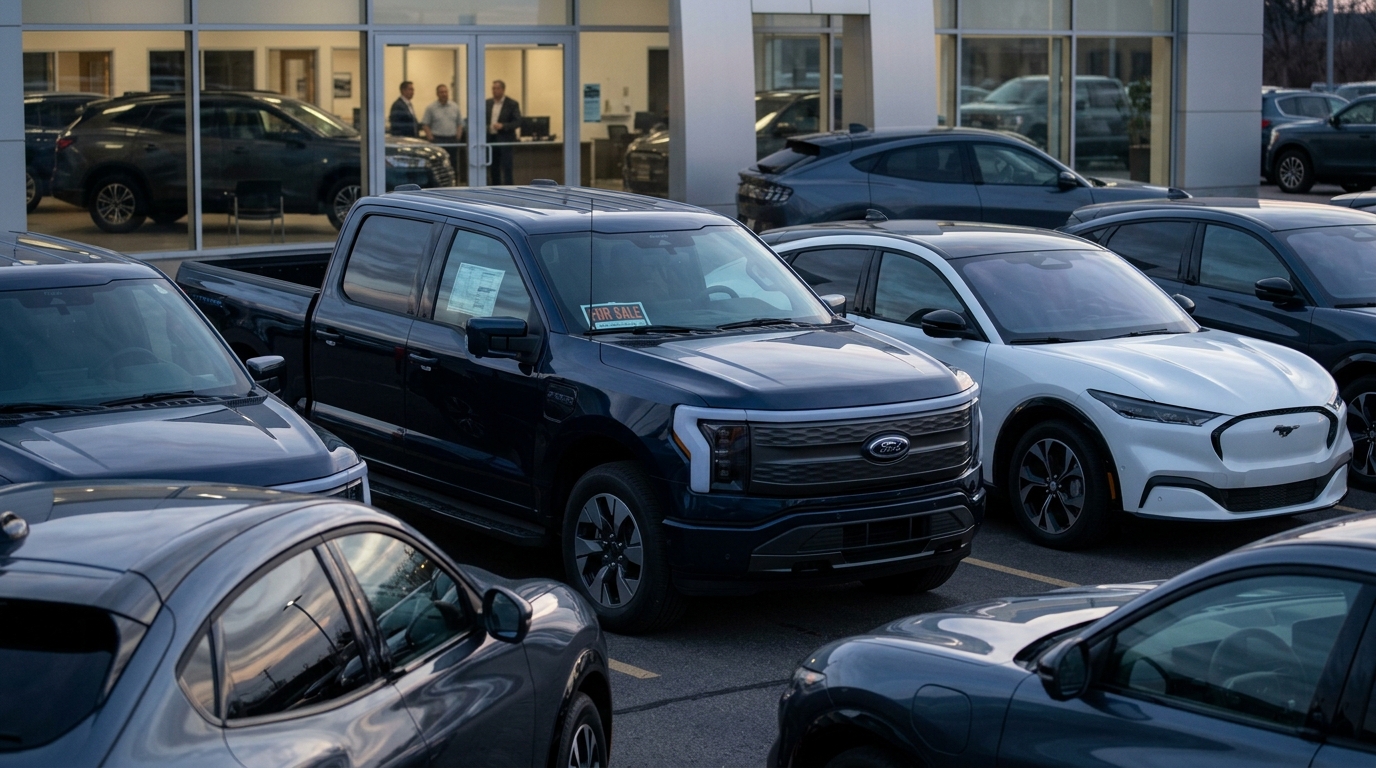
Here is where long-term investors need to stay clear-eyed. Ford sold about 10% fewer vehicles in the U.S. in August, with electric vehicle sales plunging 79.4% and hybrid sales declining 19.9% from the same month last year. The EV collapse was partly due to the end of the current F-150 Lightning program, with dealers selling only 148 units last month, down 95.4% from a year ago.
Ford has said it will take $19.5 billion in charges tied to its EV overhaul, including canceling the fully electric version of the F-150 Lightning, while General Motors said it would take a $6 billion charge tied to pulling back on some EV investments. A closed market doesn’t erase those losses or rebuild consumer demand.
The EV share of total U.S. auto sales fell from 11.9% a year ago to 7.7% in August, while hybrid vehicles were expected to capture 15.9% of U.S. retail sales in July 2026, more than double the EV share. The consumer has already voted, and the winner so far is Toyota, which bet on hybrids while Ford and GM were writing down their EV factories.
What This Means for Long-Term Holders
A permanent ban, if it passes, removes a competitive threat that hasn’t fully materialized inside the U.S. yet. That is a genuine, if asymmetric, benefit. Toyota and Hyundai saw strong growth driven by hybrid demand in Q2, while General Motors posted a 4.2% sales decline, a juxtaposition that prompted analysts to note Toyota is narrowing its sales gap with the Detroit carmaker.
For GM and Ford shareholders, the more pressing question is whether either company can close that gap with hybrids and profitable trucks before the EV investment era forces further write-downs. Locking out Chinese competitors buys time. It does not buy the right product mix. Investors holding GM or Ford for the long term should treat the ban as a floor, not a catalyst.
Risks Worth Watching
Under the Senate bill’s ownership-threshold provision, Mercedes-Benz could face limits on selling cars in the U.S., as total Chinese investment in the German automaker approaches 20%, a reminder that legislative drafting can create unexpected collateral damage. The bill’s final language matters enormously. So does the question of enforcement against software and hardware already embedded in supply chains. Congressional action before January 3 is the base case the Alliance is pushing for, but the timeline is tight.
The wealth lesson here is simple: policy protection is worth something, but it is not a substitute for competitive products. GM and Ford need both.