September 7, 2026
China’s 25-million-ton pledge is lifting prices. How to position ahead of Friday’s WASDE.
November soybean futures ended last week around $13.15 a bushel, hovering near their highest level in nearly three years after four consecutive weekly gains, driven by Chinese purchases of U.S. soybeans and concerns over hot, dry weather in key growing areas. The USDA reported private exporters sold 192,000 metric tons of soybeans to China for the 2026/27 marketing year. That sale is not a one-off. Trade groups and U.S. officials have pointed to China’s commitment to buy 25 million metric tons of U.S. soybeans annually through 2028.
“The Most Disruptive Force in History”: What Elon Musk Says about Sam Altman’s Hidden AI Project
A new type of AI is now live across America… And it’s already started what Nature Magazine describes as a $367 trillion boom.
Click here to see how you can position your portfolio BEFORE this news reaches the average person.
Markets are also watching Washington. Reuters reported Sept. 3 that the United States and China are expected to announce measures on agriculture and non-tariff barriers during Chinese President Xi Jinping’s visit to Washington this month, according to U.S. Trade Representative Jamieson Greer. The September WASDE is scheduled for release on September 11. That report will update yield estimates and export demand projections for both soybeans and corn, which is also on track for a fourth consecutive weekly gain, near $5.40 a bushel.
Trying to trade the WASDE itself is a coin flip. Yield surprises move futures sharply in both directions within minutes, and retail investors rarely have the positioning to benefit. The better opportunity is in the companies that profit from elevated soybean volumes regardless of whether Friday’s number lands a cent above or below consensus.
The Crushers: Bunge and ADM
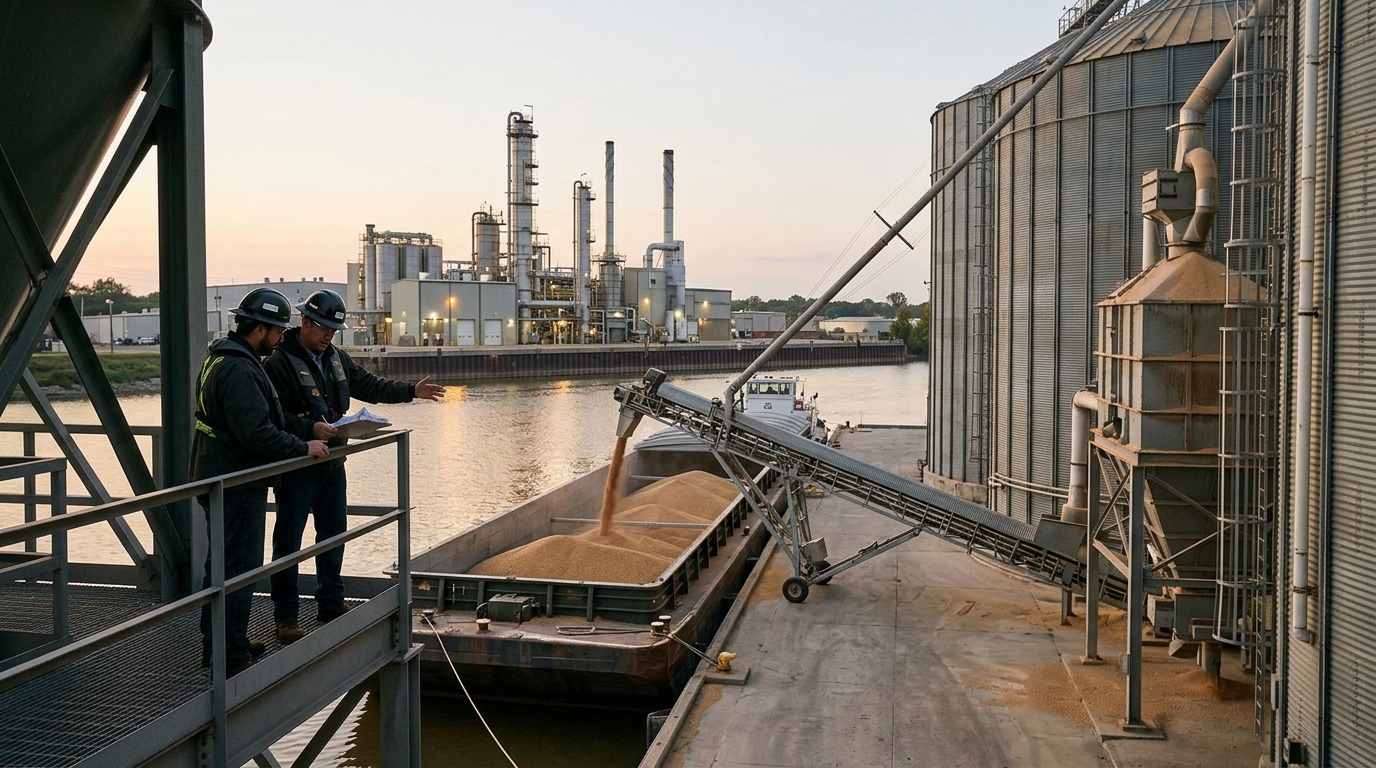
When Chinese buyers take delivery of U.S. beans, those beans flow through crushers and grain traders first. Bunge (BG) is the clearest beneficiary. Its Soybean Processing and Refining division delivered adjusted segment EBIT of $445 million in the second quarter, up from $304 million a year earlier, driven by stronger processing performance in North America and Argentina. Adjusted earnings per share rose to $2.00 from $1.31 a year earlier, and Bunge raised its full-year 2026 outlook to $9.25 to $9.75 per share.
410 new millionaires a day?
According to Bryan Bottarelli, “If my math is correct, what I’m revealing could generate as many as 410 new millionaires a day.” Bryan explains everything – including how to find out about his #1 stock – in this short presentation.
ADM (ADM) raised its 2026 adjusted earnings forecast to about $5.15 to $5.60 per share, citing expected improvements primarily in its crushing and ethanol businesses following finalization of renewable volume obligations. Agricultural services also benefited from increased shipments, including soybeans, to China from North America and strong corn exports. Both stocks give investors direct exposure to crush margins, which expand when soybean demand outpaces supply flexibility.
The Input Providers: Corteva and Nutrien
A sustained rally in crop prices changes farmer behavior. Growers who see $13 beans for the 2026/27 season become more willing to spend on seed technology and fertilizer. Corteva (CTVA) raised its full-year 2026 outlook, citing strong first-half execution and resilient demand across key agricultural markets, with farmers continuing to prioritize investments that enhance productivity and returns. Corteva now targets operating EBITDA of $4.1 to $4.3 billion, growth of roughly 9% at the midpoint.
Nutrien (NTR), the world’s largest potash producer, expects stronger farm economics to support fertilizer demand in the back half of 2026, after record potash sales volumes in the first half. Mosaic (MOS) presents a more complicated picture: Reuters reported May 11 that the company withdrew its 2026 phosphate production forecast and announced partial curtailments at U.S. and Brazilian facilities as costs for sulfur, ammonia, and urea have squeezed margins. A rebound in soybean prices helps farmer affordability, but Mosaic’s supply-side constraints make it a riskier way to play the theme.
The Cyclical Outlier: Deere
Farm equipment is the laggard in this chain. Deere has said 2026 should mark the bottom of the agricultural equipment cycle, though it still expects sales declines in key regions. For large agriculture equipment, Deere projects U.S. and Canada demand to decline 15% to 20%. A sustained improvement in soybean economics is exactly the catalyst that could move Deere’s large-ag order book into 2027. Deere stock is up over 9% since it beat fiscal Q3 estimates, delivering revenue of $12.61 billion. Deere is a longer-dated bet on the soybean rally: the stock rewards patience rather than immediate price action.
5 Little-Known Stocks Behind Today’s Defense Tech Shift
Behind the headlines, a major transformation is underway.
Modern warfare is being driven by AI, autonomous systems, and next generation technology. A handful of lesser known companies are helping power this shift.
This report uncovers five stocks quietly playing a critical role in the future of defense.
How to Position
For investors who want commodity exposure without an equity-specific view, the Teucrium Soybean Fund (SOYB) is designed to provide price exposure to the soybean market for future delivery by holding CBOT soybean futures. It sidesteps company execution risk but carries roll costs and an expense ratio that is commonly cited around 0.63%.
The cleaner wealth-building approach is to hold the processors, specifically Bunge and ADM, where the China buying commitment translates directly into recurring crush-margin revenue. Keep position sizes modest before Friday’s WASDE: a bullish supply surprise could pull prices back, temporarily pressuring the very stocks benefiting from strong demand. The structural case, a multi-year Chinese purchase commitment and a biofuel mandate that keeps crush margins wide, extends well beyond any single crop report.
The Wealth Builder Takeaway
Commodity rallies are volatile and hard to time. The investors who build lasting wealth from them are rarely the ones trying to call the top or bottom of a futures contract. They are the ones who identify the businesses that earn a fee on every bushel that changes hands, and own those businesses through the cycle. That is what Bunge and ADM represent in this soybean move. The Chinese purchase commitment is a floor, not a ceiling.