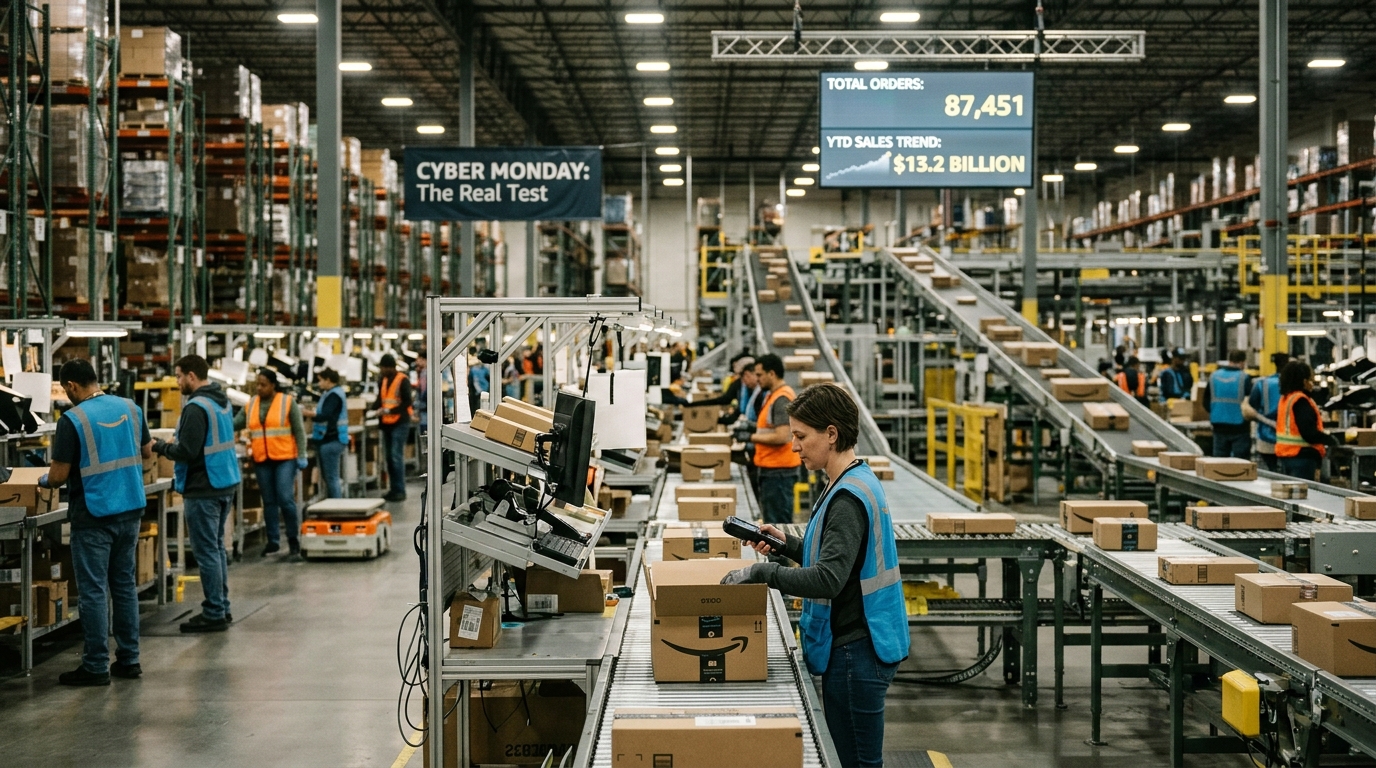
Black Friday 2026 did not disappoint. Adobe Analytics expects final Black Friday online sales to range between $13 billion and $13.4 billion, exceeding its September forecast of $12.9 billion. By 6:30 p.m. ET, U.S. online shoppers had already spent $9.7 billion, up 12.8% from the same period last year. Amazon closed the shortened session up roughly 4%, reclaiming ground it had surrendered mid-week.
Now every retail investor faces the same question: does this week’s enthusiasm mean anything twelve months from now?
The Bigger Trend
The five-day window from Thanksgiving through Cyber Monday keeps growing. Total online spending across the period is projected to reach $47.5 billion, up 7.4% from last year. Cyber Monday is expected to remain the biggest online shopping day of the season, generating $15.1 billion in sales, representing annual growth of 6.2%. That would be the first single day in history above $15 billion.
But growth rates, by themselves, do not tell investors where to put capital. The harder question is which businesses actually convert record gross merchandise volume into durable earnings power.
The Investment Case
Amazon is the clearest beneficiary of this shift to digital-first shopping. The company generated $716.9 billion in net sales in 2025, up 12% from the year before. But the claim that this number is expected to rise 25% to $892.2 billion in 2026 is not supported by Amazon’s own public guidance, so it should be treated as speculation rather than a baseline. According to Bernstein analyst Zhihan Ma, Amazon and Walmart are “the most obvious e-commerce destinations” among shoppers. Amazon’s holiday promotion window has expanded beyond a single day, a reminder that Black Friday has become a multi-week event.
Walmart deserves equal attention. Walmart’s recent results have highlighted continued e-commerce growth and strong advertising momentum. Walmart has the cleaner holiday operating story because value-seeking shoppers support traffic and volume. The stock is not cheap, but “over 50 times trailing earnings” overstates the current valuation in most common calculations, so the better framing is simply that Walmart trades at a premium multiple. The underlying business is structurally gaining share in e-commerce.
Target looks different. The claim that Target recently delivered a 28% EPS surprise with $27.97 billion in revenue against $26.47 billion expected is not supported by Target’s November 18, 2026 results release, and those figures should not be treated as factual. Target does, however, continue to trade at a lower multiple than Walmart, which gives it more room to move on positive holiday data.
Shopify is the infrastructure play few discuss in this context. Shopify president Harley Finkelstein told CNBC on Friday that sales through AI agents were running about 3.3 times higher than a year earlier, calling this “the first real Black Friday where agentic is playing a real role.” Platform operators capture volume regardless of which individual merchant wins.
Building Wealth Around This Idea
The seasonal trap is real. Amazon stock rose in only 14 of 26 Black Friday weeks measured between 2000 and 2025, with a median move of 0.03%. A one-day pop driven by shopping data is not a reason to overweight retail; it is a reason to revisit whether the structural case already in your portfolio is intact.
Holiday sales are forecast to rise 4.2% year over year, but inflation-adjusted growth may be only 2.2%. That spread between nominal and real growth is the gap retailers must fill with margin discipline, not volume alone.
That nominal-versus-real growth gap is not just a retailer problem — it sits inside a broader consumer credit picture. Household delinquency rates are rising into a rate environment where the Fed has put a December hike back on the table.
Risks to Monitor
Valuation is the first risk. Walmart’s premium multiple leaves little margin for execution error. Target’s recovery, with the stock near a 52-week high, leaves less room for disappointing holiday traffic. Amazon faces its own test: AWS re:Invent arrives next week, and cloud growth expectations remain demanding independent of whatever the shopping data shows.
A strong Cyber Monday number on November 30 would confirm that consumer spending has real momentum into year-end. A miss would be a sharper signal than any single Black Friday figure.
Daily Wealth Takeaway
Record online shopping days make headlines, but they do not make investment cases on their own. The retailers worth owning for the long run are the ones expanding margin and digital share in every quarter, not just the ones that benefit from a single weekend of consumer enthusiasm. Buy the structural winner, not the seasonal spike.