July 3, 2026
Rivian Just Surprised Everyone
The delivery beat was one thing. What came with it is worth paying attention to.
First a note from Banyan Hill Research
Dear Reader,
Every week, these strange white crates leave a high-security Tesla compound in Lathrop, California.
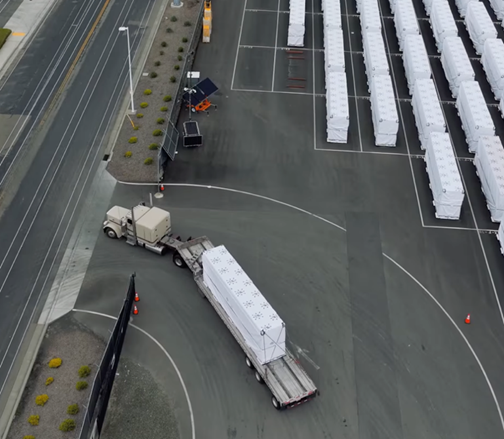
They’re showing up near the Hoover Dam. At an Air Force base in Georgia. In the heart of New York City…
An estimated 4,000 of them are now spread across 48 locations in 14 states. And more roll out every week.
But you won’t see this on CNBC, and you won’t read about it in the Wall Street Journal.
Because these mystery Elon crates have nothing to do with electric vehicles, space, social media, crypto, biotech, robots or AI…
But former hedge fund manager Adam O’Dell knows what’s inside them…
(And he reveals it all in this urgent investment briefing)
Which is why he believes they will go down as Elon’s greatest-ever invention… his biggest ever disruption.
On July 22, Elon is expected to share this new venture with the world.
Once he does, this is going to be everywhere – from Fox Business to your family’s group chat.
Adams believes investors who get positioned before that date could walk away wealthier than they ever thought possible. Everyone else will be reading about it after the stocks have already run.
I’d hate for you to be in the second group.
Click here to watch Adam’s full briefing right now.
He’ll show you exactly what Elon is building, what’s inside these strange white crates… and he’ll give you the name and ticker of one of his top picks to play it – completely free.
Watch it now while you still have time to position yourself.
FEATURED
Rivian Just Surprised Everyone
For most of 2026, Rivian has been easy to tune out.
The stock was drifting. Cash burn was ugly. The R2 was a promise, not a product. And with the broader EV market cooling off, there wasn’t much reason to pay attention. Then July 2nd happened.
Rivian delivered 12,194 vehicles in Q2. Against guidance of 9,000 to 11,000 units. That’s not a small beat. That’s a beat that makes you reread the number twice. Shares touched $19.79 intraday before closing up around 8% at $18.63, the highest close since January.
And then management raised full-year delivery guidance to 65,000-70,000 vehicles, up from 62,000-67,000. Analyst consensus was sitting around 63,138 units. The new midpoint is 67,500. That’s a meaningful gap, and it landed the same day R2 deliveries were confirmed to have started.
Here’s the thing about the R2. The R1S and R1T were never the scaling story. They’re genuinely good trucks and SUVs, but they start near $80,000. You don’t build a mass-market EV company at $80,000. Everyone knew that. The R2 is the attempt to actually fix it.
The launch Performance trim comes in at $57,990. A Premium version at $53,990 is expected late 2026. The Standard Long Range at $48,490 arrives in the first half of 2027. And a base model targeting around $45,000 follows in late 2027. That staircase matters because each step down opens a materially larger pool of buyers. It also means Rivian is running four product introductions inside a 24-month window while burning over a billion dollars a quarter in free cash flow. That’s a lot to execute.
Slight tangent, but it actually reframes the beat: U.S. EV sales broadly fell roughly 27% year over year in Q1 2026. The sector was not helping Rivian here. This delivery beat was entirely company-specific. That’s a different signal than if the whole category had a strong quarter.
Your 82% Discount For Life-Changing Dividends
Time is running out on our 4th of July special! For just $9 – an 82% discount – you could set yourself up for massive dividends as high as 140% – no options trade involved, just buying and holding ETFs. Don’t miss out on boosting your income with this limited-time deal.
There’s also a short squeeze element worth understanding. Around 150 million shares were sold short in mid-June, roughly 12% of the float. When a heavily shorted stock gets a clean upside surprise plus a guidance raise on the same day, the move in price tends to overshoot what the data alone would justify. That’s part of what you saw on July 2nd. Not the whole story, but part of it.
The harder part of this is the financials. EBIT margin is around -58%. Free cash flow burn was -$1.075 billion in Q1 alone. Q1 consolidated gross profit came in at $119 million, but automotive gross profit was still negative at -$62 million. Rivian’s own Q1 call flagged that R2 launch complexity would weigh on automotive gross profit through Q2 and Q3, with Q4 expected to show improvement as production scales. Full-year adjusted EBITDA guidance is -$1.8 billion to -$2.1 billion. The company ended Q1 with $4.83 billion in cash and short-term investments, including the $1 billion Volkswagen equity investment received April 30. That runway is real, but it’s not unlimited.
To hit the raised guidance, Rivian needs 42,000 to 46,000 more deliveries across Q3 and Q4 combined. That’s a sequential step-up of roughly 15 to 25 percent every quarter from Q2 levels, while simultaneously ramping a brand new vehicle line. Execution risk is real. The Q2 beat is encouraging, but it doesn’t make Q3 and Q4 automatic.
And then there’s the Uber deal, which is genuinely interesting but easy to misread. Uber has committed up to $1.25 billion to deploy autonomous R2 robotaxis, starting with 10,000 vehicles in San Francisco and Miami beginning in 2028, with options to scale to 50,000 across 25 cities by 2031. That creates a long-term demand floor. But the autonomous hardware doesn’t start shipping until late 2026, and the actual robotaxi revenue is years away. It’s optionality, not a near-term lifeline.
The $400 Million Clue
A little-known industrial company just landed the largest order in its history: $400 million.
The project centers on on-site power generation, the kind companies turn to when waiting on utilities isn’t an option. What’s interesting is the timing. New orders are surging, backlog has climbed to $1.8 billion, and the biggest contracts keep getting bigger.
What I keep coming back to is the automotive gross margin line. Q2 financials drop July 30. Volume growth without margin progress just means losses are scaling up, not down. The R2 opens the market. But the economics of that opening don’t work until the lower-priced Standard models are running at scale. That’s a 2027 problem at the earliest, probably later.
The beat was real. The guidance raise was real. The short squeeze was real. Whether any of it changes the fundamental math is what July 30 is actually about.
Full breakdown here before earnings drop.
For informational purposes only.