July 1, 2026
Broadcom Dropped 20% on Record Numbers
Here’s why the selloff happened and what comes next.
First a note from Brownstone Research
Editor’s Note: Jeff Brown and Marc Chaikin, two investment legends who picked Nvidia 10 years ago, are predicting that by the end of this month, Elon Musk’s new AI breakthrough will collide with a strange market pattern with a flawless 100% track record of massive market gains. Read more below because the last time this happened everyday folks had a chance to turn $10,000 into as much as $350,000 in just about 12 months.
Dear Reader,
If you missed Nvidia when I first recommended it back in 2016, before shares jumped as high as 36,000%…
I have good news.
Elon Musk is creating a second and perhaps last chance for you to profit from this AI boom.
You see, I believe by the end of this month…
Elon’s new AI breakthrough (click here to see his patent) will collide…
With a powerful market prophecy that’s been unbroken for generations…
One that has correctly predicted some of the biggest market booms going back to 1950.
And the collision of these two economic forces…
Will give Americans a rare and perhaps last chance to turn a small stake into potentially…
An entire six-figure nest egg in the next 12-18 months.
If that sounds too good to be true…
You should know the last time these two rare economic forces collided…
Investors had a chance to turn a small stake of $10,000 into as much as $366,000 in just 14 months.
But this new retirement window won’t remain open for much longer.
The Wall Street Journal even recently warned Americans that AI advancements like this could be…
“The last chance to amass generational wealth.”
So click here now because if you miss this window…
You’ll probably never see an explosive opportunity like this again in your lifetime.
We have so much to look forward to,
Jeff Brown
Founder & CEO, Brownstone Research
FEATURED
Broadcom Is Down 20% on Record Numbers
The Q2 report landed and the numbers were genuinely exceptional. Revenue of $22.19 billion, up 48% year-over-year. AI semiconductor revenue hit $10.8 billion for the quarter, up 143% annually. Adjusted EBITDA came in at a record $15.2 billion, or 69% of revenue. A $0.65 quarterly dividend declared. By almost any measure, Broadcom delivered.
The stock still dropped more than 20% from its June high.
That’s the part worth sitting with for a second, because it tells you more about where the stock was priced going into the report than it tells you about the business itself. Expectations had moved so far ahead of execution that even a record quarter wasn’t enough. CEO Hock Tan reiterated the $100 billion AI semiconductor revenue target for fiscal 2027 rather than raising it. The Q3 AI revenue guide of $16 billion came in below analyst models that were penciling in closer to $17.2 billion. Then a report surfaced that Google may be shifting its next-gen TPU work, the so-called Triggerfish chip, toward MediaTek instead of Broadcom. None of those things, individually, are catastrophic. Together, into a crowded long position? That’s what caused the drop. AVGO is now trading around $375, down from a 52-week high of $495. Market cap sits near $1.8 trillion.
Here’s where I’m at on the underlying business, separate from the stock price.
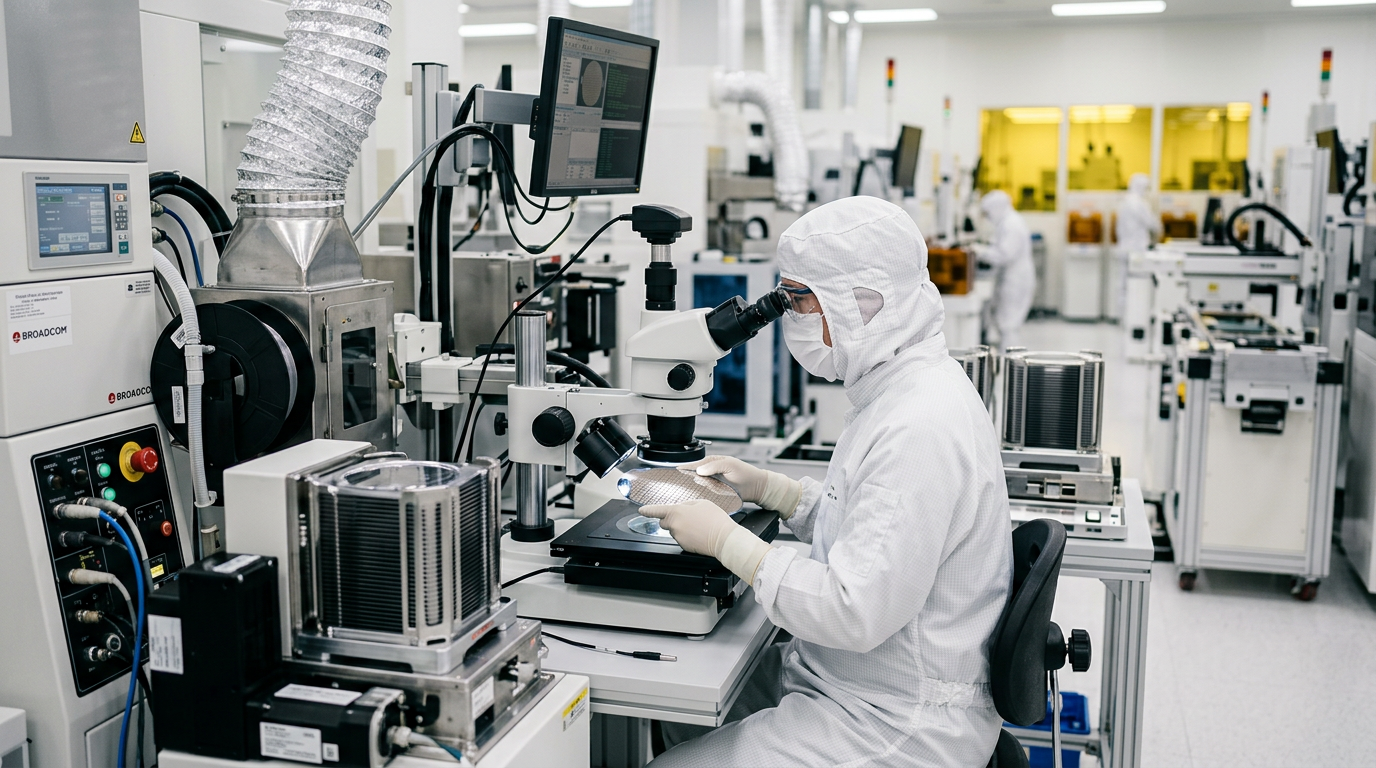
The custom ASIC franchise is genuinely hard to replicate. Broadcom isn’t selling off-the-shelf chips. It’s designing purpose-built AI accelerators for hyperscalers who want to move away from generic GPUs for specific workloads, and it does this at a level of engineering depth that most competitors can’t match. On the Q2 call, Hock Tan confirmed six core custom chip customers, including Google, Meta, Anthropic, and OpenAI. Two more remain unnamed. OpenAI’s first custom AI inference chip, called Jalapeño, was built with Broadcom. Meta’s partnership on custom AI chips runs through 2029. Anthropic signed a compute agreement covering roughly 3.5 gigawatts of capacity expected to come online in 2027. Slight tangent here but it matters: the sheer length of these contracts is underappreciated. This isn’t spot business. These are multi-year structural commitments from the companies building the backbone of AI infrastructure.
For Q3 fiscal 2026, management guided AI revenue to $16 billion, which is still over 200% year-over-year growth. Full fiscal year AI semiconductor revenue is expected to reach $56 billion, up roughly 180% from fiscal 2025. Total Q3 revenue guidance is $29.4 billion.
Bitcoin Got the Idea Right. It Got the Backing Wrong.
Bitcoin proved millions want money no government can print. But it’s backed by nothing but belief.
What happens when you keep everything it got right — and back it with real, verified gold? You find out July 8.
The valuation is where it gets harder to wave away the concerns.
At around $375, AVGO is trading at a trailing P/E of approximately 63x. That’s elevated. The forward P/E is closer to the low-30s range, and the PEG ratio sits well below 1.0, which is the number growth investors typically point to as justification. The 12-month consensus analyst price target across 48 analysts sits near $524, per S&P Global data. Zero sell ratings. Jefferies, UBS, Bank of America, and Mizuho all issued or reiterated bullish targets in the $485-$550 range after the earnings-driven drop. Overwhelmingly, the analyst community views this as a buying opportunity rather than a structural breakdown.
I don’t fully disagree with that read, but I also don’t think it’s clean.
The real risk isn’t that AI spending slows down. It’s that hyperscalers gradually bring more chip design fully in-house over time, reducing how much they rely on Broadcom’s engineering services. The Google-MediaTek report is the most visible version of that risk to date. Whether it represents a one-off decision on a single chip program or the early signal of a broader shift is genuinely unclear right now. That uncertainty is part of why the stock is where it is.
On price action: AVGO retreated from $495 into the $370-$380 zone, which is roughly where it was before the Q2 guidance-driven rally earlier in 2026. Volume on the move lower was elevated, more consistent with institutional repositioning than pure retail panic. The $360-$365 area is meaningful support. If that holds, the bull case stays structurally intact. If it breaks, the next conversation gets more complicated.
Your Free Options Book Is About to Vanish
In case you missed it… make sure you get your free “Simple Options Trading For Beginners” book before your link expires.
I eventually plan to charge money for this training, so do yourself a favor and download it now…
That way, no matter what it costs in the future, you’ll have a free copy.
Sound good?
September 3, 2026 is the date. That’s when Q3 earnings are expected, and it’s the next moment where this either gets resolved or gets messier. Between now and then, the proxies to watch are the AI chip delivery cadence out of the hyperscalers and any further news on the Google-MediaTek situation. If Q3 AI revenue comes in above the $16 billion guide, the overreaction thesis gets confirmed and the stock likely recovers toward the mid-$400s. If it meets or misses, the debate about whether $100 billion in fiscal 2027 is still achievable gets louder.
From a risk management standpoint, key levels are $360 as near-term support, $420 as resistance, and $495 as the prior high that now represents full recovery. For anyone in options, implied volatility heading into September will affect the cost of defining risk, so position sizing needs to reflect the short-term directional uncertainty even if the longer-term AI chip thesis feels intact.
The $100 billion question is whether the stock, at $1.8 trillion in market cap, was already priced for an outcome better than what management is guiding toward. And whether one strong quarter in September is enough to settle that argument. It might not be. That’s the part that doesn’t have a clean answer yet.