August 14, 2026
The Boring Companies Winning the AI Race
GEV, VRT, ETN, and DELL booked the numbers this earnings season. The market is still staring at the wrong layer.
Apple Price Hikes Reveal Mode’s Big Opportunity
Apple will potentially raise prices on Macs and iPads by $200 or more, another reminder that the devices we rely on keep getting more expensive.
Mode Mobile, is building the countertrend: technology that turns everyday smartphones into income-generating assets.
Its EarnOS platform has already helped users earn and save $1B+, reached 490M+ users, and powered 32,481% three-year revenue growth, earning Deloitte’s #1 fastest-growing software company ranking.
Now, Mode has secured the Nasdaq ticker $MODE, and its pre-IPO investment offering is open at $0.52/share with up to 20% bonus shares. But that window is closing fast.
Please read the offering circular at invest.modemobile.com. This is a paid advertisement for Mode Mobile’s Regulation A Offering.
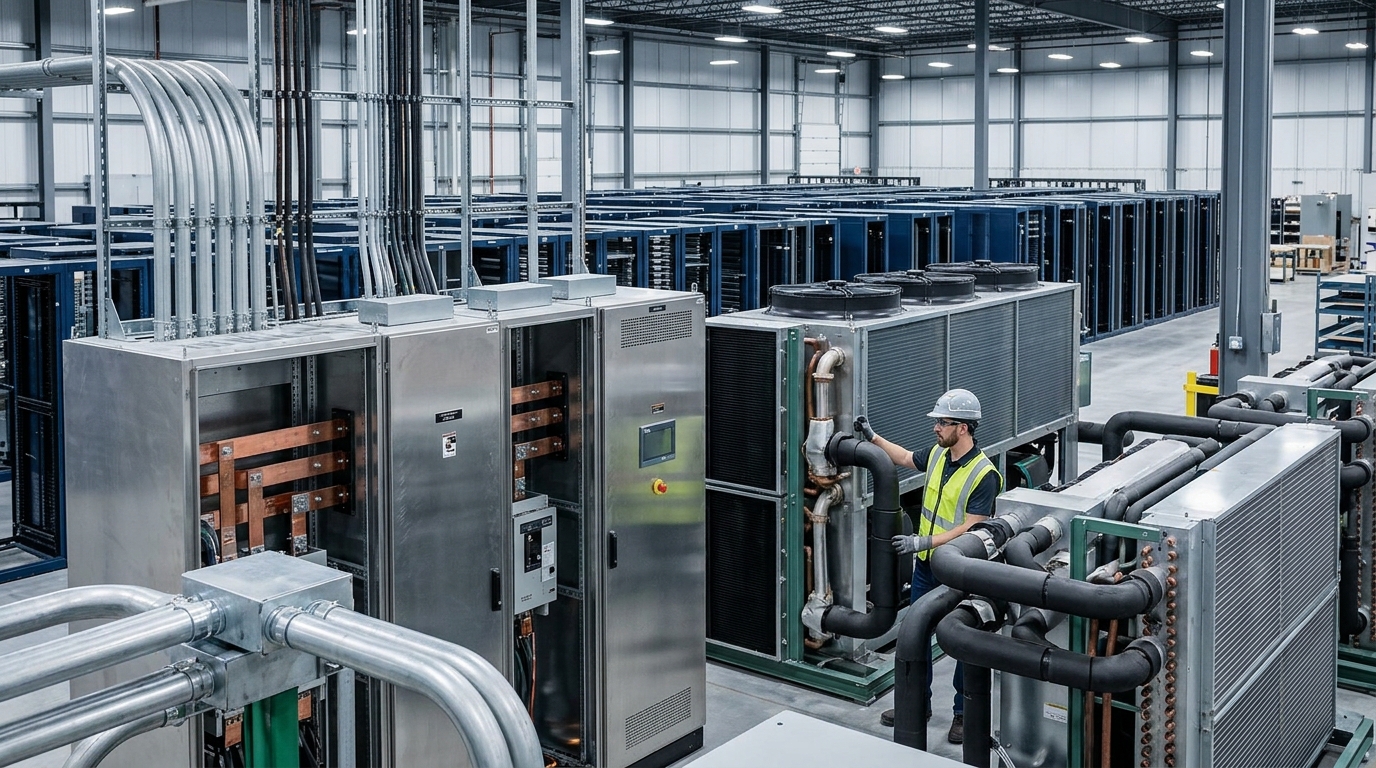
You have been sold a chip story. Nvidia up, AMD chasing, Micron along for the ride. That frame made sense in 2023 when GPUs were the scarce resource. In August 2026, the scarce resource is electrons, heat removal, and the racks that make the whole system run. The companies collecting rent on those constraints are not semiconductor designers. They make gas turbines. They make liquid cooling units. They make switchgear and power distribution equipment. They assemble AI servers at a scale no hyperscaler will touch internally. And their earnings this cycle were, by any reasonable measure, more convincing than most of the chip names that dominate the headlines.
Scoreboard
Four companies reported in the last three weeks that together tell you more about AI economics than any GPU benchmark. Here is what the numbers actually said.
- GE Vernova (GEV): Q2 2026 orders of $24.2 billion, up 88% organically year-over-year, driven by a more than doubling in Power equipment orders and 66% growth in Electrification. Backlog at a record $176 billion, up $13 billion sequentially. Adjusted EBITDA up 61% to $1.2 billion, with margins expanding 340 basis points to 10.5%. Free cash flow of $5.1 billion in Q2 alone, bringing the first-half total to approximately $10 billion, more than 2.5 times the full-year 2025 figure. Full-year free cash flow guidance raised to $11.5 billion to $12.5 billion.
- Vertiv (VRT): Q2 net sales of $3.27 billion, up 24% year-over-year, reflecting 18% organic growth, a 5% contribution from acquisitions, and 1% favorable foreign exchange. Adjusted operating margin expanded 410 basis points to 22.6%. Adjusted EPS of $1.52, up 60%, beating the $1.42 consensus. Adjusted free cash flow surged 234% to $925 million. Full-year guidance raised to net sales of $13.8 billion to $14.2 billion, implying 30% to 32% organic growth.
- Eaton (ETN): Q2 revenue of $8.53 billion, up 21%, a quarterly record. Adjusted EPS of $3.15, also a Q2 record, beating consensus by $0.07. Total company book-to-bill of 1.2, with Electrical Americas book-to-bill at 1.3. US data center backlog grew to 307 gigawatts. Full-year adjusted EPS guidance raised to $13.40 to $13.60.
- Dell (DELL): Full fiscal year 2026 AI-optimized server orders of $64.1 billion. AI server shipments of $25.2 billion for the year. AI backlog exiting fiscal 2026 at a record $43 billion. After a record Q1 FY2027, in which Dell booked $24.4 billion in AI orders and recognized $16.1 billion of AI server revenue, management raised full-year FY2027 AI server revenue expectations to approximately $60 billion.
Why This Cycle Is Different
The chip cycle has peaks. Every investor who has been in semiconductors for more than one cycle knows the script: demand surges, supply catches up, margins compress, the stock gives back half the run. That is not what is happening in the industrial power and infrastructure layer right now.
GE Vernova CEO Scott Strazik told investors in July that the company is already taking slot reservation agreements for 2031 gas turbine deliveries. Gas turbine backlog and slot reservation agreements sit at 116 GW, and management expects to reach at least 125 GW under contract by year-end. That is not a demand spike. That is a manufacturing constraint on a years-long order book, and the company is funding capacity expansion through customer down payments that contributed $6.4 billion to working capital in Q2 alone.
Vertiv operates on the same logic from a different angle. Every megawatt GE Vernova routes into a data center generates heat that Vertiv has to manage. The shift from air cooling to liquid cooling, driven by GPU rack densities that have climbed sharply since 2023, is a durable revenue tailwind that no model efficiency gain can fully offset. You can train a smarter model with fewer compute cycles, but physics still requires removing the heat from whatever compute you do run. Vertiv’s service revenues grew 32.9% year-over-year in Q2, outpacing product growth, which tells you the installed base is generating recurring demand independent of new builds.
Eaton sits one layer upstream, supplying the electrical distribution and power management equipment that gets electricity from the substation to the rack. Its US electrical backlog has now reached 307 gigawatts, which the company describes as roughly 15 years of backlog at current production rates. Management is investing more than $1 billion in capacity expansion across two dozen projects in Electrical Americas alone.
Deep Dive: What These Businesses Actually Do
Most retail investors can explain what Nvidia does. Fewer can explain what Vertiv does, even though Vertiv’s product is inside every data center that runs a Nvidia GPU.
GE Vernova makes the gas turbines and grid equipment that generate and transmit the electricity AI clusters consume. It is not a utility; it sells capital equipment to utilities, independent power producers, and increasingly to hyperscalers sourcing power directly. Its Electrification segment, which makes transformers and switchgear, is the piece connecting generation to data center loads. Both segments are in a multi-year order cycle driven by the same underlying demand. The wind segment is a headwind: Q2 wind orders fell 40% due to lower North American onshore equipment orders, and the full-year wind EBITDA loss is expected around $400 million. The Power and Electrification businesses more than cover it, but the wind drag is a real number investors should price in.
Your Free Options Book Is About to Vanish
In case you missed it… make sure you get your free “Simple Options Trading For Beginners” book before your link expires.
I eventually plan to charge money for this training, so do yourself a favor and download it now…
That way, no matter what it costs in the future, you’ll have a free copy.
Sound good?
Vertiv makes the power and cooling systems inside data centers: uninterruptible power supplies, thermal management units, and increasingly liquid-cooled rack systems for the densest AI clusters. Its product portfolio spans thermal systems, liquid cooling, UPS, switchgear, busbars, and modular solutions. It gets paid when data centers are built and when they are upgraded. The upgrade cycle is a recurring revenue stream that competitors cannot easily replicate because Vertiv’s equipment is integrated into facility design. One concrete example: in Q2, Vertiv deployed integrated power and liquid cooling systems at the Naval Postgraduate School’s new NVIDIA DGX GB300 AI installation, a sign that enterprise and sovereign deployments are now pulling as hard as hyperscalers.
Eaton makes electrical distribution equipment, including switchgear, circuit breakers, and, through its Boyd Thermal acquisition, liquid cooling systems for data centers. The Boyd acquisition adds direct liquid cooling capability to a company that already dominated the electrical distribution layer. Management described the Boyd integration as performing above expectations in Q2. The pending separation of Eaton’s Mobility business via a Reverse Morris Trust with Dana, targeted for Q1 2027, will deliver approximately $1.1 billion in cash and sharpen the portfolio around electrical and aerospace.
Dell is the integrator. It assembles the GPUs, memory, networking, and storage that hyperscalers, sovereign cloud buyers, and enterprise customers need packaged into deployable AI server systems. Dell does not design the GPU; it designs the system around the GPU, handling deployment, services, and lifecycle support. That is a lower-margin business than fabless chip design, but it is a business with $43 billion in AI backlog exiting fiscal 2026 and a pipeline that kept accelerating. Q1 FY2027 alone saw $24.4 billion in new AI orders, and AI server revenue of $16.1 billion in a single quarter, up 757% year-over-year.
Data Section
The numbers across these four names, taken together, describe a layer of the AI trade that is generating real cash flow now, not forward promises.
GE Vernova:
- Q2 2026 orders: $24.2 billion, up 88% organically year-over-year
- Q2 2026 revenue: $11.1 billion, up 22% year-over-year (12% organic)
- Adjusted EBITDA: $1.2 billion, up 61%; margin 10.5%, up 340 basis points
- Q2 free cash flow: $5.1 billion; first-half total approximately $10 billion
- Backlog: $176 billion, up $13 billion sequentially
- Equipment backlog: $88 billion, up 77% year-over-year
- Full-year 2026 revenue guidance: $45.5 billion to $46.5 billion
- Full-year free cash flow guidance: $11.5 billion to $12.5 billion (raised from $6.5 billion to $7.5 billion)
- Gas turbine backlog and slot reservation agreements: 116 GW, targeting at least 125 GW by year-end
- Data center electrification orders: over $5 billion year-to-date, more than double full-year 2025
- Gas turbine output capacity target: 30 GW annually by 2030, funded by customer down payments
Vertiv:
- Q2 2026 net sales: $3.27 billion, up 24% year-over-year (18% organic)
- Adjusted operating margin: 22.6%, up 410 basis points year-over-year
- Adjusted operating profit: $738 million, up 51%
- Adjusted EPS: $1.52, up 60% year-over-year
- Operating cash flow: $1.1 billion; adjusted free cash flow: $925 million, up 234%
- Net cash position; $5.6 billion of liquidity
- Full-year 2026 guidance: net sales of $13.8 billion to $14.2 billion; adjusted EPS of $6.65 to $6.75; adjusted free cash flow of $2.4 billion to $2.6 billion
Eaton:
- Q2 2026 revenue: $8.53 billion, up 21% year-over-year (14% organic, 7% from acquisitions)
- Adjusted EPS: $3.15, a Q2 record, up 7% year-over-year
- Free cash flow: $874 million, up 22% year-over-year
- Book-to-bill: 1.2 overall; 1.3 in Electrical Americas
- US data center backlog: 307 GW (described by management as approximately 15 years of backlog)
- Electrical Americas rolling 12-month orders: up 41% year-over-year
- Full-year 2026 organic growth guidance: 11% to 13%
- Full-year adjusted EPS guidance: $13.40 to $13.60
- Mobility separation: targeting Q1 2027 via Reverse Morris Trust with Dana; approximately $1.1 billion cash distribution expected
Dell:
- Full fiscal year 2026 revenue: $113.5 billion, up 19%
- Full fiscal year 2026 AI-optimized server orders: $64.1 billion
- Full fiscal year 2026 AI shipments: $25.2 billion
- AI backlog exiting fiscal 2026: $43 billion (record)
- Q1 FY2027 AI server revenue: $16.1 billion, up 757% year-over-year
- Q1 FY2027 AI orders: $24.4 billion
- Q1 FY2027 revenue: $43.8 billion, up 88% year-over-year
- FY2027 full-year revenue guidance (as of Q1 report): $165 billion to $169 billion
- FY2027 AI-optimized server revenue target: approximately $60 billion (raised from $50 billion after Q1)
- FY2027 non-GAAP diluted EPS guidance: approximately $17.90
- Record full-year FY2026 cash flow from operations: $11.2 billion
Is It Cheap?
The honest answer is that none of these stocks are cheap on trailing multiples. The argument for each one is not that it is a traditional value play. The argument is that the multiples are reasonable against a growth trajectory already embedded in firm orders, not analyst projections.
GE Vernova trades at roughly 39 times forward earnings on a backlog of $176 billion, with 2031 gas turbine production already partly spoken for. That is a premium, but it is a premium on a company that physically cannot deliver its orders fast enough. The risk on the multiple is execution, not demand. The wind segment EBITDA loss of approximately $400 million is the primary drag on the earnings quality argument and deserves scrutiny each quarter.
Vertiv has expanded its adjusted operating margin from the low single digits three years ago to 22.6% today. The free cash flow machine it is building, $925 million in a single quarter against a company that was generating minimal cash in 2022, is what matters for long-term valuation. The stock has run sharply in 2026, but the free cash flow trajectory is still accelerating, and full-year adjusted free cash flow guidance of $2.4 billion to $2.6 billion implies further step-up in H2.
Eaton’s valuation is more moderate than Vertiv’s, in part because the pending Mobility separation creates near-term complexity and the Boyd integration is still absorbing attention. The US electrical backlog at 307 GW suggests the demand runway is not close to exhausted.
Dell is the most interesting valuation case. After Q1 FY2027, management raised full-year revenue guidance to $165 billion to $169 billion and non-GAAP EPS guidance to approximately $17.90, well above what analysts had expected. AI server revenue of $16.1 billion in a single quarter, at infrastructure-scale margins, is not a business that looks expensive against where estimates were six months ago.
Bull, Base, and Bear
Bull case: Hyperscalers maintain or grow their capex commitments through 2027. GEV converts its slot reservation agreements into firm orders at the pace management is signaling, hits 125 GW under contract by year-end, and grows its gas turbine manufacturing capacity toward the 30 GW annual target by 2030. Vertiv’s APAC business sustains the above-20% organic growth that confirms the AI buildout is genuinely global. Eaton’s Electrical Americas backlog keeps converting with expanding margins as the capacity ramp matures. Dell’s FY2027 AI server revenue reaches $60 billion at mid-single-digit margins, with enterprise and sovereign customers broadening the base beyond hyperscaler concentration. In that scenario, all four are compounding earnings faster than their current multiples price in.
Base case: Hyperscaler capex holds at current levels but does not accelerate. GEV and Vertiv continue converting backlogs into revenue with improving but stable margins. Eaton benefits from the Boyd integration and strong electrical demand, but the Mobility separation creates some near-term noise heading into Q1 2027. Dell sustains its FY2027 AI revenue target but margin pressure from component costs caps EPS upside relative to guidance. All four still grow earnings meaningfully through mid-2027. None return the triple-digit gains early investors captured. That is not a failure; it is what a mature phase of a durable cycle looks like.
Bear case: A major efficiency breakthrough in model architecture substantially reduces the power and cooling intensity per unit of AI output. Hyperscalers pause new data center commitments, and existing orders face push-outs. GEV’s slot reservation agreements do not convert at management’s pace, wind losses remain a visible drag, and the EPS miss in Q2 2026, where adjusted earnings of $2.47 fell well short of the $3.04 Street forecast, repeats. Vertiv’s Q2 revenue came in $110 million below consensus, and the company attributed it to timing; if timing becomes a pattern, the free cash flow thesis frays. Dell faces margin compression if AI server profitability is structurally capped at the low end of the mid-single-digit range. The backlogs are real in all four cases, but the pace of conversion determines the multiple.
Action Plan
The cleanest way to think about positioning is sequentially: electrons first, then thermal management, then distribution, then servers. GEV and ETN sit on the electron and distribution side, with orders locked years in advance and meaningful free cash flow already on the income statement. VRT owns thermal management, which is a function of installed base growth as much as new data center builds. DELL sits closest to the GPU cycle but with a customer base broadening rapidly into sovereigns and enterprise, with Dell management citing more than 4,000 AI buyers across the customer count by the end of fiscal 2026.
- GEV: This is a long-cycle business; the backlog converts slowly and the EPS can disappoint on any quarter where wind losses or execution slip. A 3% to 5% position for investors with a genuine three-year horizon is a reasonable starting point. Scale in on any quarter where an earnings miss is driven by the wind segment rather than by Power or Electrification order weakness, which remains the real thesis driver.
- VRT: The free cash flow inflection is the signal. The Q2 revenue miss, attributed by management to supply chain timing and project phasing, sent the stock down roughly 12% in premarket on the day of the report. That kind of reaction on a timing issue, in a company with $925 million of adjusted free cash flow in one quarter, is the type of entry point the thesis is built for.
- ETN: The Mobility separation, targeting Q1 2027 via Reverse Morris Trust with Dana, is a re-rating event. Investors who position ahead of that close are likely to own a more focused electrical and aerospace business with cleaner margin optics and a $1.1 billion cash distribution on the way. The 307 GW US data center backlog makes the demand side hard to argue against.
- DELL: Dell raised its FY2027 AI server revenue target to $60 billion after Q1 results in May, and full-year revenue guidance now sits at $165 billion to $169 billion. At $17.90 in guided non-GAAP EPS, the stock is not priced like a high-growth compounder. Scale in gradually; sensitivity to component input costs is a real risk, and the stock can move sharply on any shift in server component pricing or hyperscaler capex signaling.
Cheap Investor Checklist
- GEV gas turbine backlog and slot reservation agreements: watch for quarterly conversion rate from SRAs to firm orders; the path to 125 GW by year-end is the near-term milestone
- GEV wind segment EBITDA: management expects a full-year loss of approximately $400 million; a deterioration from that level is the primary risk to the investment case
- GEV adjusted EBITDA margin: first-half margins reached 10.5%, up 360 basis points year-over-year; any quarter below that trajectory warrants scrutiny
- VRT adjusted operating margin: expanded to 22.6% in Q2; the full-year guided trajectory implies continued expansion in H2
- VRT APAC organic growth: broad-based strength across APAC was cited by management in Q2; a sustained above-20% read confirms the global nature of the buildout
- VRT revenue timing: the Q2 miss was attributed to supply chain congestion and project phasing; watch Q3 for the catch-up shipments management expects
- ETN Electrical Americas book-to-bill: 1.3 in Q2; any sustained drop below 1.0 is an early warning signal on demand deceleration
- ETN Mobility separation: targeting Q1 2027; the $1.1 billion cash distribution and portfolio sharpening are the primary re-rating catalysts
- ETN US data center backlog in GW: 307 GW as of Q2; watch for sequential growth or any commentary suggesting push-outs
- DELL AI server revenue versus the $60 billion FY2027 target: quarterly shipments need to run at roughly $15 billion per quarter to reach the number; Q1 was $16.1 billion, setting a strong base
- DELL AI operating margin: management targeting mid-single digits; any quarter above 6% is a positive surprise on a revenue base that could reach $60 billion
- Hyperscaler capex guidance for 2027: Microsoft, Amazon, Alphabet, and Meta guidance updates in October and January will either validate or challenge order books at all four companies
Bottom Line
If hyperscalers continue spending at or above current levels, the constraint on AI buildout is not GPUs. It is electrons, cooling capacity, and electrical distribution. GEV, VRT, ETN, and DELL are the companies collecting that constraint premium, with backlogs already on the books.
If capex cools, these names will see multiple compression before they see order cancellations. The backlog provides a revenue cushion that chip designers do not have.
Three time-stamped events will either confirm or challenge the thesis by mid-2027: the ETN Mobility separation close in Q1 2027, VRT’s margin trajectory in the back half of 2026, and GEV’s conversion of slot reservations into firm orders over the next two quarters. Watch those three. The rest of the story is already in the financials.