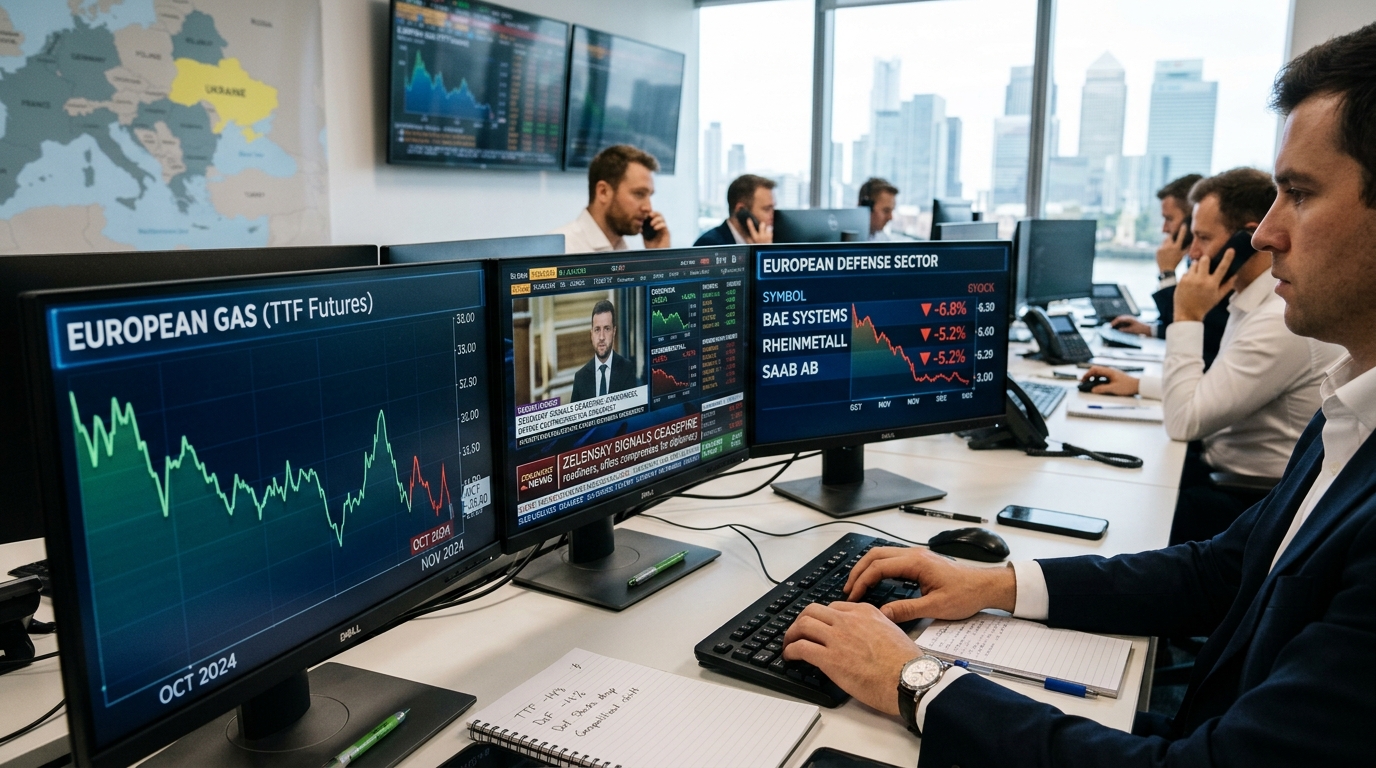
When Zelensky speaks explicitly about stopping where Ukraine stands, two trades collide: European gas falls and defence shares fall with it. This morning that is exactly what traders face. Zelensky said Ukraine is ready for a ceasefire along the current line of contact to move to diplomacy, calling it a very significant compromise given Russia’s refusal to withdraw from Ukrainian territory. He floated a similar idea in an interview with Danish broadcaster DR on 10 November. Today’s statement is the most direct yet, and that matters for positioning.
The backdrop is the U.S.-brokered talks that opened in Abu Dhabi on 10 November, the first direct negotiations since February, where Washington’s envoys proposed a new European security architecture involving Russia and European nations. Putin is still making maximalist demands previously rejected by Kyiv, including Russian control over parts of eastern Ukraine and a reduction in Ukraine’s military size. Nothing has been resolved. That gap is the trader’s friend: the market will price in peace, then walk it back.
What Happens to Gas
The pattern already played out in early November. TTF front-month fell 17.7% from €103.94 to €85.59 per MWh between 30 October and 6 November as peace-talk signals hit the market. By 27 November, front-month pricing around €83 per MWh was still in play, depending on the contract month. Every credible ceasefire signal since October has pressured the forward curve because the market anticipates the eventual softening of EU sanctions on Russian energy supply.
The risk is asymmetric today. If the talks fail or December turns cold, TTF could quickly rebound back toward the mid-€90s per MWh. Zelensky’s offer is real, but Russia’s negotiating position has not moved. Zelensky has said that during the Abu Dhabi talks the Russian delegation stated it did not have authorization to discuss de-escalation in the Black Sea or a halt to attacks on Ukraine’s energy infrastructure. Gas longs have a floor here; gas shorts need to be sized accordingly.
What Happens to Defence
The sector was already wounded before this morning’s interview. Rheinmetall shares plunged around 17% on 5 November after the company cut its 2026 sales and margin outlook, citing delays in military vehicle contracts and artillery ammunition deliveries. In the same session, Leonardo fell and BAE Systems also declined. Year-to-date, Rheinmetall has been down roughly 50% to high-50s percent in late November, depending on the measurement date, while Leonardo has been down only modestly.
Peace headlines compound that damage in the short run, but the structural story has not changed. Rheinmetall’s sales rose 38% in the first nine months of 2026, operating profit climbed 68%, and its backlog reached €78 billion as of 30 September. The stock has fallen so far that even bottom-end analyst estimates represent significant upside, and Morningstar named Rheinmetall among European defence stocks with the most upside in a 16 November article. JPMorgan rates BAE Systems and Leonardo Overweight, citing long-duration order books and products that are hard to replace.
The Trade Ahead
Zelensky’s offer creates an immediate sentiment shock, not a structural shift. Russia’s refusal to commit to a ceasefire at the current contact lines remains a sticking point. Until Russia formally reciprocates, any ceasefire optimism is a headline, not a deal.
On gas: optimism on peace discussions has already capped gains in TTF this month. A further drop into the low €80s per MWh on today’s headline is a fade, not a chase, unless Moscow signals genuine movement. The rebound trade off cold weather or a Russian rejection of Zelensky’s terms is the higher-probability play into December.
On defence: Rheinmetall and BAE absorb another peace-scare sell-off on top of an already-bruised flow. The discipline is not to confuse a ceasefire headline with a peace agreement. Backlog-driven earnings at BAE and Leonardo do not evaporate if Russia stalls. Watch for a dip into Rheinmetall in the €720-740 range as a re-entry zone, with the January investor event as a catalyst. Leonardo remains the cleaner position: strong order momentum and a raised 2026 new-orders outlook, with a valuation well below Rheinmetall’s even before this year’s correction.