Dear Friend,
I’m giving you a free stock pick before December 8th.
Because getting the name after a stock takes off isn’t the same as owning it before.
Dylan believes December 8th could be the turning point for this one.
It’s not Tesla.
It’s not SpaceX.
It’s the company Elon’s been paying since 2012.
He doesn’t own its chip technology. He licenses it.
Now he’s filed plans for a million satellites.
Every chip built on this company’s designs carries a royalty back to it.
Dylan believes Elon’s bill could get 100X bigger.
You don’t need an invitation to the SpaceX IPO to own this stock.
Just the ticker. And a brokerage account.
I’m handing you the first one free.
Waiting could be the expensive part.
Get your free stock pick before December 8th here >>
The Buck Stops Here,
Kelly Maguire
Behind the Markets
P.S. December 8th is the date Dylan’s watching for a potential move. Get the name, see his case, and decide whether you want to own it beforehand.
Black Friday’s $807M Credit Tab Says More Than $12.9B
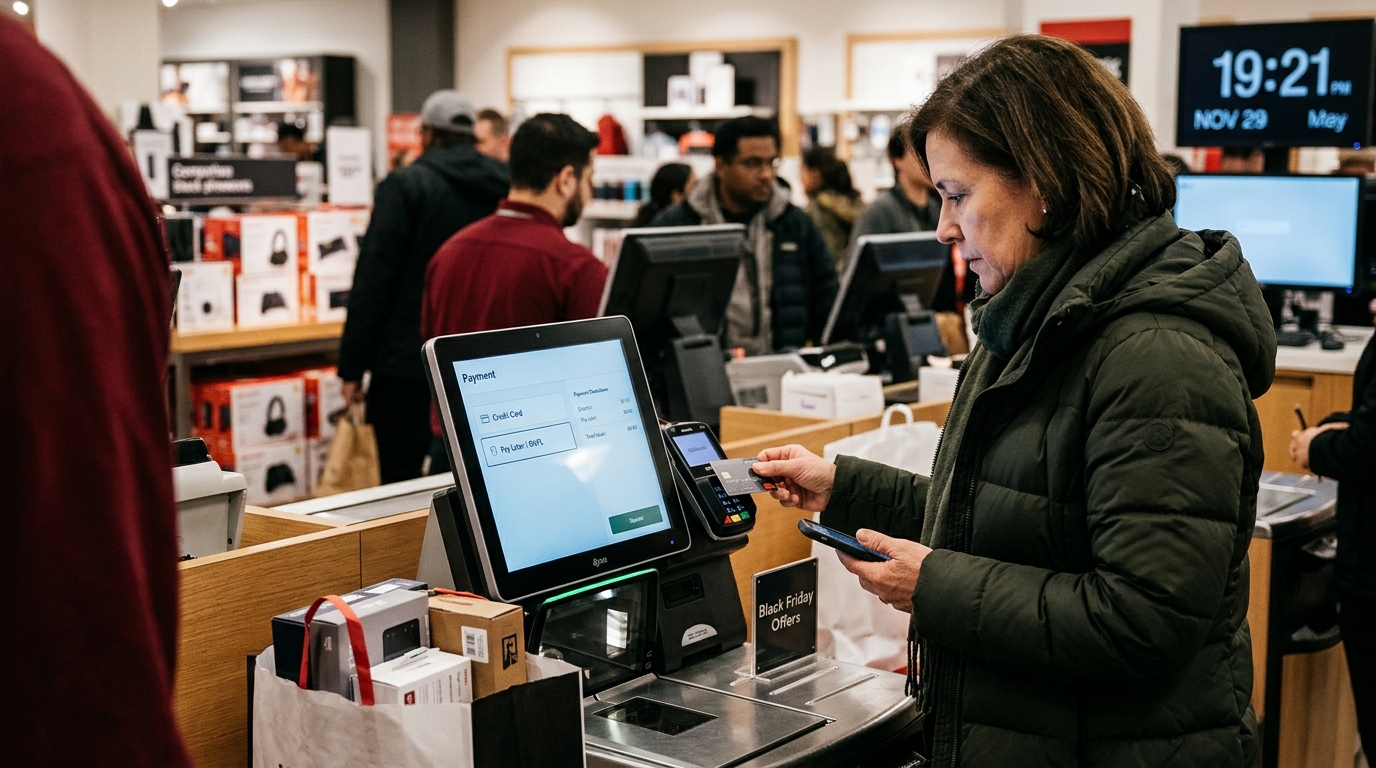
The number retailers want you to see today is $12.9 billion. That is Adobe’s forecast for U.S. online spending on Black Friday 2026, up 9.2% year over year, sitting inside a projected $275.1 billion online season, up 6.7%. The number worth scrutinizing is $807 million.
Adobe projects buy-now-pay-later (BNPL) spending for online orders to reach $807 million on Black Friday 2026 alone. That is not a rounding error. It is a single-day financing figure that reflects how stretched a meaningful slice of the consumer base actually is. LendingTree survey data shows 29% of BNPL users have used loans for groceries, up from 25% in 2025 and 14% in 2024, and 47% reported late payments in the past year, up from 41% in 2025 and 34% in 2024. People borrowing to buy electronics and clothing in a promotional environment are not the same as people spending from strength.
The National Retail Federation’s own forecast makes the same point in different language. NRF Chief Economist Mark Mathews said about half of the 4.2% forecast growth should come from real consumer spending, with the rest driven by higher prices. NRF expects core goods inflation to average 2.5% in 2026, up from 1.6% in 2025, with higher diesel prices raising shipping costs and surging memory prices pushing up costs for electronics, a key gift category. Strip out price inflation and the volume story is considerably thinner.
That matters for how you read today’s winners. Black Friday remains the biggest day of the year for retail foot traffic according to Sensormatic Solutions, and retailers large and small view the occasion as an opportunity to improve their year-end footing and attract new customers. But Sensormatic projects holiday store visits will fall 3.5% from last year, while shoppers who do visit are more purposeful, with conversion rates up 5.2% and sales per shopper up 4.8%. Fewer trips, more intentional purchases. That is a different consumer than the one of five years ago.
For investors holding retail positions, the divergence in that data is the story. Amazon (AMZN) and Walmart (WMT) are best positioned to absorb a shopper who has pre-researched and arrived ready to buy. Amazon has expanded its Black Friday and Cyber Monday deals to a roughly 12-day window running from November 19 through November 30. Walmart reported third-quarter revenue of $188.8 billion, up 5.2%. Both benefit when shoppers consolidate trips and prioritize value.
The consolidation toward Amazon and Walmart is not just a traffic story — it is a margin story. Amazon and Walmart can absorb a 30% markdown far more gracefully than specialty retailers whose owned-brand inventory is thinner.
Target (TGT) and Best Buy (BBY) face harder conditions. The electronics categories that anchor BBY’s Black Friday floor are precisely where memory-driven price inflation is squeezing unit economics. Target is recovering but has less pricing power than Walmart on essentials, the category shoppers are actively prioritizing this year.
Affirm (AFRM) is the other name to watch. Affirm has embedded itself into the payment flows of platforms like Amazon and Shopify and has long partnered with Walmart, meaning today’s $807 million in Black Friday BNPL flows through partners it cannot afford to lose. Volume growth looks strong on the surface. The late-payment trends underneath it do not.
Volume growth in BNPL is not the same as credit quality improving. Klarna has been deliberately moderating GMV to let its credit book season into interest income, a contrast that sharpens the question Affirm’s late-payment data raises.
The Wealth Builder Takeaway
Record dollar figures in retail spending can mask a consumer who is paying more for less and financing the gap. Before adding to any retail or BNPL position on the back of today’s headlines, ask whether the growth is volume or price, and whether the borrower on the other side of a BNPL transaction has the balance sheet to follow through. The first hard read arrives with Cyber Monday data on November 30, 2026. That is the number that will tell you whether today’s optimism was earned.