November 4, 2026
Bonus Content: European Stocks Rose While US Futures Fell. What It Means

Dear Reader,
My name is Jeff Brown, founder and CEO of Brownstone Research.
Something could happen on November 11 that catches most investors completely off guard.
A tiny stock – trading at under $1 – could announce a supply deal with Elon Musk.
If that happens, the move could be fast.
Similar partnership announcements have sent Musk suppliers soaring…
By as much as 395% in a single day.
And the insider I recently interviewed believes that if you hold a little longer…

You could potentially see 39x your money in under two years.
This isn’t a guess.
On page 37 of the SpaceX IPO filing, Musk names the exact sector this company operates in.
And with $85.7 billion from the IPO and another $25 billion from bonds…
Musk is about to go on a huge spending spree.
This company holds the keys to the future of Musk’s AI masterplan.
It’s even helping roll a new Cybercab off the line every 10 seconds.
Including turning $13,140 of his own money into around $1.85 million in under a year.
We put everything in an urgent strategy session…
Including a free ticker you can act on right away.
But you need to see it before November 11.
After that, you could miss out entirely.
Click here to watch the strategy session now.
We have so much to look forward to,
Jeff Brown
Founder & CEO, Brownstone Research
European Stocks Rose While US Futures Fell. What It Means
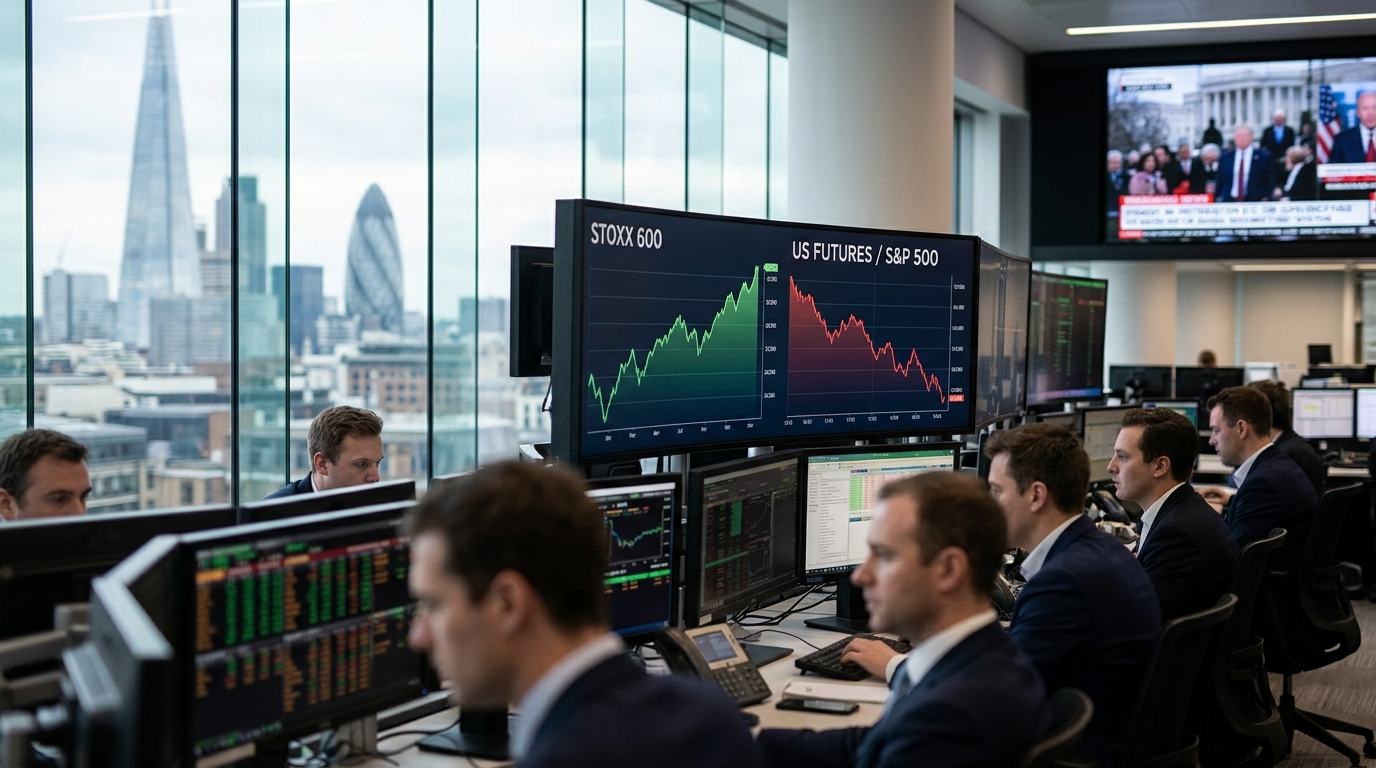
Wednesday morning handed investors a clean, real-time illustration of geographic diversification. While S&P 500 futures slid and Nasdaq contracts fell as much as 2% overnight before trimming losses, the Stoxx Europe 600 gained 0.5% by 08:16 GMT. The dollar index fell to an intraday low near 101.25, its weakest level in about a month, after Democrats captured both the Senate and the House in the U.S. midterm elections. Europe did not just hold up. It moved in the opposite direction from the American market at the moment of peak uncertainty.
The sector breakdown was telling. European banks climbed more than 2% as investors rotated into domestically focused lenders that had lagged the broader market for much of the year. Clean energy names surged even harder: Vestas jumped roughly 5%, Orsted gained more than 7%, and Nordex advanced about 4.7%. Italy’s FTSE MIB outperformed the region with a roughly 1.2% gain, and Deutsche Bank, Société Générale, and Intesa Sanpaolo each rose more than 3%.
Tech stocks, the pressure point of the session, also stabilized in Europe as investors looked for an earnings anchor ahead of major U.S. tech results. That recovery, combined with a roughly 4% to 5% jump in Novo Nordisk after the company raised its full-year outlook, reflected something important: European markets carry a fundamentally different sector composition than the S&P 500, one that is less exposed to AI-driven valuations and more weighted toward financials, healthcare, and industrials.
The Portfolio Question This Raises
Today’s divergence is not an argument to abandon U.S. equities. It is an argument to quantify what you actually own. Most American investors hold 80 to 85% of their equity allocation in domestic stocks. That is well above the 40% international weighting Vanguard’s published guidance says investors should consider to capture the full diversification benefit. The gap between what investors hold and what the data supports has widened through years of U.S. outperformance.
European equities currently trade at a meaningful discount to global peers on a forward price-to-earnings basis. The dollar’s weakness today adds an additional layer for unhedged U.S.-based holders: a falling greenback translates directly into better translated returns on European positions.
Currency and valuation tailwinds do not exist in isolation from European monetary policy. Record euro short positioning and sticky eurozone inflation data are the ECB variables that could reprice both the currency and European equities quickly.
A practical starting point is 20% to 30% international within an equity sleeve, with roughly 70% of that in developed markets like Europe. ETFs tracking the Stoxx 600 or the broader MSCI EAFE index, including iShares’ IEFA and Vanguard’s VXUS, offer low-cost, liquid access without requiring single-stock selection. Neither is a substitute for the other: Europe brings sector and currency diversity; the U.S. brings growth concentration. Both have a role.
Risks Worth Watching
The Democratic sweep creates its own uncertainties. Congressional scrutiny of AI spending could weigh on technology valuations on both sides of the Atlantic. Defense names were among the session’s weaker pockets in parts of Europe, reflecting investor concern that shifts in Washington could alter the tone of oversight and spending priorities. That is a potential headwind for one of Europe’s strongest-performing sectors in recent years.
Currency exposure cuts both ways. A weaker dollar is a tailwind today; a reversal would compress translated returns for unhedged U.S. investors in European funds. And political gridlock in Washington, while removing some policy risks, also removes the possibility of further fiscal stimulus that has supported U.S. growth.
The dollar’s direction is the mechanism that determines how much of Europe’s equity gain survives translation back into U.S. portfolios. Structural forces pulling the dollar in opposite directions make the currency hedge decision more consequential than most investors treat it.
The Takeaway
When American policy becomes the variable, the value of owning assets that respond to different economic drivers becomes concrete rather than theoretical. Today was that moment. The question for every reader is not whether to own Europe, but whether the percentage you currently hold reflects a deliberate decision or simply the inertia of years of domestic outperformance.