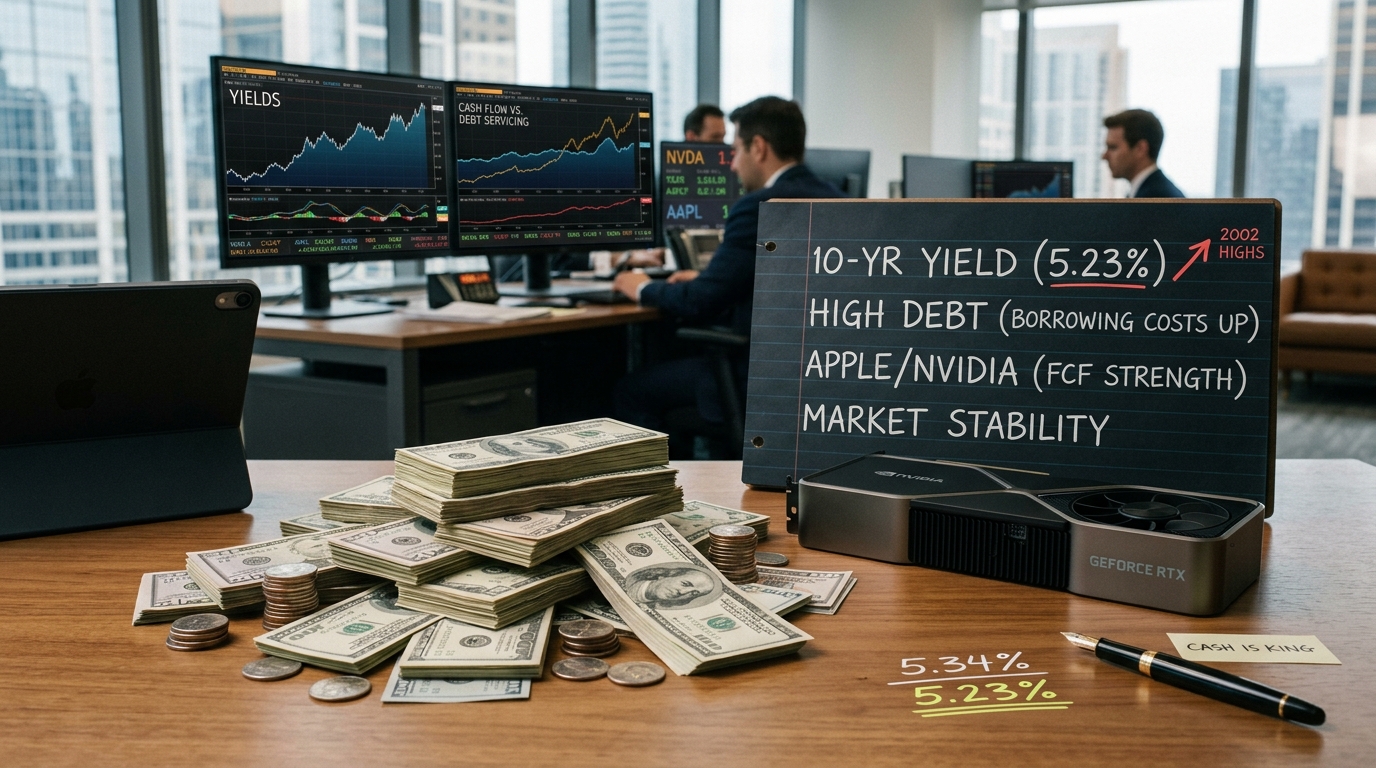
The 10-year Treasury yield hit 5.23% last Friday, its highest level since 2007. On Thursday it briefly touched 5.34%, a level last seen in 2002, before buyers stepped in. For companies carrying heavy debt loads, that move is not abstract: higher yields raise financing costs for businesses and force governments to spend more on debt service. But a handful of tech and healthcare names are structured so that rising rates barely register on their income statements. The divergence is now wide enough to trade.
Market Snapshot
The benchmark 10-year yield has climbed to a roughly two-decade high, fueled by sticky inflation, heavy bond issuance, and an AI-fueled investment boom. Traders now expect additional Federal Reserve tightening risk into 2027. Equity markets have been notably resilient despite rising rates and geopolitical uncertainty, with the S&P 500 still relatively close to recent highs.
Stocks in Focus
Apple (AAPL) is the clearest case. Apple continues to generate enormous free cash flow, giving it substantial flexibility to fund investment, shareholder distributions, and debt repayments without relying heavily on external financing. Apple is also still net cash overall, even with tens of billions of dollars of debt outstanding, and its capex burden is modest relative to peers because manufacturing is outsourced. While Alphabet’s free cash flow turned negative in Q2 2026 as capital expenditure surged to $44.9 billion, Apple’s asset-light model is the opposite story. The rate environment penalizes borrowers. Apple is not one.
Nvidia (NVDA) is more nuanced. The company issued $25 billion of senior unsecured notes in June 2026, its biggest bond offering to date, spanning seven tranches with coupons ranging from 4.25% to 5.625%. That sounds alarming in a 5.3% yield world until you look at what Nvidia generates. Free cash flow was about $48.6 billion in a single three-month stretch. Nvidia also held roughly $65.1 billion of cash and marketable securities as of late July 2026, against debt with an estimated fair value of about $31.4 billion. The borrowing was opportunistic, not desperate. Instead of drawing down cash to fund buybacks, Nvidia leaves that firepower in place and lets debt carry part of the load. For a business compounding far faster than its cost of borrowing, that trade-off is hard to argue with.
Bristol-Myers Squibb (BMY) offers a contrasting healthcare angle. Free cash flow was roughly $12.8 billion, but the balance sheet looks different: leverage is elevated, with debt-to-equity commonly screened at well above 2x because equity has been compressed relative to debt. BMY is up about 22% year to date and yields around 4%, which looks attractive at face value. The risk is that a 2027 Eliquis step-down coupled with a failed or delayed Milvexian result could push annual operating cash flow net of capex toward the roughly $5 billion dividend bill. The FCF exists. The debt load means rate pressure compounds faster than at Apple or Nvidia.
Sector Watch
Morgan Stanley’s Global Investment Committee suggests investors favor stocks, especially high-quality U.S. large-cap companies that generate reliable cash flow. Within defensives, healthcare has seen tailwinds strengthen that may offer relative valuation support, with State Street upgrading the sector to positive given attractive valuations, improving managed care trends, and continued strong biopharma innovation. Healthcare FCF leaders like Bristol-Myers Squibb carry about $12.8 billion in TTM free cash flow, while Cigna’s FCF reached $7.66 billion for the period ending March 2026, up 27.45% year over year.
Risk Radar
The bigger danger is in the middle tier. The largest hyperscalers are now collectively guiding to capex in the neighborhood of $700 billion (or more) for 2026, and reaching those numbers means a big drop in free cash flow, with some companies at risk of slipping into negative territory in certain periods. Analysts have cautioned that the near-term impact could include weaker free cash flow, constrained capital returns, and increased sensitivity to financing conditions, particularly if debt becomes a more meaningful funding source for infrastructure expansion. Companies that need the bond market to fund their AI ambitions are now paying near two-decade-high prices to access it.
The Cheat Sheet
- Top Market Theme: Rising yields are sorting companies into two groups: those whose FCF exceeds their cost of capital and those being slowly squeezed by it.
- Stock to Watch: Apple. Massive ongoing FCF, a net cash position, and a capex model that does not require billions in new borrowing at 5%-plus rates.
- Sector to Watch: Healthcare, where FCF leaders like Cigna and BMY offer yields and cash generation that can hold up even if rates stay elevated into 2027.
- Biggest Risk: Hyperscaler FCF turning negative across more names as roughly $700 billion in combined 2026 capex meets a bond market charging near two-decade-high rates.
- Biggest Opportunity: Nvidia’s roughly $48.6 billion single-quarter FCF versus roughly $25 billion of newly issued notes means it can absorb higher rates almost invisibly while leveraged competitors cannot.
- One Thing to Remember: In a 5.3% yield world, debt-free or net-cash companies do not just avoid pain. They gain market share from rivals forced to redirect cash flow toward interest payments.