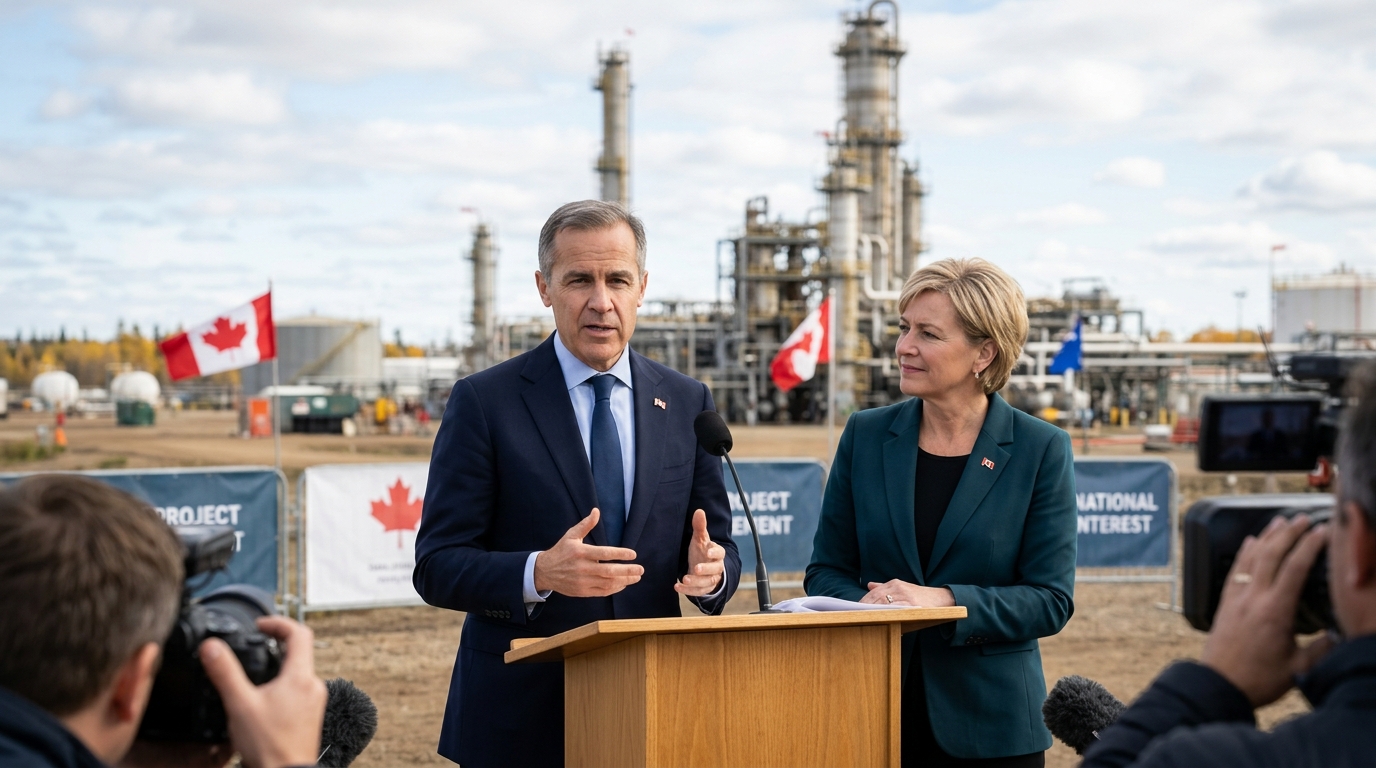
On October 1, Prime Minister Mark Carney stood beside Alberta Premier Danielle Smith in Fort McMurray and designated Pacific Link a project of national interest. The proposed heavy oil export line is up to roughly 1,250 kilometres long, and would be led by a new ownership group involving Trans Mountain Corporation, Alberta’s petroleum marketing agency, and Pembina Pipeline. The project enters a streamlined federal review that targets a conditions document by September 1, 2027, with construction potentially starting as early as that date. The goal is straightforward: today, 90% of Alberta’s oil goes to the United States, and Pacific Link is pitched as a way to export an additional 1 million barrels per day to growing Asian markets.
That is a genuine long-term positive for Alberta oil producers. The problem is the calendar. The independence question of the October 2026 Alberta referendum will be one of ten questions put to voters on October 19. The vote will not itself separate Alberta from Canada. It is framed as whether Albertans want to proceed with the separation process, with any actual departure requiring further legal and political steps. Polls show the separation side trailing, but the uncertainty is real. A May 2026 Angus Reid Institute survey found 60 percent of Albertans would vote no, compared to 35 percent who would vote yes. That 35 percent is not a number any serious investor can wave away.
So who actually benefits from Pacific Link, and who carries the political baggage? Start with the pipeline operators. Trans Mountain Corporation is positioned as a lead in the ownership group, and Pembina says it will contribute development and execution expertise. Enbridge and TC Energy are not named operators here. TC Energy, which announced on September 29 that Coastal GasLink Phase 2 will proceed following LNG Canada’s positive final investment decision, is already occupied with a major gas infrastructure build-out of its own. Enbridge’s leverage to Pacific Link is indirect: higher throughput volumes out of Alberta over the long run, nothing that changes the earnings model next quarter.
For the upstream producers, Suncor and Canadian Natural Resources are the names worth examining. Suncor generates roughly CA$26.9 billion from oil sands and CA$36.8 billion from refining and marketing. It trades around CA$88, with a P/E closer to 13. Canadian Natural is the largest producer of heavy crude oil in Canada, and at roughly CA$65 to CA$70, it carries a P/E around 12. Both are operationally lean. Both would be direct beneficiaries if Pacific Link reaches its 2032 or 2033 target operating date, because a new egress route to Asia lifts the chronic discount that Western Canadian crude takes versus WTI.
But here is the problem with buying either one today, specifically because of Pacific Link. Officials have acknowledged that fast-tracking the project does not guarantee it will ultimately be built. Financing is unresolved. An open season to determine how much pipeline capacity oil producers are willing to contract is not expected until next spring. The pipeline also faces significant Indigenous and environmental concerns, and the federal government has acknowledged that a majority of Indigenous communities consulted were not prepared to support the listing. The regulatory designation is a green light to run, not a finish line.
Layered on top is the political risk. If the October 19 vote produces a surprise, or simply a closer result than polls suggest, the uncertainty premium on every Alberta-headquartered energy stock widens. Markets hate unresolved constitutional questions more than they hate high valuations.
The honest answer to whether any single Canadian oil producer is worth buying on this designation: not yet. Suncor and Canadian Natural Resources are genuinely well-run businesses at reasonable prices, and Pacific Link, if built, would be structurally important for both. The federal government has said the pipeline, combined with optimization of the Trans Mountain system, could reduce Canada’s fixed pipeline dependence on the U.S. from about 82% to 83% of capacity down to 65% to 70%. That matters. It just does not matter on October 2. Wait for the October 19 vote to clear. If Albertans vote to stay in Canada by a comfortable margin, the political cloud lifts and Canadian oil stocks become a much cleaner buy on the Pacific Link thesis.