Dear Friend,
I’m giving you a free stock pick today.
It’s not Tesla. It’s not SpaceX.
It’s the American company sitting on the one metal Elon can’t launch without.
Silver.
Every solar panel on every Starlink satellite is printed with it.
And Elon just filed to launch 1,000,000 satellites.
On January 1st, a deadline Congress set squeezes Chinese suppliers out of America’s solar factories.
American silver becomes the prize.
Dylan’s found the company with a legendary silver mine and a refinery 1 mile away.
He believes this stock takes off January 1st.
See today’s free silver pick here >>
The Buck Stops Here,
Kelly Maguire
Behind the Markets
P.S. It trades on the NYSE, so a few clicks in any brokerage account and it’s yours. Just don’t wait past January 1st.
Cisco Is Selling More AI Than Ever. The Profit Per Dollar Is Falling.
Cisco reports its fiscal first-quarter 2027 results after Thursday’s close, and the headline numbers will almost certainly look impressive. Analysts expect about $18.1 billion in revenue, up about 21.7% from a year ago, alongside earnings of $1.32 per share. The company has beaten Wall Street’s earnings estimate in each of the past four quarters. The question worth asking before those results land is a different one: what does the company actually earn on each dollar of its fastest-growing business?
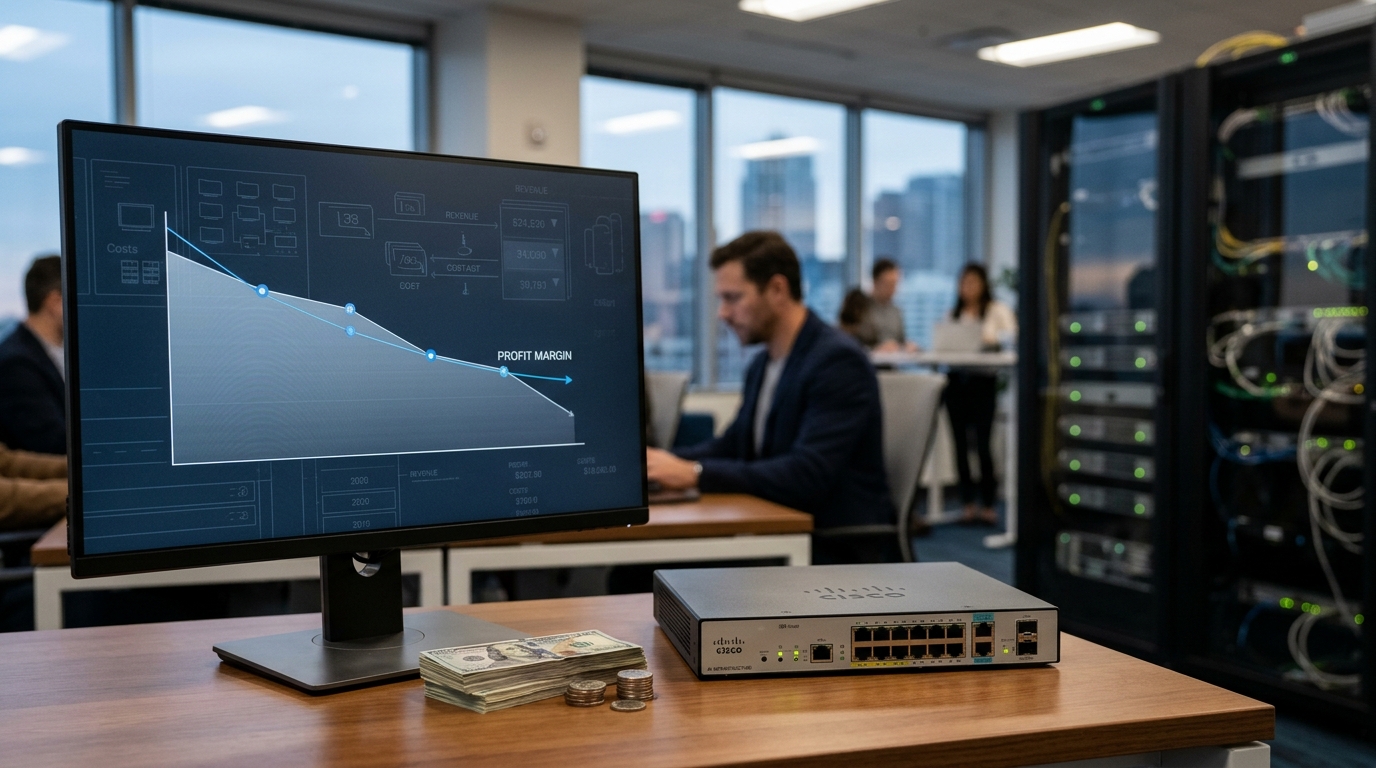
The answer is uncomfortable. AI infrastructure sales to hyperscalers carry gross margins of roughly 30% to 40%, well below Cisco’s traditional networking products. Morgan Stanley cited exactly that dynamic when it downgraded the stock to Equal Weight on November 5, sending shares down about 7.6% in a single session. The bank projects AI revenue reaching $9 billion in fiscal 2027 and $12 billion in 2028, above management’s own $7.5 billion target, and estimates that mix shift dilutes consolidated gross margin by about 1.8 percentage points in fiscal 2027 alone.
The margin compression Cisco faces is not unique to its product mix. Broadcom’s custom silicon division shows how hyperscaler capex concentrates in a handful of chip suppliers, which shapes the pricing power every networking vendor faces when selling into the same buildout.
The demand side is not in dispute. Cisco booked more than $9 billion in hyperscaler AI infrastructure orders in fiscal 2026, roughly 4.5 times the fiscal 2025 level. Networking revenue grew 28% in the most recent quarter. The company’s Silicon One chips and Acacia optical technology are winning design spots inside the data centers being built right now. AI infrastructure revenue went from less than 2% of total sales in fiscal 2025 to roughly 6% in fiscal 2026, and is projected to nearly double again in fiscal 2027.
But fiscal 2026 non-GAAP gross margin fell 210 basis points year over year to 66.3%, and product gross margin dropped 270 basis points to 64.8%. Management guided Q1 fiscal 2027 gross margin to 65%-66%, signaling continued pressure. CFO Mark Patterson has told analysts to expect a slight gross margin headwind through the year as AI volume scales.
Thursday’s report is therefore a two-answer test. First: did orders hold at a level that justifies the $7.5 billion AI revenue target, or did AI infrastructure buying pause after a sprint? Second: is operating leverage absorbing the margin mix problem, or is it widening?
For long-term investors, the structural case remains coherent. Cisco’s own annual report describes AI adoption as fueling a “multi-year networking supercycle,” and the installed base of enterprise equipment due for refresh is real. The stock, trading near $95 after the downgrade, sits at roughly 19 times fiscal 2027 consensus earnings, a reasonable entry point if margin pressure proves manageable.
The wealth-building lesson here applies beyond any single earnings call. When a business transitions into a faster-growing but lower-margin product category, revenue growth and profit growth can run in opposite directions for several quarters. Thursday’s numbers will start to show which trajectory Cisco is actually on.