October 20, 2026
Bonus Content: VZ Is Cashing In as Big Tech Seizes the Ocean Floor
Dear Reader,
What I’ve uncovered hidden in the market is making me more worried than I’ve ever been in five decades …
It keeps me up at night …
You need to see the most important warning of my career …
And one of the most important warnings any American family will receive before the next great financial crisis hits this country.
What is coming could be devastating to anyone with any money in the stock market. It could also be devastating to anyone with a bank account, annuity or money in “safe assets.”
I’m Dr. Martin D. Weiss. I’m a Wall Street Journal, BusinessWeek, and New York Times best-selling author.
And for 55 years I have run Weiss Ratings … the only 100% conflict-free, independent financial rating agency in America.
We are paid by no one we rate. We answer to no one but our subscribers.
And in the 55 years since I issued my first public warning before a financial crisis, I have publicly predicted six major American crashes before they happened.
What I’m seeing now is a $3 trillion problem.
And the biggest danger right now is NOT just another stock market crash.
The biggest danger is NOT only a major bank failure.
Rather, it’s a chain reaction of crashes and failures that could cause a global freeze in the financial markets. And it starts here:
Go here now see the most important warning of my career
Good luck and God bless!
Sincerely,

Martin D. Weiss, PhD
Weiss Ratings Founder
VZ Is Cashing In as Big Tech Seizes the Ocean Floor
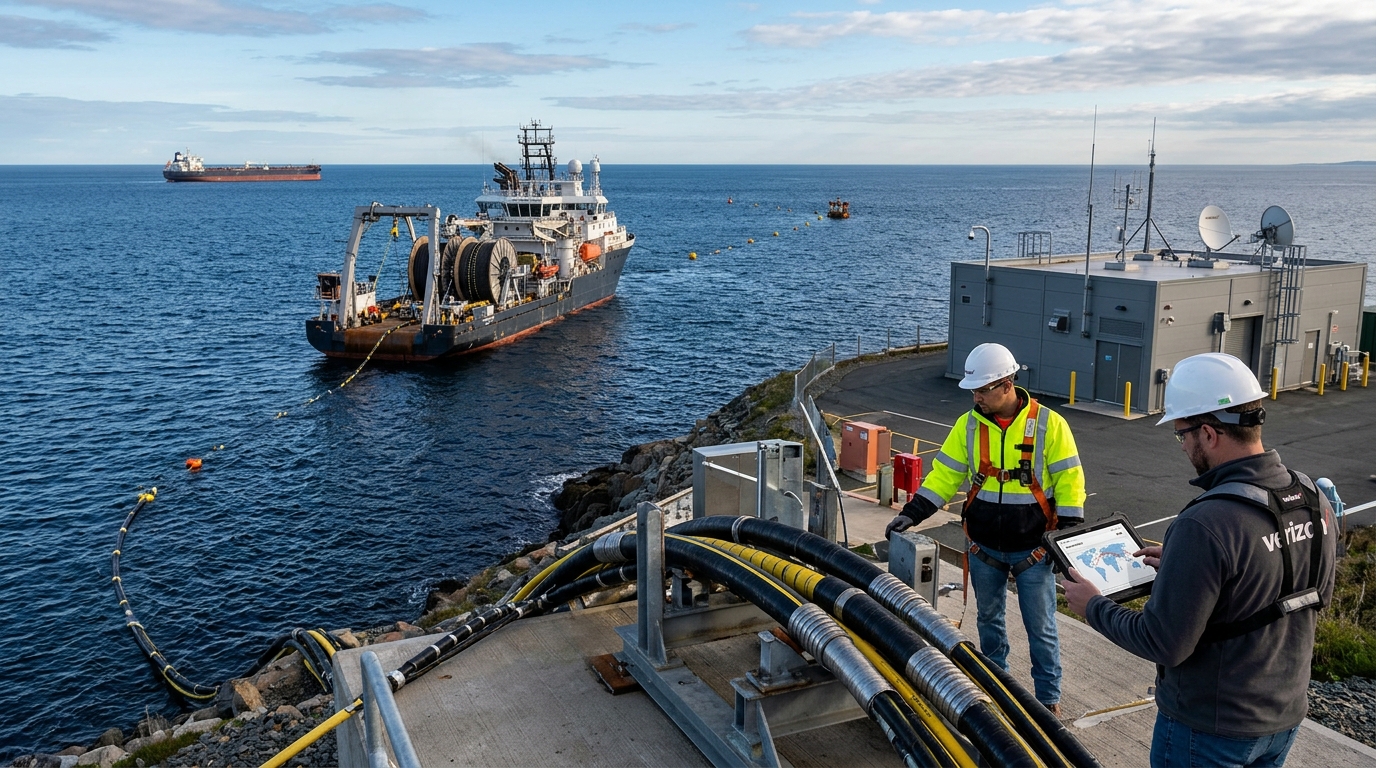
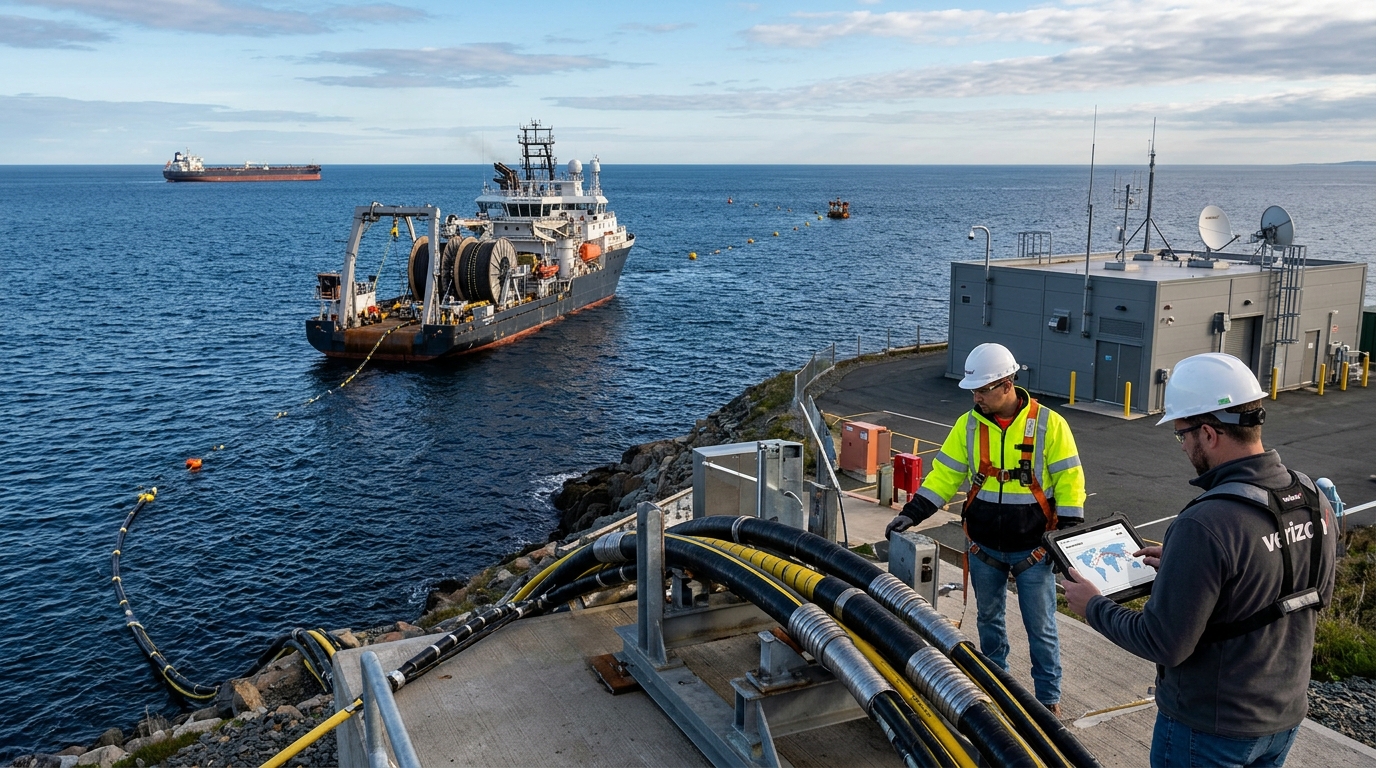
The world’s internet runs on glass buried under seawater. Over 99% of all intercontinental data traffic travels through more than 600 submarine cable systems spanning over 1.5 million kilometers of ocean floor, according to TeleGeography. That figure alone should anchor every conversation about where AI infrastructure money actually goes. Most investors look upward, toward chips and data centers. The real bottleneck is below.
What has changed in 2026 is who controls those cables. Google, Meta, Microsoft, and Amazon now command about 71% of global subsea capacity, up from roughly 10% a decade ago. On the transatlantic route alone, hyperscalers account for over 90% of used capacity, and they are involved in more than two-thirds of all planned deployments. The old consortium model, where a club of telecom carriers pooled capital and split capacity, has cracked. Hyperscalers are no longer content to lease bandwidth; they design, finance, and in growing cases outright own the cables.
For most legacy carriers, that shift is an existential threat. Traditional operators lose their largest wholesale bandwidth buyers when those buyers migrate to private infrastructure. For Verizon specifically, however, the picture looks different, and that distinction matters to investors holding VZ.
Verizon has spent 2026 repositioning itself not as a submarine cable owner competing with Google, but as the physical-layer partner those hyperscalers need on land and at the enterprise edge. In July, CEO Dan Schulman disclosed a $1 billion-plus dark fiber agreement with Google, supplying dedicated capacity across Verizon’s North American long-haul network to serve AI data center interconnects. Schulman flagged additional hyperscaler contracts expected before year-end, with the pipeline projected to generate multiple billions in contracted revenue. Verizon’s $16.0 to $16.5 billion capex range for 2026, confirmed in its SEC filings, is being deployed across fiber expansion and AI corridor infrastructure simultaneously.
The BT joint venture, announced June 29, adds another dimension. Verizon and BT are combining their international enterprise wireline units into a 50/50 venture serving more than 3,000 customers across more than 180 countries, representing approximately $4 billion in combined annual revenue. Verizon pays BT a $625 million equalization payment, and in return gains scaled international reach without carrying the full cost of owning transoceanic infrastructure. The JV leans on third-party and parent-company capacity, including subsea access, rather than requiring Verizon to build its own ocean cables. It is capital efficiency applied to a market most carriers are exiting at a loss.
The subsea investment cycle itself is near a generational peak. TeleGeography estimates the value of submarine systems entering service between 2026 and 2029 exceeds $16 billion, a level the industry has not seen since the 2000-2001 cycle. TeleGeography also projects nearly 40 cable systems will enter service in 2026, representing roughly $6 billion in value.
None of that directly benefits Verizon’s balance sheet. What does benefit it is the secondary demand wave: the terrestrial fiber, the enterprise connectivity layer, the dark fiber corridors that hyperscalers need once their private cables reach shore. That is the market Verizon is building toward, and the BT deal and Google contract together show the strategy is finding real revenue.
The risk is execution speed. Verizon has not reported a Q1 2026 fiber-passings figure of 17.1 million locations in its earnings materials, but it has framed its fiber strategy around materially expanding its footprint, including the Frontier assets. Closing the remaining gap while absorbing the Frontier Communications integration and funding the BT equalization payment tests the balance sheet. Free cash flow reached $6.4 billion in Q2, up 24.4% year over year, which provides cushion. But investors should watch the debt trajectory closely as AI corridor contracts scale.
The ocean floor is no longer a telecom asset. It is a hyperscaler asset. Verizon’s bet is that every private cable still needs a land-side partner. So far, Google is paying for that bet in nine figures.