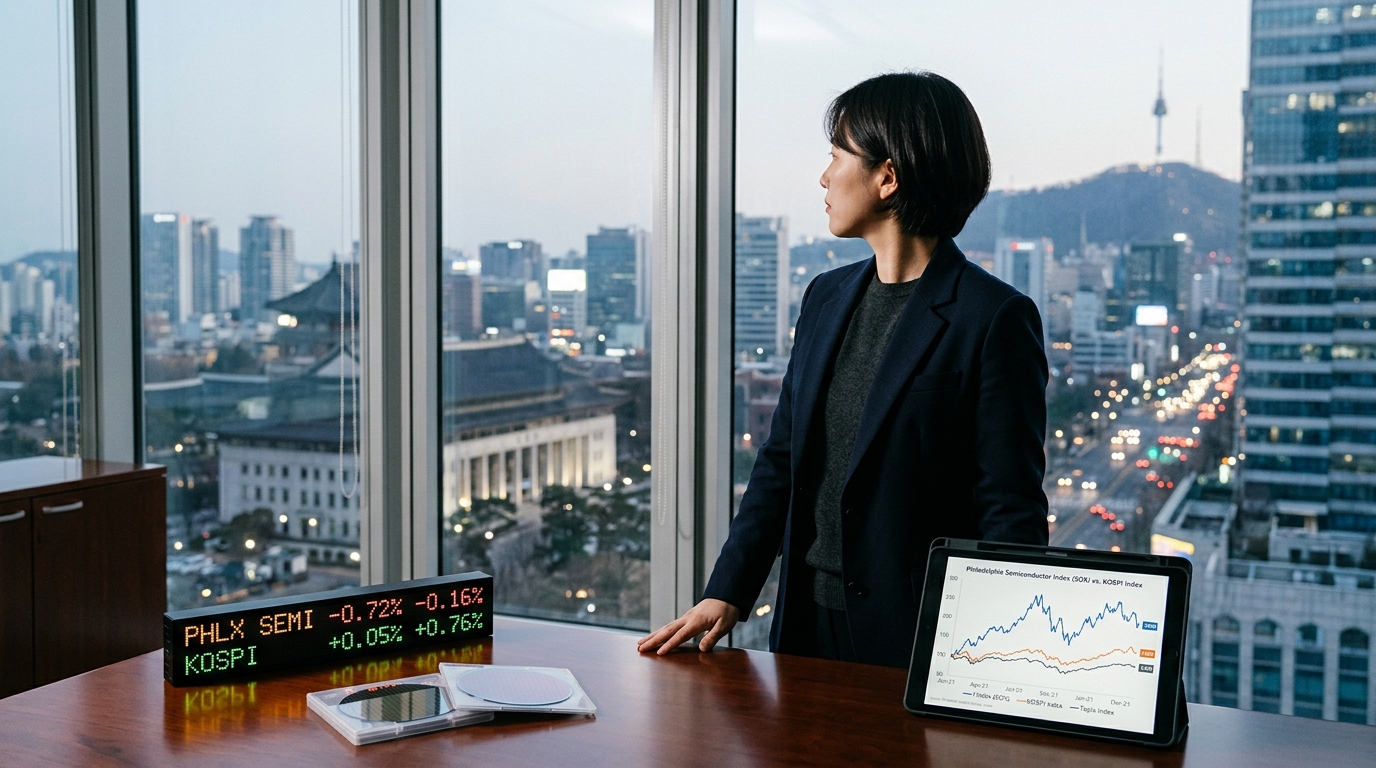
Eighteen years is a long streak to break with a single session of light buying. The Philadelphia Semiconductor Index rose 1.6% on October 19, snapping an eight-session losing streak, its longest since October 2008. During that streak the index fell about 15.7% cumulatively. Markets breathed. Then they looked east, and the relief stopped.
What Actually Moved
Memory chip stocks led the gains in the U.S., with Western Digital up 6.09%. Amazon jumped 4.98% to close at $262.45, after Morgan Stanley named it a top pick following the rollout of a new Trainium software layer aimed at making it easier for developers to run PyTorch workloads on Trainium. The Nasdaq 100 closed 1.2% higher. But the gains faded from their morning highs: the SOX ended up 1.6% after being up as much as about 3.7% earlier in the session, giving back more than half of its intraday high.
Overnight, Asia delivered the verdict. On October 20, the KOSPI closed down 3.73% at 5,552.74, while Japan’s Nikkei 225 fell 1.30% to 64,075.42, with weakness tied in part to semiconductor and AI-related shares. APAC stocks were mostly lower despite the rebound on Wall Street, as the region failed to sustain the AI-led recovery, with chip-heavy markets in South Korea and Japan leading the decline.
Why It Happened
The U.S. bounce was almost entirely technical. HSBC chief multi-asset strategist Max Kettner called it “an incredibly technically-driven market” and said he sees no fundamental catalyst, outside of earnings, capable of calming nerves around AI. Rosenblatt Securities’ Michael James was blunter: “Rubber bands can only stretch so far in one direction before they snap,” he said, noting that “nothing changed between Friday’s close and this morning’s open, other than nothing bad happened over the weekend.”
Korea is wrestling with something technically driven trading cannot fix. The original wound was opened on October 13, when China’s CXMT said it had achieved a 4F² DRAM architecture milestone. The company described a memory-cell architecture that, on paper, could reduce cell footprint versus conventional designs, a direct competitive threat to Samsung Electronics and SK Hynix if it translates into high-volume, high-yield production. Whether the technology works at commercial yields remains unproven, but Seoul investors are not waiting for the footnotes.
What the Market May Be Missing
The split between U.S. and Korean chip prices is not a regional curiosity. It is the market pricing two different risks simultaneously. U.S. chip names are being bought as an oversold bounce in AI infrastructure hardware. The KOSPI is being sold on fears that hyperscalers and other large buyers will use the existence of lower-cost Chinese supply as leverage in memory price negotiations, a pattern that has historically compressed memory margins before it dents volumes.
Those are not the same trade. The American buyer on October 19 was betting on sentiment mean-reversion. The Korean seller on October 20 was responding to a structural competitive threat and a margin squeeze that arrives before any volume loss. Foreign and institutional investors drove the Seoul selloff, while retail buyers were net buyers on the day. Smart money and domestic retail rarely agree on direction by accident.
Where It Shows Up
The divergence concentrates in memory. Over recent sessions, SK Hynix and Samsung have fallen far more sharply than major U.S. peers, reflecting investor concern over both Chinese competition and potential oversupply. Foreign selling has been heavy in Korea in October, adding pressure to index heavyweights. The iShares Semiconductor ETF SOXX, which holds the U.S.-listed names, bounced. The Korean-listed Seoul shares did not. That separation matters: SK Hynix ADRs gained in New York while the Seoul-listed stock fell, which is not a rounding error. It is two markets pricing the same company differently.
Risks and Counterpoints
The bullish case for U.S. chips is not weak. Goldman Sachs upgraded CoreWeave to Buy on October 19, and several Wall Street analysts backed AI capital expenditure fundamentals, helping ease the earlier panic over AI spending peaking. The bearish case rests on whether CXMT’s claims translate into actual yield and volume, and whether pricing pressure on memory is a one-quarter phenomenon or a structural reset.
What to Watch Next
The chip sector’s resilience faces an immediate test with heavyweight earnings from Meta, Tesla, and others due this week. Daishin Securities analyst Lee Kyung-min noted that concerns about the profitability of AI investments have not disappeared, and the market’s recovery has limited sustainability. The level to watch in Seoul is whether Samsung and SK Hynix stabilize on any positive memory pricing data. In the U.S., watch whether Amazon and other hyperscalers confirm or revise AI capital expenditure plans in their upcoming reports. Until earnings answer the AI spending question, the gap between New York and Seoul stays open.