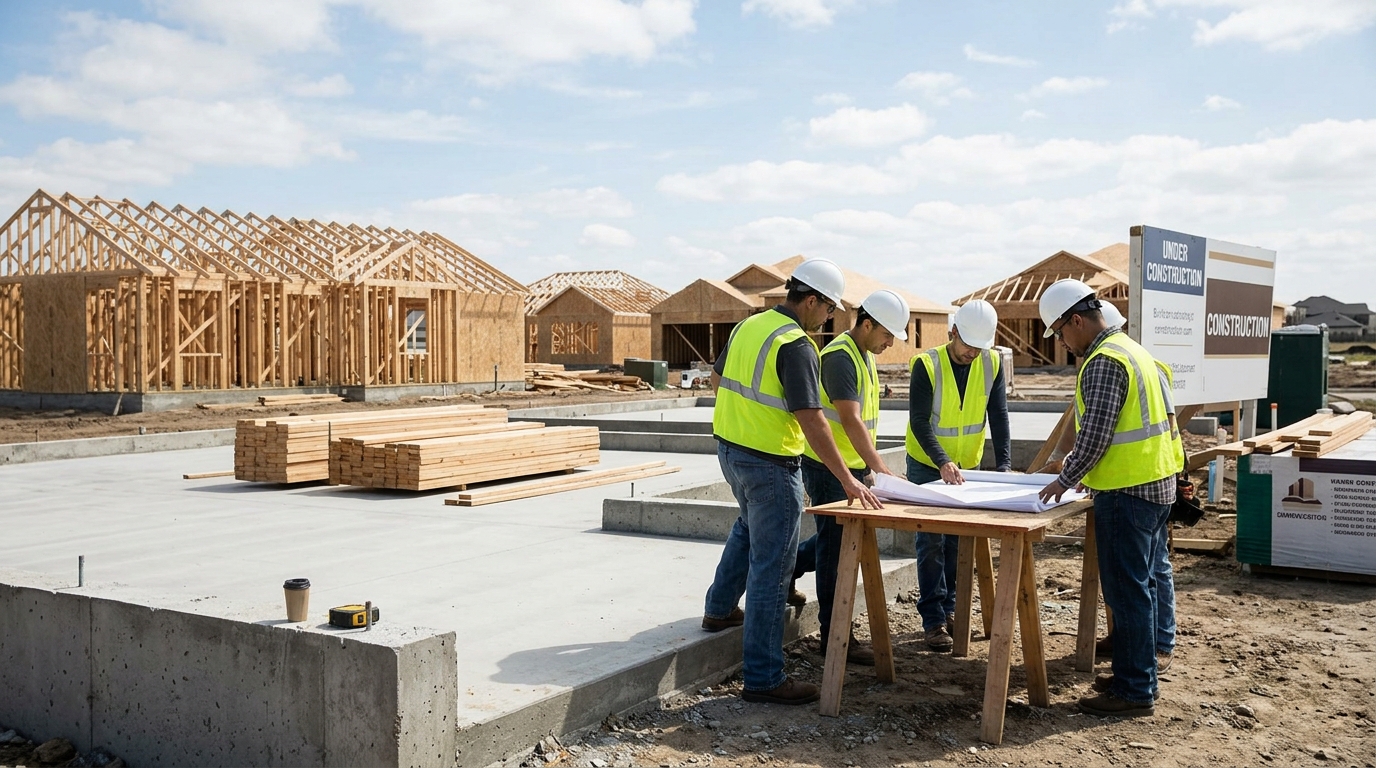
This morning’s 8:30 ET release from the Census Bureau is the most consequential housing data in months, and the market already knows the sentiment side of the ledger is bad. The NAHB’s October Housing Market Index dropped three points to 29, a level not seen since June 2012. The reading came in below the 31 median estimate in a Bloomberg survey of economists. Now September housing starts either confirm the deterioration or offer a narrow reprieve.
The consensus estimate for September starts is 1.31 million units, against August’s 1.275 million. That is the number to anchor every trade idea below. A beat above 1.31M gives homebuilder bulls something to work with. Anything that prints at or below August’s pace removes their last argument.
What the Starts Number Buys
A September read at 1.32M or higher, led by single-family activity, is the minimum needed for a credible bounce in D.R. Horton (DHI), Lennar (LEN), and PulteGroup (PHM). DHI reports fiscal fourth-quarter earnings on October 29, making this week’s housing data a direct read on demand conditions heading into that release. Some major-bank desks have published meaningfully lower starts assumptions for the month, roughly in the 1.25M area. If that view is right, the bounce thesis collapses before it starts.
PHM carries homebuilding revenue of roughly $16 billion. Both regions are exposed to rate-sensitive move-up buyers, so single-family permits matter more than the headline. A strong single-family permits number, above 900K, would carry more weight for PHM than the aggregate starts figure.
The Short Side: BLDR and HD on a Miss
If starts come in at or below 1.25M, the sharpest short opportunity sits in Builders FirstSource (BLDR), not the homebuilders themselves. BLDR has already lost roughly 57% over the past twelve months. The company heads into its October 29 earnings report with analysts broadly looking for year-over-year declines in both earnings and revenue. A weak starts print accelerates the margin pressure story and gives the next analyst downgrade a hard data point to cite. RBC Capital downgraded shares to Sector Perform with a target of $62, down from $88.
Home Depot (HD) is the secondary short. A prolonged housing construction slowdown eventually hits its pro-contractor segment, the division Wall Street has relied on to differentiate HD from a purely discretionary story. A starts miss reinforces that thesis into HD’s next earnings.
The Macro Ceiling
Regardless of what the Census Bureau reports at 8:30, the structural ceiling on homebuilder stocks is clear. In its October 2026 housing outlook, Fannie Mae’s Economic and Strategic Research Group projected the average rate on a 30-year fixed mortgage would reach 7.4% in the fourth quarter of 2026 and average 7.5% across all four quarters of 2027. That represents a substantial upward revision from September, when Fannie Mae expected rates to average 6.8% in the final quarter of 2026 and 6.7% throughout 2027.
The NAHB survey found that 43% of builders cut prices in October, up from 38% in September and 35% in August. The average price cut held at 6% for the seventh consecutive month. Builders are absorbing margin damage to move inventory, not building new supply. That combination, volume concessions plus 7.5% rate forecasts through all of 2027, is what makes BLDR the cleaner short even if today’s headline number surprises to the upside.
Trader’s Action Plan
Watch the single-family starts and permits components, not just the headline. A total starts beat driven by multifamily is noise; single-family above 940K is signal. Builders’ expectations for sales over the next six months already fell five points to 32 in the NAHB survey, so even a modest starts beat is unlikely to revive the forward outlook. DHI at $135 and LEN near $76 are event trades into their respective earnings, not trend reversals. BLDR below $55, heading into its own October 29 report, is where the conviction sits on the short side. Position sizing should reflect the data uncertainty; the Census Bureau’s own confidence intervals on monthly starts regularly span more than 10 percentage points.