Dear Investor,
This is one of the key signs that a big altcoin bull run could be coming (fast)…
When “bad news” hits the market, prices don’t plummet… they soar.
That’s exactly what we saw when the Clarity Act failed to pass the Senate on September 15th.
Prices dipped slightly, but by the weekend, they were higher than they started.
That’s because while the Senate was failing to pass the CLARITY Act, the SEC already had its own crypto framework on the table… open for public comment until October 20th.
And on Friday, the CFTC quietly filed its own crypto rules with the White House budget office.
Two agencies. Two frameworks. Both moving right now.
That gap… between what the headlines say and what’s actually happening… is the most useful thing an investor can find.
Because look at where prices sit while this plays out.
Bitcoin is still below the record it set last October.
Most altcoins are further behind than that.
The rules are being written. The prices haven’t caught up.
I’ve spent years looking for exactly this kind of mismatch:
- KDA: 17,556%
- PRE: 3,900%
- OCEAN: 2,650%
- ALBT: 1,933%
Past performance doesn’t guarantee what happens next.
But it’s why my attention is on one coin trading under $1 right now.
My full report reveals the coin, its ticker, and exactly why it’s currently my #1 crypto under $1.
Normally $97. Right now, $3:
Reveal my #1 crypto under $1 now.
To your massive success in this market during these exciting times…
Bryce Paul
Crypto 101
Adobe Analytics expects U.S. online sales to hit $275.1 billion this holiday season (Nov. 1 to Dec. 31, 2026), growing 6.7% year over year from $257.8 billion in 2025. That is the headline number, and it sounds bullish. Read further into the forecast and a more complicated picture forms: the growth is being financed by the deepest promotions in years, by stretched consumers buying essentials rather than gifts, and by a payment method that shifts purchase risk off retailers entirely.
The backdrop matters. The University of Michigan’s Index of Consumer Sentiment fell to 48.1 in September 2026, its lowest reading in four months and down 15% from January 2026, as rising inflation fears and a deteriorating outlook for business conditions weighed on households. Year-ahead inflation expectations rose to 4.6%, the highest since June 2026, while five-year expectations edged up to 3.4% after holding at 3.3% for three consecutive months. Consumers will spend, but they will wait for the price to drop first.
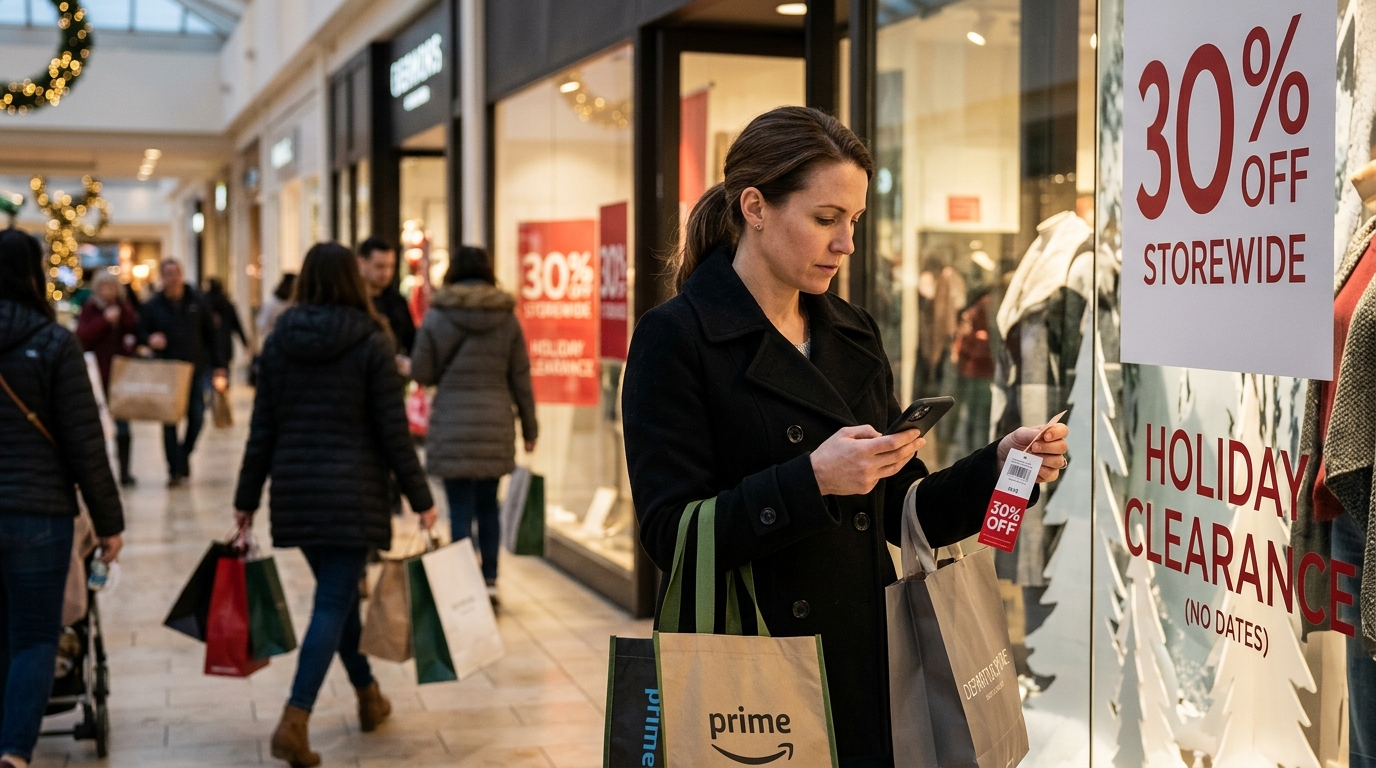
Adobe expects competitive discounts this holiday season, up to 30% off listed price during Cyber Week. The second-biggest online shopping day of the season will be Black Friday at $12.9 billion, up 9.2% year over year, driven in part by the biggest discounts for categories such as TVs, apparel and appliances. Gross merchandise volume is growing. Margins are the question.
This is where the retailer mix matters enormously. Amazon and Walmart carry private-label and owned-brand inventory that can absorb a 30% markdown far more gracefully than a specialty chain paying full wholesale cost. Target occupies middle ground. Its owned brands in apparel and household basics give it some protection, but its higher exposure to discretionary categories makes margin defense harder in a deal-driven environment. Best Buy sits in the most exposed position: electronics, where discounts are expected to peak at roughly 30% below listed prices during Cyber Week, with the deepest markdowns concentrated in electronics and computers. Volume growth at Best Buy is essentially guaranteed. Whether any of it converts to profit is not.
The more durable investment insight inside Adobe’s data involves what consumers are actually buying. While consumers have historically embraced holiday deals to buy gifts or gadgets, many are taking advantage of discounts to stock up on essentials. During Cyber Week, online sales of personal hygiene products are expected to jump 150% and clothing basics by 210%, with baby products up 113%, pet products up 93%, and household cleaning items up 49% (all versus average September 2026 sales levels). That spending pattern rewards retailers with dominant positions in everyday essentials. Walmart’s grocery and consumables business, and Amazon’s subscription and private-label reach, are structurally better positioned than gift-oriented or electronics-focused competitors when the consumer is buying detergent on discount rather than a television.
Then there is payment infrastructure. Buy Now Pay Later is expected to drive $21.3 billion in November and December, up 6.6% year over year, with usage set to spike on Cyber Monday where BNPL will account for $1.09 billion in a single day. BNPL providers collect merchant fees regardless of what the retailer marks down. The deeper the discount, the more consumers reach for installment financing, which is precisely when payment platforms collect their fees most reliably.
The Prime Day event in October (which began in 2021) has become an industrywide e-commerce moment driving significant consumer spend in advance of the holiday season. Adobe expects $95.8 billion will be spent online in October 2026, up 8% year over year. The season no longer starts November 1. It starts now. Retailers who cannot fund promotions across both October and the traditional Cyber Week period are competing at a structural disadvantage against Amazon and Walmart, who have the balance sheets to sustain two months of aggressive pricing.
The wealth-building lesson here is straightforward. A record dollar amount of online spending is not the same as a record amount of retail profit. When consumers shop primarily on price, the winners are the platforms with the lowest cost structures, the broadest owned-brand exposure, and the checkout infrastructure that gets paid either way. In a 30%-off holiday season, size and scale collect the margin that discounts compress everywhere else.