September 24, 2026
Sellers kept most of their shares. New buyers got none of the IPO cash. That is what the price was telling you all morning.
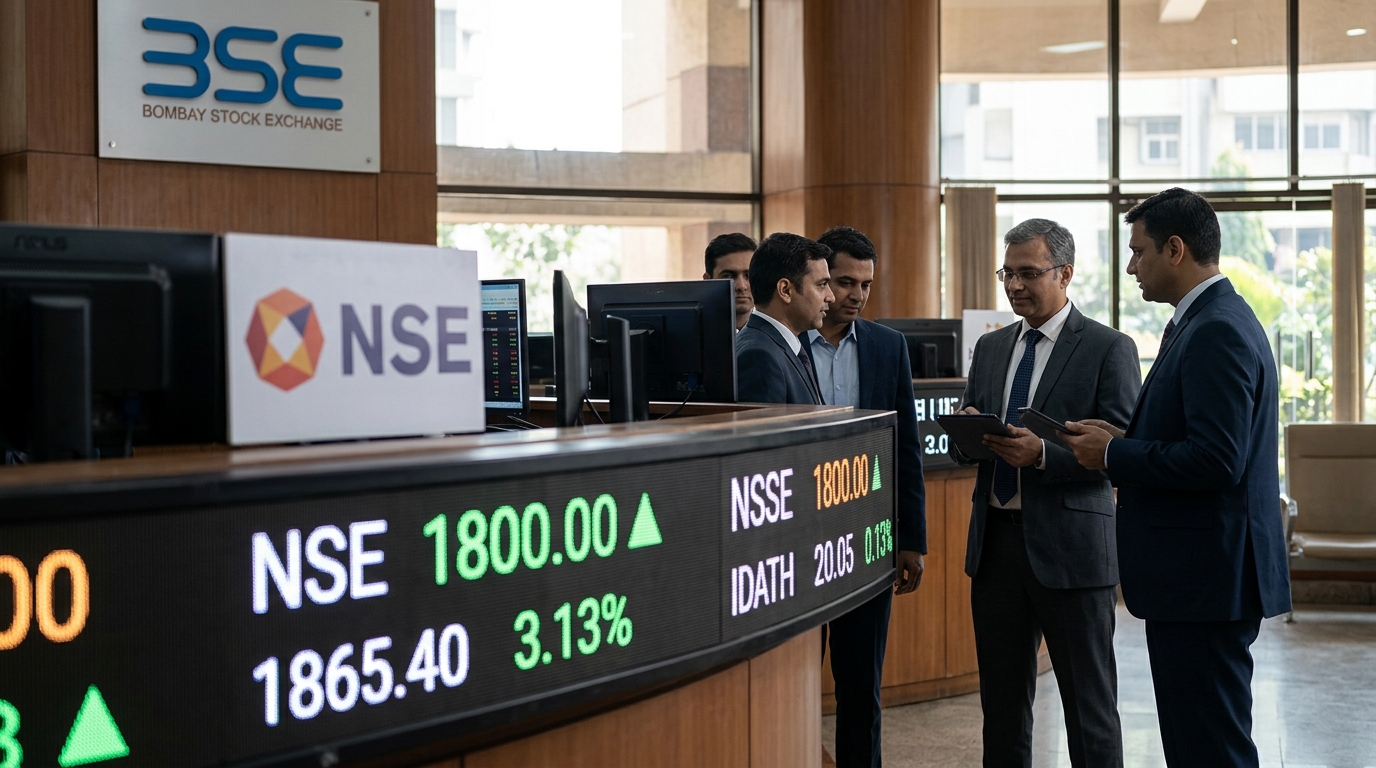
India’s National Stock Exchange listed on the BSE this morning and barely moved. Shares made a flat debut, listing at a premium of 0.84 percent over the ₹1,785 issue price. By mid-morning the stock had climbed further, trading at ₹1,865.40, a gain of 3.13 percent. Given that the book closed at 5.71 times subscribed, with bids for 50.58 crore shares against 8.86 crore on offer, the muted open surprised some. It should not have surprised anyone who understood how this deal was structured.
The AI Boom’s Most Profitable “Tollbooth” Stock?
A little-known company is quietly building what may be the closest thing to a virtual monopoly the AI era has ever seen.
Whitney Tilson – the man CNBC calls “The Prophet” – calls it the world’s most profitable tollbooth. One billionaire put more than half his $9 billion fund into it.
Right now it’s trading at a rare discount…the same kind that’s previously turned $10,000 into $55,000…in just over 12 months.
An Offer for Sale Changes Everything
This is a 100 percent Offer for Sale. That means NSE itself receives no proceeds; every rupee raised goes to existing shareholders exiting their stakes. NSE is not owned by a single entity. Its shareholder base includes domestic financial institutions, banks, insurance companies, and other organisations that have held stakes for years. Through the OFS, these existing shareholders are choosing to sell a portion of their holdings rather than the company raising fresh capital.
The practical consequence: because the deal was entirely an offer for sale, NSE didn’t raise fresh cash, so the next chapter hinges more on broadening revenue beyond derivatives than on funding expansion. For buyers in the IPO, enthusiasm in the subscription book does not translate into a stronger balance sheet at the company they just bought into. What they own is the existing business, unchanged. That distinction is what the flat open was pricing.
Of the 20 institutional investors that participated in the OFS, nine were foreign institutional investors who collectively owned 15.96 percent of NSE before the IPO. The other 11 were domestic investors. Together they owned a 36.82 percent stake and offered shares equivalent to a 5.11 percent stake through the OFS. Several larger institutional investors made only limited reductions to their holdings. Sellers keeping most of their position is a reasonable signal of long-term confidence. It also means supply could return.
World’s Largest Investors Are Moving Their Money (Not Into AI)
While the media distracts you with stories about the next big AI IPO… The world’s largest investors are moving their money into one asset – at the fastest pace in a generation. This asset has crushed the S&P 500’s return over the past 12 months… More than TRIPLED the S&P 500’s return in 2025… and has outperformed the S&P 500 over the past 25 years by more than 1,100 percentage points. According to one Wall Street veteran, with over 40 years of professional investing experience… the biggest gains could be still ahead. That’s why he’s urging you to make one money move now.
The Valuation Asks a Real Question
At the upper end of the IPO price band, NSE is valued at around 42.9 times earnings, placing it among the most richly valued exchange franchises globally. U.S. exchange companies generally trade at lower price-to-earnings ratios than that. NSE is asking investors to pay a premium multiple for a business that, in fiscal 2026, saw profit fall.
FY26 shows the risk embedded in this valuation. Revenue from operations fell a little over 3 percent and profit fell about 15 percent after derivatives activity cooled. Transaction charges remain the dominant driver of operating revenue, and activity has cooled since 2024 as regulators tightened rules, taxes rose, and traders adjusted to market-structure changes.
The bull case rests on India’s structural growth. NSE was the world’s largest exchange by equity-derivatives contract volume in FY26 and a leading venue by cash-equity trades. Profitability is also strong by global standards, with margins and returns that screen well versus many listed exchange operators. That margin profile is genuinely superior to several global peers, and the concentration risk is the trade-off.
“Market Wizard” Who Made Hundreds of Millions for Clients Reveals Two-Rule Strategy
Trading legend reveals how any American can go for their first $1,000 using his simple two-rule system.
What Long-Term Investors Should Watch
Owning exchange infrastructure is one of the most durable wealth-building positions in finance. The question here is price and concentration. Three things to monitor: first, whether SEBI imposes further restrictions on weekly options, which remain the engine of NSE’s revenue. Second, how quickly the company can expand into data licensing, index products, and technology services, the diversified revenue streams that give Nasdaq and LSEG their more stable earnings. Third, whether India’s demat account base, which stood at about 220 million by January 2026, continues to deepen engagement with exchange-traded products.
A 5.7 times oversubscribed book and a flat open are not contradictory. They tell the same story: this is a high-quality business that insiders wanted to own, priced at a level that leaves new buyers with little margin for error. In an OFS, the seller’s confidence in India’s capital markets and their own need for liquidity can coexist. The buyer has to decide whether the growth story justifies paying one of the most expensive exchange multiples on earth for a company that keeps none of the IPO proceeds.