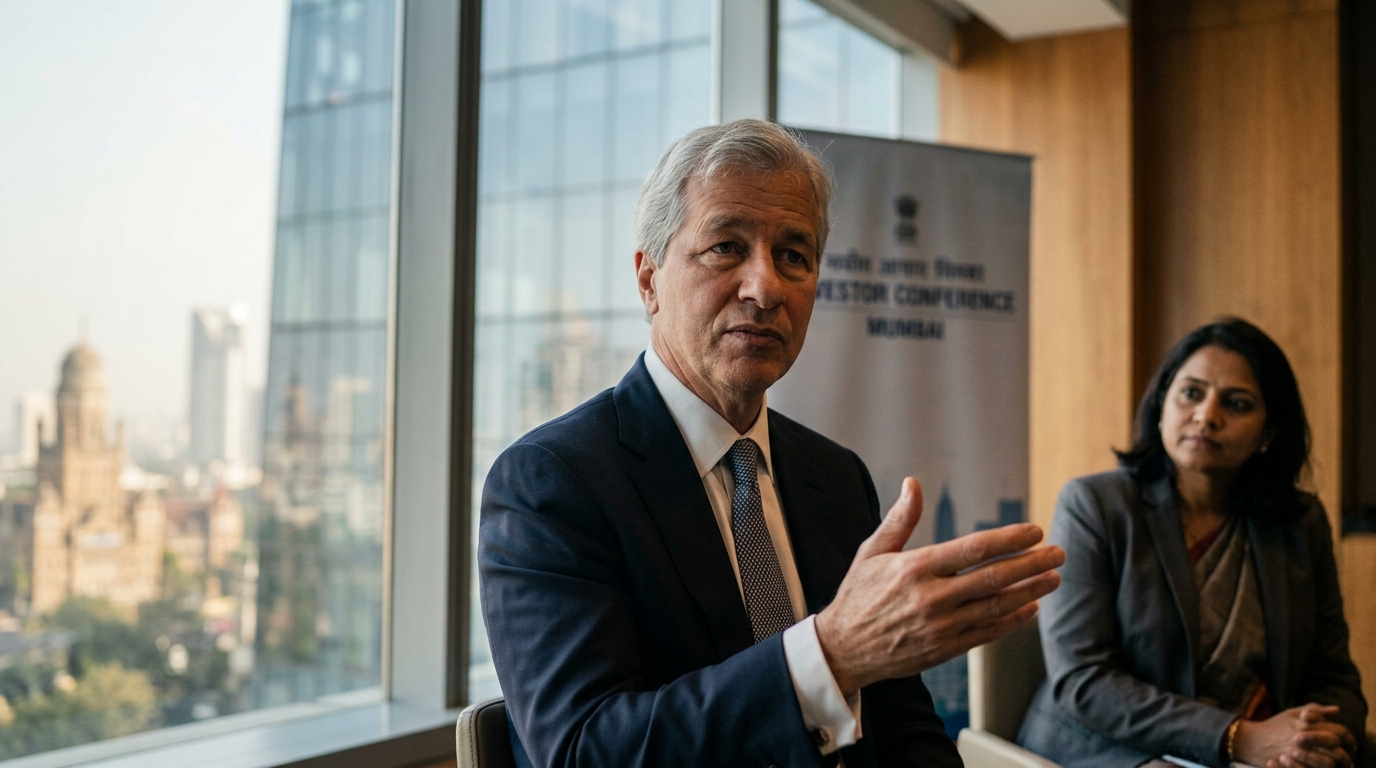
Jamie Dimon flew to Mumbai this week for the 11th J.P. Morgan India Investor Conference, met with Finance Minister Nirmala Sitharaman, and used the occasion to say publicly what many global fund managers only say privately. Global investors remain broadly positive about India’s prospects, though inconsistent application of tax rules remains a concern.
“Most investors probably have very positive views on long-term investment in India, but they worry about the inconsistent application of taxes,” Dimon said in an interview with The Economic Times. “I get a lot of complaints from companies about paying more tax on a deal than they expected.” That is not a fringe complaint. It is the single most recurring friction point foreigners cite when weighing India against other large emerging markets.
Foreign investors have long raised concerns about India’s high and inconsistently applied taxes, including policies they say are not aligned with global norms. Addressing some of those concerns, the government in June scrapped long-term capital gains tax on foreign institutional investors’ investments in government securities, effective April 1, 2026, and the RBI expanded the Fully Accessible Route for government bonds. Progress, in other words, but not resolution. There is still room for improvement, particularly around regulation, consistent taxation and policy certainty, Dimon said. India also has considerable scope to deepen its capital markets, he added.
The Bigger Trend
Dimon’s complaints land against a genuinely strong macroeconomic backdrop. India’s Economic Survey projected real GDP growth of 7.4% for fiscal year 2025-26 (an estimate, not a final outcome). Goldman Sachs Research expects India’s real GDP to grow 6.9% year-on-year in 2026 and 6.8% in 2027. That growth rate, sustained over years, is exactly what long-term investors are paying for when they buy Indian equities.
The tension Dimon articulates is not new, but his platform amplifies it. Wall Street is competing aggressively for India’s deal flow. JPMorgan itself has pointed to reforms that have increased domestic participation in India’s equity markets, even as it highlights the market’s biggest structural flaw.
The Investment Case: How Much India, and Through What?
For most U.S.-based portfolios, the practical question is not whether India deserves a place but how large that place should be and which vehicle carries the least friction.
The iShares MSCI India ETF (INDA) seeks to track an index composed of Indian equities and offers a way to express a single-country view and gain targeted exposure to companies in India. The fund holds 165 companies spanning India’s equity market, from financial giants like HDFC Bank and Reliance Industries to industrial and technology firms, with about $6.9 billion in net assets and a 0.61% expense ratio. With financials comprising about 31% of holdings and consumer discretionary about 12%, INDA essentially bets on India’s growing middle class and expanding credit markets.
The return record is honest about the risk. INDA returned 22.41% in 2021, fell 9.38% in 2022, recovered 17.49% in 2023, gained 8.99% in 2024, and returned 2.47% in 2025 (NAV total returns). That volatility is not a bug unique to the ETF. It reflects the same regulatory and tax unpredictability Dimon described from a conference stage in Mumbai.
Building Wealth Around This Idea
A 3-5% allocation to India-focused equity exposure is a reasonable starting point for a diversified long-term portfolio, enough to capture secular growth without making one country’s policy decisions a portfolio-level event. INDA is the most liquid single-country option. Investors who want broader emerging market diversification alongside India exposure can access it through broader EM funds where India has grown to become a significant weight.
The time horizon matters more here than in most developed-market positions. Dimon’s tax friction complaint is real, but the Indian government has already moved, scrapping long-term capital gains tax on foreign institutional investors’ investments in government securities (effective April 1, 2026) and expanding the Fully Accessible Route for government bonds in the past few months. That direction of travel is more important to a five-year thesis than any single year’s regulatory uncertainty.
Risks to Monitor
Tax unpredictability is the headline risk, but it is not alone. Foreign companies often have a hard time competing in India because they are not allowed to, Dimon noted, and as a result India attracts less foreign direct investment than its growth rate might otherwise suggest. Currency risk is real: a weakening rupee erodes dollar-denominated returns even when Indian stocks rise in local terms. And single-country ETFs concentrate political risk in one government’s policy decisions.
Daily Wealth Takeaway
The most durable wealth-building insight from Dimon’s Mumbai trip is this: strong economic growth and investable equity markets are not the same thing. India has the former in abundance. The latter depends on policy predictability that is still a work in progress. Position sizing, not avoidance, is the right response. Own enough to benefit when the story matures further, not so much that a tax ruling or regulatory reversal forces a decision at the wrong moment.