September 6, 2026
Bonus Content: Pharma Pricing Now Covers 89% of the Market. Here Is What It Means for Your Dividend Checks.
Elon Musk recently posted something that stood out.
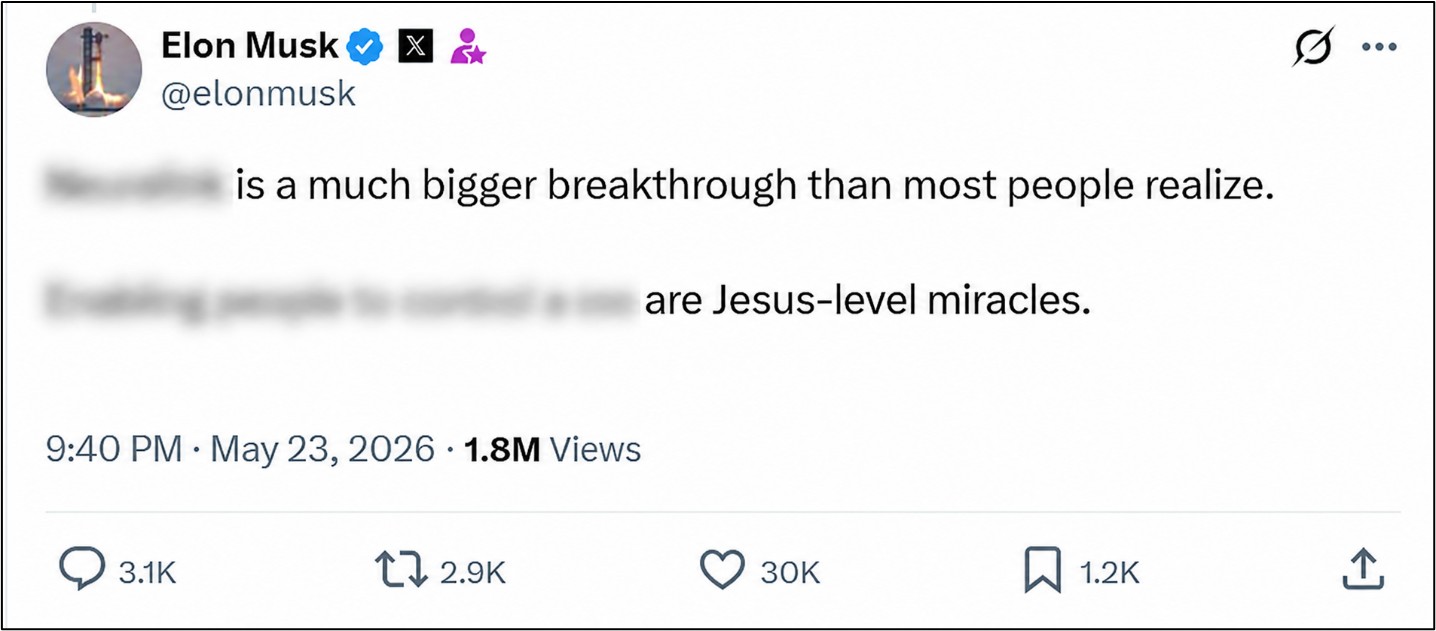
Most readers took it as another headline from one of the world’s most closely watched executives.
Wall Street veteran Matt McCall read it differently.
He saw a signal pointing toward a major venture Musk has been quietly developing since 2016.
This is not another SpaceX project.
It has nothing to do with electric vehicles.
And it is not a conventional artificial intelligence program.
It is an entirely new application of AI — one that moves the technology beyond computing and into a distinct industrial category.
Musk has spent years on the underlying technology: filed patents, built specialized equipment, and assembled a dedicated team at a private facility in Fremont, California.
Institutional capital is now moving in.
Nvidia has already backed 11 companies in this emerging field. Google, Apple, Amazon, Microsoft, Meta, and Tesla are allocating capital here as well.
See why the largest names in technology are positioning in this sector.
Matt believes the post may indicate this technology is approaching a commercial inflection point.
He has identified one small-cap public company that sits at the center of this buildout — still largely under-covered by the broader market, yet Nvidia has already taken an eight-figure stake in it.
Matt has November 14th marked.
A scheduled event in Washington on that date could bring significantly wider attention to this sector and the companies inside it.
As broader market awareness of Musk’s build catches up, this company’s current under-the-radar profile may not last.
[Read the full briefing ahead of November 14th.]
To your wealth,
Stephen Prior, Publisher
Monument Traders Alliance
P.S. The post is public. The company Matt has identified behind it remains largely undiscovered by the broader market.
See what Matt believes Musk may be preparing to bring into the open.
Pharma Pricing Now Covers 89% of the Market. Here Is What It Means for Your Dividend Checks.

The most-favored-nation pricing regime is no longer a large-cap experiment. The administration has now reached drug pricing deals with 26 pharmaceutical companies, including Pfizer, Eli Lilly, and Novo Nordisk, as part of its most-favored-nation policy. The agreements cover 89% of the branded drug market. The nine companies added on August 31 were mostly midsized names: Alcon, Astellas Pharma, BeOne Medicines, BridgeBio, CSL, Kyowa Kirin, Sun Pharma, Teva Pharmaceuticals, and UCB. The policy now touches generics, specialty biologics, and essential medicines alike.
The Bigger Trend
The agreements are for so-called most-favored-nation prices, meaning that Medicaid will pay prices tied to what other countries pay. A 2024 RAND Corp. analysis using 2022 data found that U.S. prescription drug prices averaged nearly 2.8 times those in comparison countries, while brand-name drug prices were more than three times as high after accounting for estimated rebates. Closing that gap has been the stated goal all along. What changed on August 31 is that the program now has enough industry coverage to function as a structural floor, not a headline initiative.
That pricing gap has long been one reason institutional investors have treated large-cap pharma with caution — but it is not the only one. healthcare sector’s cheapest relative valuation in decades and what it signals for investors examines how persistent policy uncertainty has compressed multiples across the sector to levels rarely seen, creating a backdrop that makes the current pricing agreements land at an unusually interesting entry point for income-oriented portfolios.
The nine new manufacturers committed to invest at least $19.6 billion collectively in U.S. manufacturing, and several companies are donating active pharmaceutical ingredients for key products to the Strategic Active Pharmaceutical Ingredients Reserve to reduce reliance on foreign nations. In exchange, the companies receive relief from pharmaceutical tariffs. That trade shapes the long-run competitive landscape as much as the pricing terms themselves.
That tariff relief does not exist in isolation — it is one piece of a broader and rapidly shifting trade architecture that affects every importer in the pharmaceutical supply chain. three simultaneous trade actions rewriting import rules for American pharmaceutical and goods importers provides the wider context for understanding how durable that relief is likely to be, and what a reversal could mean for companies that have structured manufacturing commitments around it.
The Investment Case: Dividend Stocks in a Priced World
Income investors who own Pfizer or Amgen for yield need to hold two things in their heads at once. Pfizer has already absorbed the policy into its numbers: the company reaffirmed full-year 2026 revenue guidance of $59.5 to $62.5 billion and adjusted diluted EPS of $2.80 to $3.00. Amgen, meanwhile, beat second-quarter earnings estimates, with quarterly revenue rising 10% year over year to $10.1 billion. Neither company’s dividend looks endangered today, but neither has unlimited pricing runway going forward.
Pfizer’s guidance stability is reassuring, but the revenue picture for large mRNA-platform manufacturers is being shaped by more than pricing policy alone. how Moderna’s 177% rally on undisclosed clinical data unfolded and then reversed offers a close look at the volatility that can accompany pipeline catalysts in this space — a reminder that even well-capitalized dividend payers carry event risk tied to their next-generation programs.
The more interesting angle is what the policy does to health insurers and pharmacy benefit managers. By allowing patients to bypass traditional PBM middlemen and access most-favored-nation pricing directly from manufacturers, the TrumpRx platform threatens the traditional rebate-driven profit model. CVS responded by adapting rather than resisting: CVS announced it would accept TrumpRx discount cards across its 9,000 retail locations, prioritizing pharmacy foot traffic and dispensing fees over the protection of its Caremark PBM’s rebate spread. That is a genuine strategic pivot, and its long-term effect on earnings is still being priced in.
CVS has paid cash dividends every quarter since becoming a public company. The quarterly payout now stands at $0.665 per share, or $2.66 annualized, with a yield more than twice the S&P 500 average. Cigna raised its quarterly dividend to $1.56 per share in early 2026, an increase from the 2025 cash quarterly dividend of $1.51 per share. Both payouts look intact for now. But key risks include ongoing PBM regulation, medical cost inflation in stop-loss and specialty drugs, and the earnings step-down associated with the shift to a rebate-reduced model.
Building Wealth Around This Idea
This is not a moment to abandon dividend-paying pharmaceutical and health-insurance names. It is a moment to understand which ones are running toward the new pricing environment and which are still negotiating with it. CVS has moved early toward transparent cost-based models. Cigna’s Express Scripts reached a settlement with the FTC and is under a more fee-based, delinked structure in parts of its book. Some critics note that after most-favored-nation deals, companies often raise prices in other countries so that the prices the U.S. compares to will be higher over time. That dynamic could soften the revenue impact for large branded-drug manufacturers if it holds.
Position sizing matters here more than stock selection. A concentrated bet on any single pharma dividend payer carries policy risk that a diversified allocation across large-cap manufacturers, generic specialists like Teva, and vertically integrated health services companies like CVS does not.
Risks to Monitor
Trump’s requests for Congress to enact legislation to make MFN pricing mandatory has run into headwinds from pharmaceutical lobbyists and some lawmakers. That means the agreements remain voluntary and theoretically reversible under a future administration, which is itself a risk worth pricing into any long-horizon thesis. On the insurer side, regulatory and reimbursement uncertainty for the PBM and retail pharmacy businesses remains the key risk and does not disappear with the latest drug pricing news.
Daily Wealth Takeaway
When a policy regime shifts from targeting a handful of household names to covering nearly the entire industry, the investment story stops being about which companies signed and starts being about which business models survive the transition intact. The dividend checks from the strongest players in this space are not in immediate danger. The rebate-driven fee structures that once padded those earnings quietly are.