September 1, 2026
Bonus Content: Your Electricity Bill Is Already Part of the AI Data Center Fight
Editor’s Note: What if you could claim a stake in both OpenAI and Anthropic’s IPOs… with just $200? What if I said you don’t even have to wait for them to go public? Follow the link below to see the details from former IPO insider Jason Bodner – the man who spent nearly two decades helping IPOs go-to-market.
After SpaceX’s public offering, I know many of you might feel skeptical about investing in IPOs.
SpaceX has already experienced losses as high as 50% since its peak…
And despite all the hype, it has ended up crushing many ordinary investors.
So what I’m about to say might shock you…
But the reason why that happens is because virtually everyone invests in IPOs the WRONG WAY.
My name is Jason Bodner, I was an IPO insider on Wall Street for nearly two decades.
I helped IPOs go to market by connecting them with big institutional investors right before they went public.
During my time, I discovered a way to potentially make six-figures from the biggest IPOs on the planet…
And that’s not some theoretical number, I’ll show you exactly how I did it in the past right here.
The truth is…
This upcoming surge of AI IPOs, including OpenAI and Anthropic, is the biggest IPO wealth wave in U.S. history.
Barron’s estimates that it’s a $4 trillion dollar IPO wave.
To put that in perspective…
That’s big enough to cut a $24,000 check to every tax paying citizen in America.
Look, I understand if SpaceX’s IPO has you skeptical…
Your doubts are 100% justified.
But if you let fear and uncertainty control your decisions now…
You could miss out completely.
Please, I urge you, for the sake of your financial future…
Take the next few minutes and hear what I have to say…
It may just be your ticket to a fruitful retirement.
Click here to view my latest presentation.
Regards,
Jason Bodner
Founder, Outlier Alpha
Your Electricity Bill Is Already Part of the AI Data Center Fight
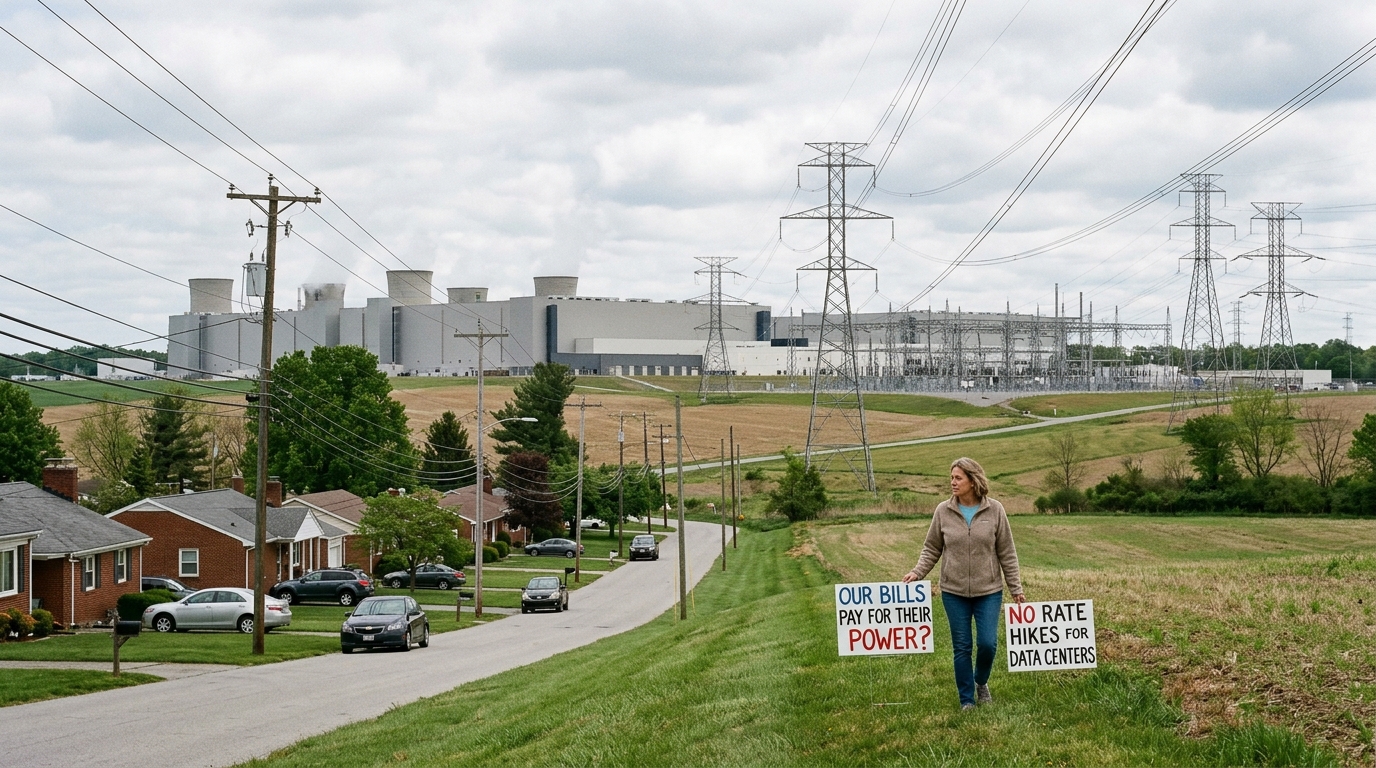
Wall Street has started naming it explicitly in risk disclosures. Several banks have recently cited political opposition as a risk to the entire AI sector. The flashpoint this week came from X’s safety team, which identified a suspected Chinese bot network amplifying America’s data center revolt, with roughly 200 accounts posting content on how AI strains the electricity grid and increases utility prices, along with cartoons depicting data center operators enriching themselves at the public’s expense. The influence operation grabbed headlines. But the underlying revolt it was boosting is entirely real, and it matters far more to investors than the bots do.
At least 75 data center projects worth approximately $130 billion were blocked or delayed in a single quarter, roughly matching the scale of all of 2025 in just three months. The quarter reflected a structural shift rather than a cyclical spike: communities have internalized an opposition playbook, legislative sessions introduced formal regulatory uncertainty, and the number of active opposition groups more than doubled across 49 states. Legislative pushes for moratoriums ballooned in Q1 2026, with proposals introduced in 14 states, and Senator Bernie Sanders and Representative Alexandria Ocasio-Cortez introducing a federal version.
The central grievance is money. Specifically, whose money.
Under traditional utility ratemaking, infrastructure costs can be spread across all customers, which means residential households could face higher electricity bills to support the power infrastructure required for data centers, with those costs passed on to ratepayers. That is not a theoretical concern. One Virginia homeowner received a $281 electricity bill in January 2026, a massive spike from roughly $100 the prior month, and worries his rates will keep climbing as AI data center demand grows. Goldman Sachs reported that electricity prices had already increased 6.9% year-over-year as of February 2026 and believes prices will continue rising as AI facilities increase their demand.
The hyperscalers at the center of this fight are not backing down. Google, Amazon, Microsoft, and Meta collectively plan to spend $725 billion on capital expenditures in 2026, up 77% from last year’s record $410 billion. Amazon alone announced $200 billion in capital expenditures for 2026, the bulk aimed at AWS data centers, up from $96.5 billion spent in 2025. That scale of investment requires permitting, power connections, and community approval across dozens of jurisdictions simultaneously. When communities say no, that capital either sits idle or migrates elsewhere, concentrating pressure on fewer willing locations.
The policy response is moving, but slowly. In March 2026, President Trump announced a Ratepayer Protection Pledge, under which hyperscalers including Amazon, Google, Meta, and Microsoft committed to building or buying their own power and covering the cost of all grid upgrades required for their facilities. The enforceability of those commitments remains unclear, given the initiative’s voluntary nature. New Jersey moved further, passing legislation on June 30 requiring data centers consuming 50 megawatts or more to carry full infrastructure costs rather than shifting them to residential ratepayers. New York Governor Kathy Hochul signed an executive order in July 2026 imposing the country’s first statewide moratorium on hyperscale data center permits.
For investors holding MSFT, META, GOOGL, or AMZN, the siting fight is already showing up in earnings guidance. Meta cited growing competition for land, power, and skilled workers needed to build data centers as a factor in raising its full-year capex projection. Microsoft’s CFO attributed a portion of its elevated $190 billion capex budget to rising component costs, and told investors the company expects to remain capacity-constrained through at least 2026. Capacity constraints driven by local opposition translate directly into delayed revenue from cloud services.
The Chinese bot angle is a real security concern, but investors should not let it obscure the underlying dynamic. As one analyst put it, “China tried to exploit opposition to data centers” is a different claim from “China created that opposition.” The opposition is organic, bipartisan, and growing. The question every long-term holder of these stocks needs to answer is not whether the buildout continues. It will. The question is whether the cost of that buildout stays on the developers’ balance sheets or migrates to the monthly bills of a hundred million American households. That regulatory outcome will determine the political durability of the entire AI infrastructure investment cycle.