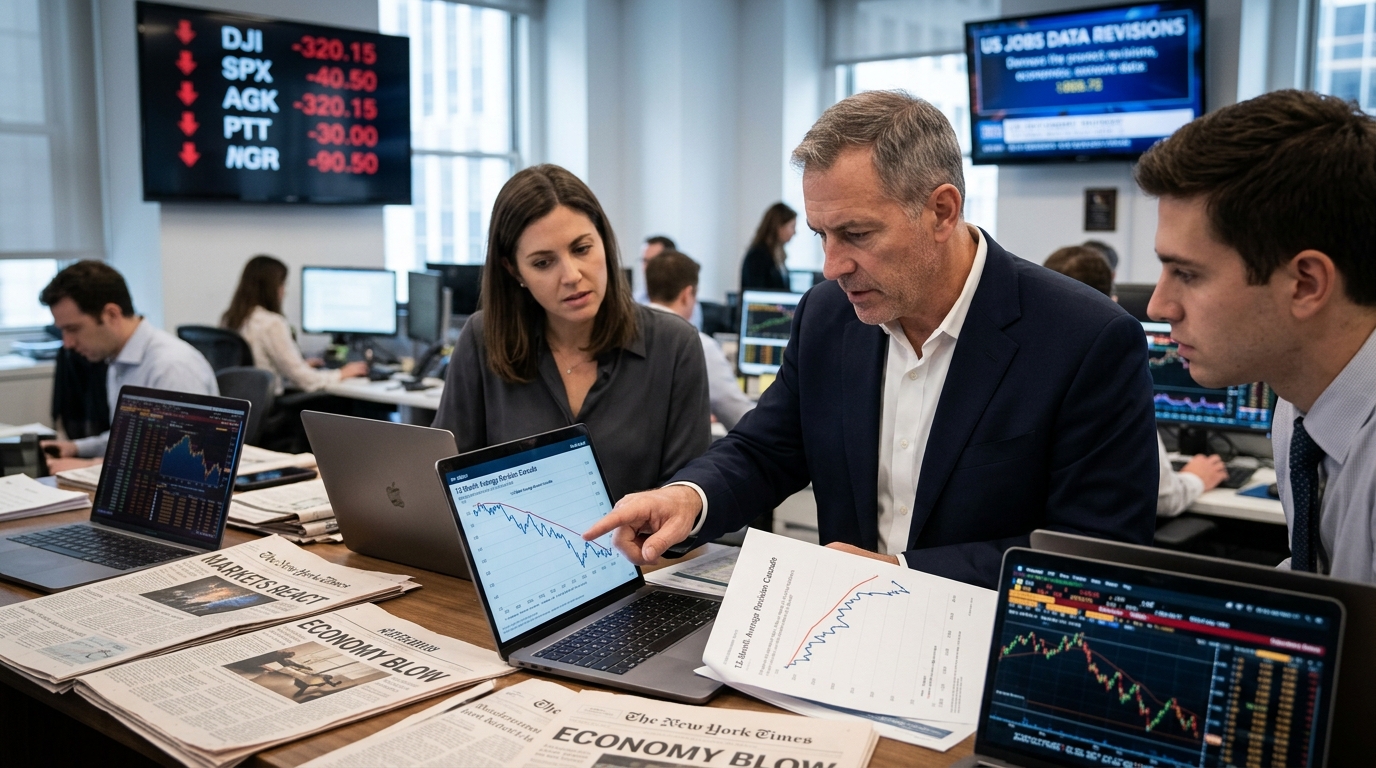
Before this morning, most of Wall Street expected the July jobs report to deliver something like 80,000 to 90,000 new positions, a modest bounce from June’s soft headline of 57,000. Instead, nonfarm payrolls fell by a seasonally adjusted 23,000 for the month, versus a Dow Jones consensus forecast of 83,000. The headline number is striking. The revision history behind it is worse.
The Big Question
Is the U.S. labor market experiencing a cyclical soft patch driven by one-time distortions, or is a broader structural deterioration now visible in the data? The answer has direct consequences for the Federal Reserve, for credit-sensitive equity sectors, and for any investor who built a position around the assumption that the economy was stabilizing after a difficult 2025.
Why Wall Street Cares
Going into today’s release, markets were still debating whether the Fed would hike again this year. The FOMC has been sitting on a federal funds rate target range of 3.50% to 3.75%, holding despite inflation that has remained well above its 2% target. The implicit bet was that a stable labor market gave the Fed cover to stay restrictive, and possibly tighten once more. That calculus just changed materially.
Following the jobs report, the directional shift was straightforward: a weaker labor print increases the pressure to wait. Equity futures moved higher and Treasury yields moved lower as the market processed what this number means for the path of rates.
The Bull Case
The most charitable reading of July’s data centers on distortion rather than deterioration. The key factor behind the surprise job loss was local government education, which fell by about 50,000 jobs in July, a category that is susceptible to distortions from the seasonal adjustment process. In other words, the BLS’s model for stripping out expected summer school-calendar effects may have misfired, and a portion of that loss could reverse in August.
The unemployment rate fell to 4.1%. The bullish case is that the headline is noisier than the signal, and the Fed should look through it.
Even with hiring muted, the market can still look “frozen” rather than collapsing. That is a different problem, and arguably a more manageable one.
The Bear Case
The bearish read is harder to dismiss. The headline loss of 23,000 jobs is not the most damaging number in this report. Revisions to prior months compounded the weak picture: the BLS revised May’s job gain down by 66,000 to 63,000 and June’s gain down by 37,000 to 20,000, leaving the two months combined 103,000 lower than previously reported. In addition to the weak numbers for June and July, those revisions are what bring the 12-month average down to just 34,000. That figure, 34,000 monthly net jobs in a roughly $30 trillion economy, is the number institutional economists are circling this morning.
The sector breakdown tells a story that goes beyond seasonal noise. Financial activities employment fell by 14,000 in July, continuing a downward trend that has left the sector down 121,000 jobs since a recent peak in May 2025. Average hourly earnings for all employees on private nonfarm payrolls rose just 2 cents to $37.62 in July and were up 3.2% over the past year. With inflation running around 3.5% in the most recent CPI reading, that implies real wage growth is negative again. That is not a seasonal distortion.
The number of long-term unemployed, defined as joblessness lasting 27 weeks or more, edged down to 1.8 million but still accounted for 25.5% of all unemployed people. That is not the signature of a labor market snapping back.
The labor force participation rate was 61.4% in July, essentially unchanged on the month. Even so, participation has drifted lower over the course of 2026, which matters because a falling participation backdrop can mechanically flatter the unemployment rate.
The Evidence
The backdrop makes this report harder to explain away as noise because the weakness is showing up in places that typically track consumer throughput. In July, employment declined in retail trade and in local government education, while health care continued to add jobs.
Within retail, warehouse clubs, supercenters, and other general merchandise retailers accounted for a loss of about 21,000 jobs in July. These are not idiosyncratic business failures. They reflect pressure at the consumer end of the economy.
The phrase economists have adopted for 2026 is “low fire, low hire.” That framing was supposed to be reassuring. Today’s data suggests the balance is tilting toward the wrong side of it.
The Mavens’ View
What sophisticated investors are processing this morning is an economy that has handed the Fed a nearly impossible position. The central bank is trying to contain inflation that is still above target, while the three-month average of job creation has slowed sharply and the one-month print has now turned negative.
That is not the language of a soft patch. It is the language of a shift in regime, where the Fed risks making a policy error in either direction: tighten into weakness, or hold and let inflation stay too hot for too long.
What Investors Are Missing
The debate in markets today will center on September hike odds. That is the wrong lens. The more important question is what a sustained 34,000-per-month jobs environment does to corporate earnings estimates, particularly for consumer discretionary and financial services companies that have been underwriting their outlooks on continued labor market resilience.
Financial activities employment is now 121,000 jobs below its May 2025 peak, a decline that has unfolded quietly over 14 months. That is not a number consistent with strong consumer credit demand, robust mortgage origination, or expanding insurance sales. It is consistent with a sector that is already bracing for slower growth, and doing so through headcount before it shows up in reported earnings.
A second-order point: local government education was the swing factor this month. If that category is truly seasonal-noise-driven, the headline could snap back. But the market risk is that investors treat that possibility as an all-clear, when the revisions and the sector composition are arguing that the slowing trend is real.
Stocks to Watch
JPMorgan Chase (JPM) and the large-money-center banks are the most direct read. Financial activities employment is in a sustained 14-month decline. If credit intermediation is contracting as a sector, loan volumes and net interest income assumptions embedded in sell-side models deserve scrutiny going into Q3 earnings season.
Walmart (WMT) and Costco (COST) sit at the center of the retail job-loss story. Warehouse clubs, supercenters, and general merchandise retailers shed about 21,000 jobs in July. Companies cutting hours and headcount in retail are almost always responding to observed sales softness before it appears in public guidance. Watch the August traffic data carefully.
Marriott International (MAR) and the hotel and leisure sector face a specific read-through. Leisure and hospitality employment fell by about 40,000 in July, a sector that had been a reliable source of payroll gains across 2024 and early 2025. That reversal, if it persists into August, will pressure RevPAR assumptions for the back half of the year.
UnitedHealth Group (UNH) represents the one corner of this report that held. Health care continued adding jobs, though below trend. As employers cut, benefits and health care administration become the relative safe harbors. Managed care and health services providers are among the few sectors with a labor-market tailwind today.
The 34,000 economy was not in any bank’s forecast deck entering 2026. It is the number investors need to build around now.