July 23, 2026
Tesla’s Big Quarter Has a Catch
Record deliveries, surging revenue, and a margin problem nobody can ignore.
First a note from Frontieras
A 2,240% Gold Giant with a Neighbor Already Drilling
In mining, property lines matter to lawyers.
They matter less to geology.
One gold producer in Papua New Guinea has already turned this regional corridor into a multi-billion-dollar success story. It produces tens of thousands of gold-equivalent ounces per quarter and has become one of the top names in the world.
Now a smaller explorer is drilling nearby.
Not in a random patch of jungle.
In the same structural corridor, where surface work has already pointed to gold, copper, and silver mineralization.
The timing is interesting, too.
Across the developed mining world, many of the obvious deposits have already been drilled, mined, or picked apart. Ore grades are declining. Reserves are depleting. New discoveries are getting harder and more expensive to define.
In the South Pacific, it is different.
Rugged, remote, complicated. But still one of the few places where large undeveloped mineral systems remain on the map. Recently, the Oregon Group, a critical minerals intelligence firm, described this region as holding some of the largest undeveloped copper-rich deposits in the world.
No two projects are the same.
But the neighbor proved the district can produce.
Now the question is what sits next door.
See why this frontier location is getting attention again…
What does it tell you when a company grows revenue 26% year over year, sets an all-time delivery record, and still watches its stock slide 4% in after-hours trading the same night?
It tells you the market was grading on a different curve entirely.
Tesla reported Q2 2026 results after the close on Wednesday, July 22. On the surface, it was a strong report. Underneath, it raised a question that patient investors should be sitting with right now: what exactly is this company worth, and at what price does it become worth owning?
What the Numbers Actually Say
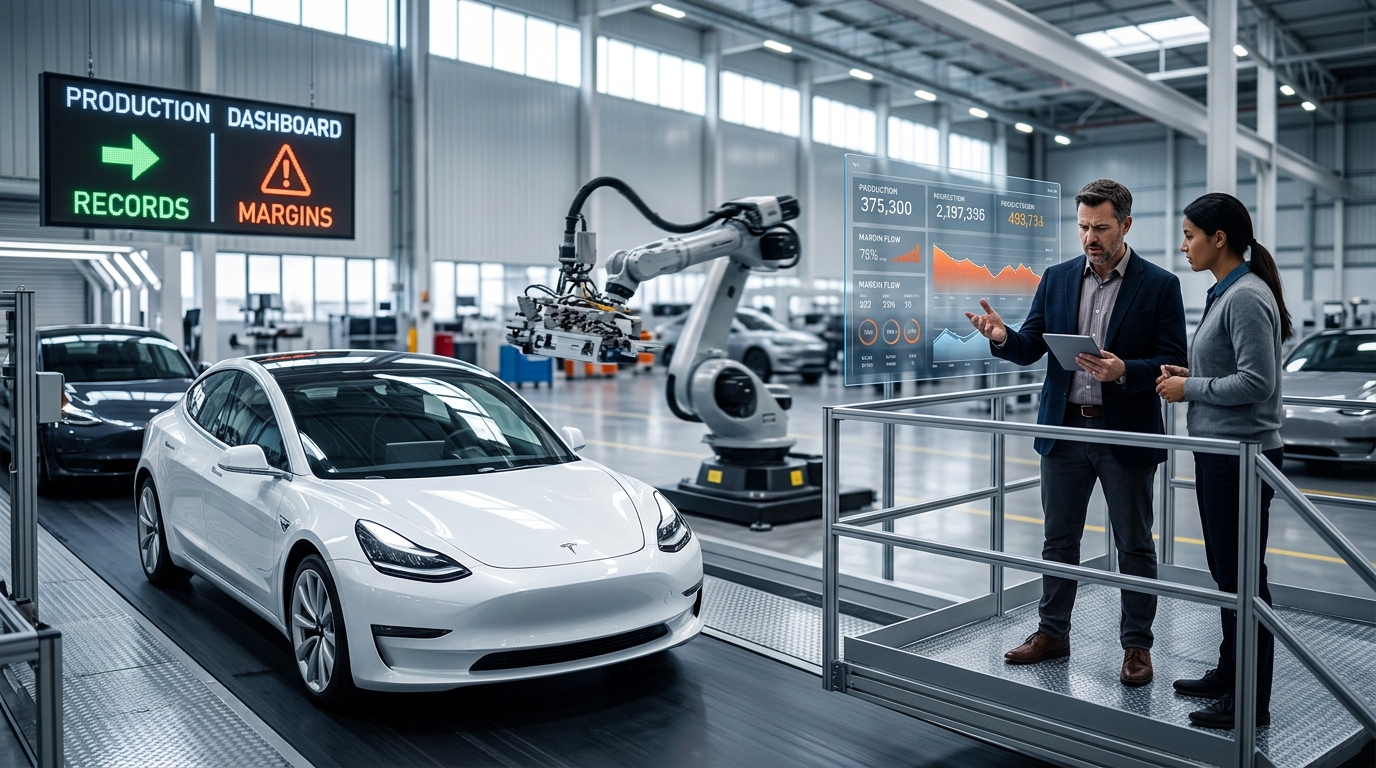
Revenue came in at $28.24 billion, up 26% year over year and ahead of the Bloomberg consensus near $26.3 billion. Trailing twelve-month revenue crossed $100 billion for the first time in company history. Vehicle deliveries hit 480,126 units, up 25% year over year and roughly 75,000 above what analysts had modeled. Energy storage deployments reached 13.5 GWh, a 53% sequential jump from Q1’s 8.8 GWh.
Those are genuinely impressive numbers. The problem is what came with them.
- Adjusted EPS: $0.33 vs. $0.51 expected — a 35% miss on the bottom line
- GAAP operating income: $398 million, down 57% year over year
- Operating margin: 1.4%, compressed from 4.1% a year ago
- Capital expenditures: $5.79 billion, up 142% year over year
- Free cash flow: negative $1.09 billion (better than the negative $3.64 billion feared)
- Operating cash flow: $4.70 billion, up 85% year over year
- Active FSD subscriptions: 1.48 million, up 56% year over year
- Services and Other revenue: $4.58 billion, up 50% year over year, with record gross margin of 14.1%
- Automotive gross margin (ex-credits): 16.3%, down from 19.2% sequentially
GAAP net income came in at $1.11 billion, or $0.32 per share. That looks tolerable until you notice it includes a $1 billion unrealized gain on Tesla’s SpaceX equity stake, which the company excluded from its non-GAAP figures. Strip that out and the underlying operating result is considerably thinner than the headline suggests.
The stock closed regular trading at $374.01. It slid further after the bell.
“My system said ‘SELL’ right before this stock tanked. Today, I’m shouting ‘BUY NOW’ before it soars.”
In 2023, Marc Chaikin’s system flashed bearish on an automotive company no one had yet heard of. The stock crashed 35%. Today, his system rates this company “Very Bullish” and Marc calls it a screaming buy thanks to a new “groundbreaking partnership” with Nvidia that hands this company the keys to the self-driving kingdom on a silver platter.
Why the Profit Went Somewhere Else
Wall Street wanted to see delivery volume convert into earnings. It mostly did not. That gap between a 26% revenue gain and a 57% drop in operating income deserves a real explanation, not a wave of the hand.
Three things drove it. First, lower average vehicle selling prices compressed automotive gross margins. Second, operating expenses rose 47% to $4.35 billion, driven almost entirely by R&D: pre-production costs for Cybercab, Tesla Semi, Optimus, and expanded AI compute infrastructure. Third, capex more than doubled sequentially to $5.79 billion, up 142% from a year ago. That last number is the one that reframes everything else.
CFO Vaibhav Taneja confirmed on the call that full-year 2026 capex will exceed $25 billion and is expected to keep growing for the next two to three years. Tesla has also secured $30 billion in additional debt capacity to fund the buildout if needed. Elon Musk described it plainly: the company is spending on capex as fast as it responsibly can. He called it a balance between capital efficiency and time.
Slight tangent, but it matters here. Energy gross margins also fell sharply, from 39.5% to 20.4% sequentially, due to a $240 million warranty true-up and the absence of tariff-related benefits that helped Q1. That was a one-time headwind, but it’s worth noting because energy had been the segment posting the most impressive margins in the business.
What Tesla Is Actually Building
This is where the stock gets genuinely hard to evaluate. Tesla is not a car company right now — or rather, it is a car company funding three other companies simultaneously inside its own balance sheet.
The Robotaxi fleet has now logged more than 380,000 fully unsupervised miles across seven U.S. markets with no notable incidents, according to VP of AI Ashok Elluswamy on the earnings call. The program is scaling to entire states rather than city by city. Weekly miles driven are growing at double-digit percentage rates. Miami, Orlando, and Tampa all launched unsupervised rides in July, adding to existing Austin operations. Phoenix and Las Vegas have preparations underway.
On Optimus: Musk called it the hardest product Tesla has ever attempted to manufacture at scale. First-generation production lines are being installed at the Fremont factory following the decommissioning of Model S and Model X lines. Initial robots will be used internally for training data collection. There is no existing supply chain for many of the components, so Tesla has had to build or develop much of it in-house, with Samsung, TSMC, and Micron named as key partners for compute and memory. Musk expects Optimus to eventually be the most important product Tesla has ever made.
FSD subscriptions hit 1.48 million, up 56% year over year. In North America, 55% of Q2 deliveries included an FSD subscription at the point of sale. That attach rate matters for the long-term services model.
The A-Z breakdown of this “battle-tested” income strategy – FREE (ticker included)
Most traders who struggle with options aren’t bad at trading – they’re just drowning in noise. New charts, tools, alerts, algorithms, and opinions crop up daily… and simply figuring out where to start can become overwhelming. Dave Aquino’s 11-Hour Options for Beginners guide cuts through that noise with a clear plan and shows you real results. Inside, you’ll get the A-Z breakdown of his 11-hour options income strategy in plain English, complete with the “battle-tested” ticker he’s used nearly 900 times with a 95.3% success rate. And today, it’s yours – FREE.
Is It Cheap?
Let’s be direct about this. No. Not by any conventional measure that value investors use.
As of July 22, Tesla’s trailing P/E sits around 312. The forward P/E is approximately 165, against an automotive industry median forward P/E near 13. The EV/EBITDA multiple is roughly 124. Return on equity is 4.9% and return on invested capital is 6.3%. Those are modest figures for any company, let alone one trading at multiples that imply decades of flawless execution.
Cash and investments stand at $43.5 billion. The balance sheet is not broken. But the valuation has never been tethered to what Tesla earns today. It is a bet on what gets monetized three to five years from now across Robotaxi, FSD licensing, Optimus, and energy storage. That bet may be the right one. It is still a bet, not a discount.
Here is the tension. The market cap stands at roughly $1.4 trillion. The stock already prices in a substantial portion of the autonomy optionality. If any of the major bets slip by even 18 months — Robotaxi regulatory friction, Optimus manufacturing delays, FSD monetization moving slower than hoped — the math at current prices becomes very difficult to defend.
Cheap Investor Scorecard: TSLA
| Factor | Score | Notes |
|---|---|---|
| Business Quality | 8/10 | Brand strength, platform optionality, services now at record margins |
| Financial Strength | 6/10 | $43.5B cash, $30B debt capacity secured; FCF now negative |
| Valuation | 2/10 | Trailing P/E ~312, forward P/E ~165, EV/EBITDA ~124 |
| Competitive Position | 7/10 | FSD lead, Supercharger moat; Waymo and BYD are real competitive pressures |
| Cash Flow | 4/10 | Operating cash flow $4.7B (+85%); capex up 142%, FCF negative $1.09B |
| Management Execution | 6/10 | Delivery beat was genuine; EPS misses are becoming a pattern |
| Catalyst Strength | 8/10 | Robotaxi scaling, Optimus production, FSD monetization all in motion |
| Margin of Safety | 1/10 | Essentially none at current prices for disciplined value investors |
| Long-Term Potential | 9/10 | If autonomy and Optimus scale, the upside case is genuinely transformative |
| Cheap Test | FAIL | Exceptional business. Not a bargain at current levels. |
Three Ways This Plays Out
Bull case. Robotaxi scales aggressively across the U.S. and into international markets through 2027. FSD subscriptions push past 2.5 million paying users as attach rates climb. Optimus begins limited commercial deployments ahead of schedule. Energy storage, already growing at 53% sequentially, becomes a multi-billion dollar annual profit driver. If two or three of those materialize on timeline and at scale, today’s entry price may look defensible in four or five years.
Base case. Execution is uneven. Timelines slip 12 to 18 months across product lines, as they have before. The core auto business holds up. Services keep compounding. FSD subscribers grow steadily. The stock grinds sideways as the capex cycle suppresses earnings through 2027 and investors wait for proof.
Bear case. Regulatory friction materially slows Robotaxi beyond a handful of markets. Optimus hits the manufacturing obstacles Musk himself described as the hardest scaling challenge Tesla has ever faced. Auto margins compress further as BYD and other global competitors intensify pricing pressure. Operating income already fell 57% year over year on 26% revenue growth. The bear case does not require imagination. It just requires more of what this quarter already showed.
The Honest Assessment
Tesla is not mispriced in the way this publication typically hunts for. There is no irrational fear, no short-term earnings disappointment masking durable fundamentals, no Wall Street overreaction creating a real discount. The market knows exactly what Tesla is building. It has assigned that vision a $1.4 trillion market cap. The stock is not cheap because the future being priced is extraordinary — and extraordinary futures require extraordinary execution delivered on time.
What Q2 2026 confirmed is that Tesla is now deep into its most capital-intensive period ever. Capex up 142% year over year. Full-year spending exceeding $25 billion. Two to three more years of elevated investment ahead. The money is going to real things: Robotaxi infrastructure, Optimus production lines at Fremont, AI compute clusters in Texas, semiconductor fabrication through the Terafab project, energy storage factories. None of it is frivolous. All of it is long-duration.
The question is not whether the bets are intelligent ones. It is whether a forward P/E of 165 and a trailing P/E above 310 already prices them in.
For a value investor, the answer is watch and wait. A pullback that brings the forward multiple into the 80 to 100 range — still generous by any historical standard for a car manufacturer, but defensible for a technology platform with genuine autonomy traction — would create a genuinely interesting conversation. At today’s price, the business quality is not the question. The price is the question.
If you bought lower and have been holding, the case for patience through the investment cycle is reasonable. If you are looking to start here, the margin of safety is thin. That is not a knock on Tesla. It is just what the math says.