July 15, 2026
Is Apple Actually Cheap Right Now?
Running the world’s most valuable company through our valuation framework.
First a note from EnergyX
Lithium demand is fueling a modern-day gold rush, set to grow 5X by 2040.
Industries like AI, robotics, and energy depend on it. Microsoft’s CEO even says the AI race will be won on energy costs, not model quality.
That’s creating opportunities for investors. One company, EnergyX, already turned this demand into a $1B unicorn valuation.
EnergyX’s patented tech can recover up to 3X more lithium than traditional methods. That breakthrough earned $150M+ in investments, including from industry leaders like General Motors and POSCO.
Here’s how they’re redefining the $204B energy storage market:
- Disruption: EnergyX’s GET-LiT™ technology recovers lithium from brine at the lowest cost when benchmarked against industry leaders, and it’s protected by 120+ patents.
- Ecosystem: From technology to production resources, EnergyX is building a vertically integrated platform to power the global transition to EVs, backed by investment from leaders like General Motors and Eni.
- Opportunity: Until Thursday, EnergyX is offering everyday investors the chance to join, ahead of full-scale commercialization.
Now they’re ready to unlock commercial lithium production just as experts project demand will grow 5X by 2040. They’ve just commissioned the largest lithium production facility in the U.S. and have the rights to approximately 150,000 acres of lithium-rich land.
There is a question worth sitting with before July 30.
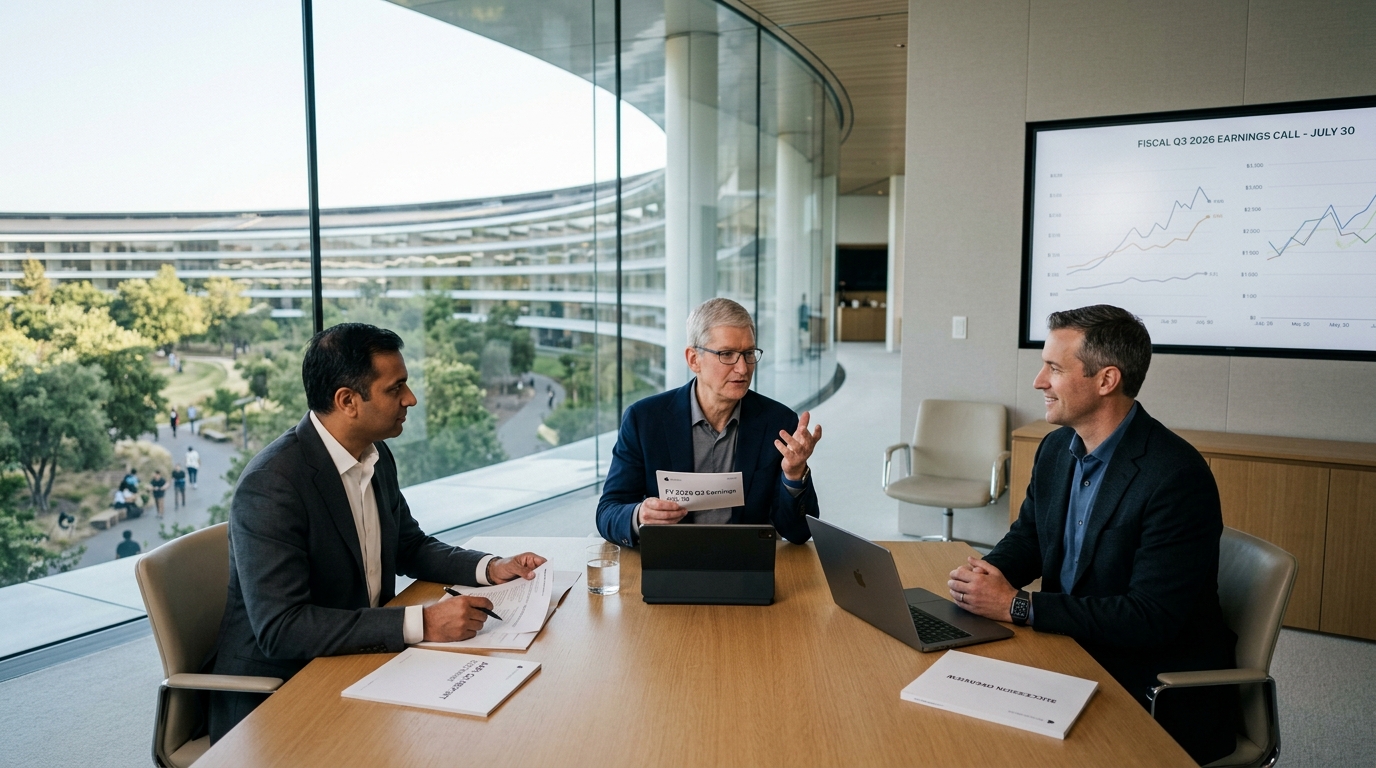
Apple is about to report fiscal Q3 2026 earnings. Tim Cook will host his final call as CEO. The product pipeline heading into the fall is arguably the most consequential in years. The stock just hit an all-time closing high of $317.31 on July 13, has gained roughly 16% since late June, and carries a market cap pushing $4.7 trillion. The business is generating cash at a pace that would have seemed implausible a decade ago.
So here is the question: is Apple actually cheap? Or is it simply excellent?
Those are very different things. And getting that distinction right is exactly what this publication exists to do.
The business, honestly assessed
Apple’s fiscal Q2 2026, reported in late April, was its best March quarter on record. Revenue reached $111.2 billion, up 17% year over year and above the $109.66 billion consensus. Diluted EPS came in at $2.01, up 22%, beating the $1.95 estimate. iPhone revenue hit $57 billion, also up 22%, driven by the iPhone 17 lineup. Services reached an all-time high of $30.98 billion, up 16.3% year over year, with gross margins of 76.7%. Overall company gross margin was 49.3%. Net income was $29.6 billion.
The capital return program keeps scaling. The board approved a new $100 billion share repurchase authorization and raised the quarterly dividend 4% to $0.27 per share. In the first six months of fiscal 2026, Apple generated more than $82 billion in operating cash flow and spent just $4.3 billion on capital expenditures. Free cash flow for the full fiscal year ending September 2026 is now projected to reach approximately $140 billion, up more than 40% from fiscal 2025. For context, Microsoft spent $38 billion on capital expenditures in a single recent quarter alone.
The installed base now exceeds 2.5 billion active devices. That number matters more than almost any other. It is the foundation of the Services segment, and Services is where the margin expansion story actually lives.
61% of Americans Worry America Could be on the Verge of Another Civil War
Today, more than half of America thinks a civil war is likely.
Former CIA Advisor Jim Rickards agrees.
He just uncovered a fascinating plot by Trump to keep the Democrats out of the White House until 2033.
And while he believes it could be successful, it could also trigger America’s Second Civil War.
What the market is paying for
Here is where the honest analysis gets uncomfortable.
Apple currently trades at roughly 34 times forward earnings. Its 10-year average is closer to 23 times. The stock closed at $314.86 on July 14, inside a 52-week range of $201.50 to $323.45, and the average analyst price target across 18 Buys, 11 Holds, and one Sell is approximately $325 to $327. That means the consensus sees roughly 3% to 4% upside from here. Not nothing, but not a margin of safety either.
The bull case runs through Citigroup (target $365, raised July 13), Morgan Stanley ($360), and JPMorgan ($345, raised this week ahead of earnings). Wedbush’s Dan Ives is at $400. The bear case is KeyBanc, which downgraded Apple to Underweight on July 14 with a $250 price target, citing soaring memory chip costs pushing device prices higher, slowing indexed consumer spending, and the risk that price hikes damage the very upgrade cycle the bull case depends on. KeyBanc noted that their consumer spending index showed Apple-related spending down 2% month over month, versus a three-year average of plus 9% for that period. That is a meaningful divergence.
Both camps have legitimate arguments. That tension is the whole story right now.
The mispricing question
The Cheap Investor framework starts with a specific question: has the market gotten something wrong? Is there a gap between perception and reality that patient investors can exploit?
With Apple, the more interesting version of that question runs in reverse. The market may not be undervaluing Apple. It may be valuing it with unusual precision for a business of this complexity. The risk is not that the market is too pessimistic. The risk is that it is already pricing in most of the good news.
A slight tangent worth making: part of what has driven Apple’s recent surge is not Apple-specific at all. Investors have been rotating away from companies spending aggressively on AI infrastructure and toward businesses generating reliable cash. The five largest AI builders are projected to collectively spend more than $725 billion on capital expenditures in 2026, a figure that now exceeds their combined free cash flow. Apple sits on the opposite end of that spectrum. It is generating a projected $140 billion in free cash this fiscal year while spending less than $13 billion on capital expenditures. Some of what you are paying for in AAPL today is that relative discipline, not just Apple’s own fundamentals.
The bigger story is why nobody saw it coming
On a single trading day, one quantum computing stock jumped 33%.
Another climbed 30%. A third surged 31%.
All three moved on the same funding announcement, within hours of each other.
These gains are not typical and past performance doesn’t guarantee future gains.
But the shocking part?
Most investors watching Nvidia never even saw this sector move.
A small group of traders has a checklist for spotting these setups before the news breaks wide.
What July 30 actually tests
Heading into the report, Wall Street expects EPS of approximately $1.89, reflecting roughly 20% year-over-year growth, on revenue of about $108.9 billion. Apple has beaten the EPS consensus in each of its last four quarters. Apple guided for 14% to 17% revenue growth and gross margin in the range of 47.5% to 48.5%, down from 49.3% in Q2. The compression comes from memory. AI-driven demand for high-bandwidth chips has tightened supply industry-wide, and Apple uses significant quantities of advanced memory in its hardware. This is not a company-specific problem, but it will show up in the numbers, and the call will determine whether investors see it as temporary or structural.
Services growth is the number that actually moves the multiple. If Services continues growing in the mid-teens, the bull case for the premium valuation holds. If it decelerates toward 10%, the multiple faces real pressure even if the headline revenue number beats. Watch the September quarter guidance closely. That is the quarter where the iPhone 18 Pro and likely the company’s first foldable iPhone, possibly called iPhone Ultra, are expected to launch. Suppliers have been told to prepare for approximately 10 million units of the foldable alone. The starting price is rumored to be around $1,999. Whether that device strengthens or tests the upgrade cycle is the single biggest hardware question Apple faces right now.
And then there is the leadership element. Cook transitions to Executive Chairman on September 1. John Ternus takes over as CEO. Ternus briefly joined the Q2 call to signal continuity and an “incredible roadmap ahead.” July 30 is the reinforcement of that message. The market does not need Cook to be irreplaceable. It needs to believe the transition is orderly and that the product roadmap survives the change in command. Any signal of friction gets amplified. Any signal of confidence gets rewarded.
The Cheap Investor scorecard
- Business quality: Elite. Ecosystem lock-in, pricing power, and brand depth are best in class. The installed base of 2.5 billion active devices is an asset with no real comparable.
- Financial strength: Exceptional. Projected $140 billion in free cash flow for fiscal 2026. $82 billion in operating cash flow in just the first half of the year. Capital expenditures of roughly $4.3 billion in the same period.
- Valuation: Premium and difficult to justify on a traditional value basis. At 34 times forward earnings versus a 10-year average of 23 times, Apple is priced for continued execution with little room for error.
- Competitive position: Record 20% global smartphone market share in Q2 2026, during a quarter when total industry shipments fell 11% to a 13-year low. Apple held price and gained share simultaneously.
- Cash flow: Among the strongest on earth. Funds $100 billion buyback programs, dividend increases, and a $30-plus billion chip supply agreement with Broadcom through 2031.
- Management transition: Orderly by design. The risk is perception during the handover period, not the underlying capability of the incoming CEO.
- Catalyst strength: Real and near-term. Foldable iPhone launch, iOS 27 with overhauled Siri AI, Services mix shift, and iPhone 18 pricing all represent tangible potential drivers in the next two quarters.
- Margin of safety: Low. The quality is not in question. The entry point is.
- Key risks: Memory cost headwinds compressing gross margins beyond Q3, KeyBanc’s thesis on demand destruction from price hikes, Siri rollout delays in key markets, App Store legal overhang, and foldable iPhone production uncertainty.
- Long-term potential: Strong. A Services-led margin expansion story compounding on top of a 2.5 billion device installed base is a durable and repeatable business model.
Exxon and Chevron Have an Unlikely New Competitor
Energy giants like Exxon and Chevron are buying land in America’s lithium hotspot. Now they’ve got a new neighbor. EnergyX has now acquired 35k gross acres in Southwest Arkansas, right next door. With tech that can recover 3X more lithium than traditional methods, they’re aiming for America’s lithium crown. General Motors already invested.
Become an early-stage EnergyX investor before Thursday night.
DISCLOSURE: EnergyX’s Regulation A offering has been qualified by the SEC. Before investing, carefully review the offering circular, including the risk factors. The offering circular is available at invest.energyx.com
The honest verdict
Apple is not cheap. It is one of the finest businesses ever constructed, and the market knows it. At 34 times forward earnings with a 10-year average closer to 23 times, you are not buying a discount. You are buying quality at a price that demands Apple keep executing at a high level across hardware, services, and now a leadership transition, all at the same time.
That said, the argument for owning Apple is not really a value argument. It is a compounding argument. The free cash flow engine, the Services mix shift, the installed base, the pricing power on premium hardware, and the foldable iPhone as a potential high-ASP category opener — these are genuine growth levers. For investors with a three- to five-year horizon who can tolerate paying a premium for certainty, Apple may still make sense.
For bargain hunters looking for a classic mispricing, it is not here. The perception and the reality are reasonably well aligned at this price. The only real mispricing, if you want to call it that, is the market’s uncertainty around the CEO transition and whether the AI strategy plays out as intended. July 30 will either narrow that gap or widen it.
Watch the Services number. Watch the gross margin commentary. Watch how Ternus shows up in the room.
The next chapter starts in two weeks.