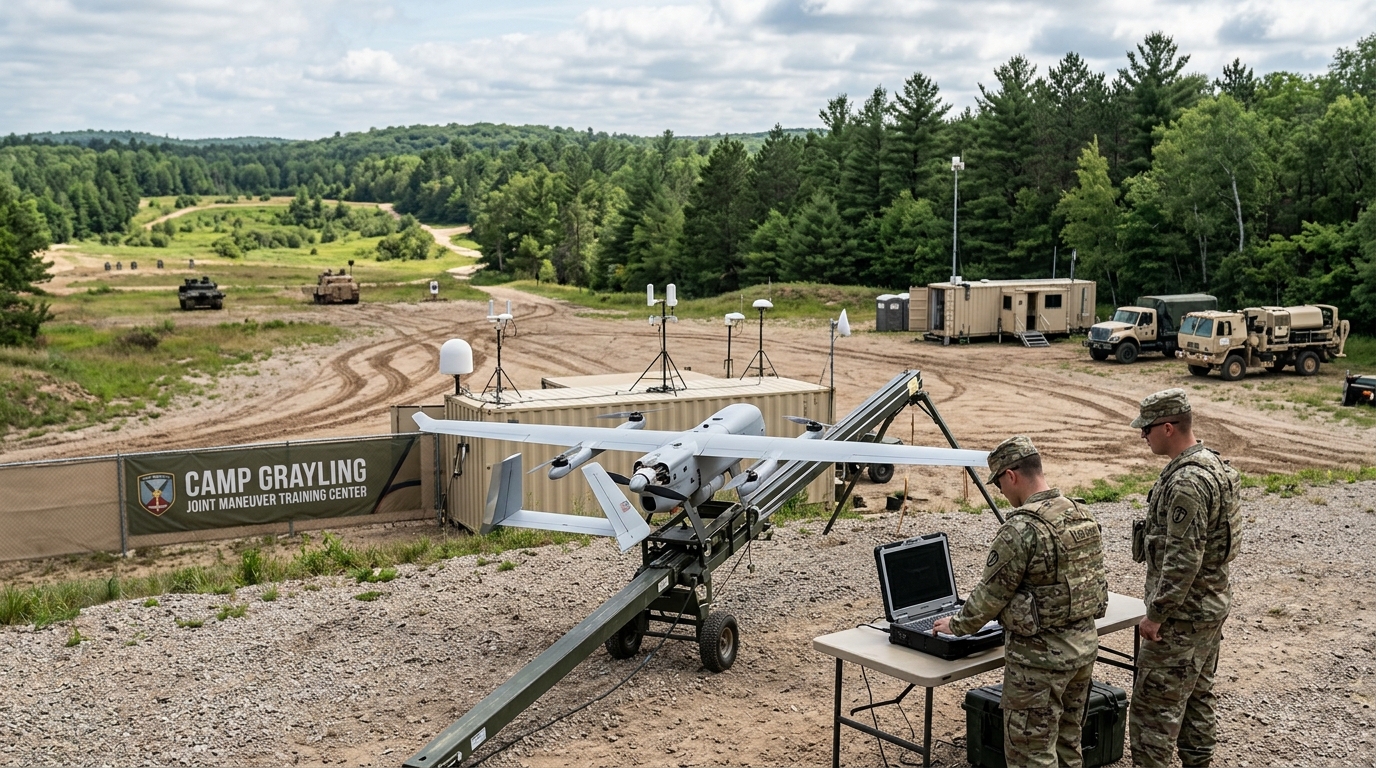
Something structural shifted in defense spending this spring. Not a headline cycle, not a one-day pop — a genuine reallocation of capital toward a category the Pentagon basically ignored for years. Drone stocks are now at the center of it, and Phase II qualifier testing at Camp Grayling, Michigan ran June 8–20, 2026.
Here is the backstory in one sentence: the war in Ukraine rewrote the book on modern warfare, and the Pentagon is now playing catch-up at scale.
The Program, the Numbers, the Scope
The Pentagon’s Drone Dominance Program is a roughly $1.1 billion initiative designed to accelerate procurement of more than 300,000 low-cost, one-way attack drones through 2027. That is not a pilot program. That is an industrial mobilization. Phase II’s Stage 1 qualifier event at Camp Grayling was scheduled for June 8–20, and the program’s Phase II Gauntlet II is slated for late August 2026.
The scale of the broader commitment is harder to process. The Pentagon’s Office of Strategic Capital-backed Defense Strategic Capital Credit Program shows a FY2027 request of about $20.2 billion. Budget documents and reporting describe FY2026 funding as “less than $1.5 billion.” That is not incremental. That is a policy decision to treat the domestic drone industrial base the same way the government treated semiconductor manufacturing: as a national security asset that cannot depend on adversarial supply chains.
For context: before the current administration’s second term, Pentagon drone purchases were a small slice of overall U.S. drone sales. The exact percentage in the commercial market is hard to pin down publicly, but the direction of travel is clear — and moving fast.
The Stocks the Market Is Watching
Four names have dominated the institutional and retail conversation: UMAC, RCAT, KTOS, and ONDS. They are not interchangeable. Each plays a different role in the stack.
Unusual Machines (UMAC) is the one the market went sideways over on May 28 — shares jumped 57% in a single session after reports (citing The Wall Street Journal) said the Trump administration was in talks with select domestic drone companies about funding arrangements that could include debt and equity structures, potentially giving the government ownership stakes. The company’s Q1 2026 revenue was about $8.1 million (up 296% year-over-year and 65% sequentially), and it reported net income of about $10.3 million — driven largely by investment gains rather than operating performance. The company has said it has grown to more than 190 employees. The key risk for traders: how quickly operating results can stand on their own without relying on investment gains.
Red Cat Holdings (RCAT) is the one with the most concrete contract wins. The company reported Q1 2026 revenue of $15.5 million — an 849% year-over-year increase — as its Teal Drones and FlightWave subsidiaries converted government backlog into recognized revenue. The Army’s Short Range Reconnaissance (SRR) Program of Record selection for the Black Widow system carries a stated acquisition objective of 5,880 systems over five years. Red Cat also announced that Black Widow was approved and added to the NATO Support and Procurement Agency (NSPA) catalogue in September 2025. (The company has also discussed international and allied orders in recent updates; specific “Drone Dominance Program” contract claims are best treated as unconfirmed unless and until a contract award is publicly documented.)
Kratos Defense (KTOS) is the largest, most liquid name in the drone defense basket. Kratos reported Q1 2026 revenue growth of 22.6% (15.8% organic), with its Unmanned Systems segment at $82.6 million. The XQ-58A Valkyrie remains the flagship in the company’s autonomous aircraft portfolio, sitting adjacent to (not inside) the Air Force’s Collaborative Combat Aircraft track and any small-drone “Drone Dominance” procurement. The broader point for KTOS: the fundamentals can outpace the stock for long stretches in defense, especially when multiples and expectations reset faster than contract revenue lands.
Ondas Holdings (ONDS) just added a different dimension. The company completed a $196.6 million all-stock acquisition of Omnisys, an Israeli defense software firm, shifting exposure beyond pure drone hardware toward higher-margin defense software platforms. (Performance claims like “up 1,100% over the past year” can swing materially day-to-day; treat those as approximate.)
The Regulatory Moat Nobody Is Talking About
Section 1709 of the FY2025 NDAA is central to the current U.S. policy posture around foreign drone and component risk. In late December 2025, the FCC updated its Covered List to include foreign-manufactured uncrewed aircraft systems (UAS) and UAS critical components, effectively restricting authorization for new foreign-made drones and components — and explicitly tying the move to Section 1709-covered equipment and services (including DJI and Autel Robotics). That is structural. Companies like DJI — which dominate global commercial drone sales — are being pushed out of U.S. government procurement, and these restrictions can reshape the broader U.S. market as supply chains re-route.
The global counter-UAS market is projected by MarketsandMarkets to grow from $6.64 billion in 2025 to $20.31 billion by 2030 (about a 25.1% CAGR). The broader drone industry is projected by Grand View Research to grow from about $73.06 billion in 2024 to $163.60 billion by 2030 (about a 14.3% CAGR).
Technical Framework
RCAT has been range-bound around the $10–$12 zone in recent trading, with $5.77 and $18.78 frequently cited as the 52-week low and high in market data services. (Intraday ranges and real-time volume comparisons for June 22 are not consistently reproducible across public sources, so treat any precise “as of today” tape-reading numbers as indicative rather than definitive.)
UMAC, after its May 28 spike, is trading in the zone where analyst targets can become less useful in the near-term. What matters next is whether any government funding structure — especially anything involving an equity component — is formally announced, and how Phase II Gauntlet II outcomes in late August affect follow-on orders.
KTOS is the one the chart watchers are circling. In defense, dislocations between price and target tend to persist until either (a) contract revenue shows up in a way investors can model quarter-to-quarter, or (b) the multiple re-rates on a clearer cycle shift.
Three Scenarios Worth Modeling
Bull case: Pentagon formally announces financing structures involving equity-like stakes through the Office of Strategic Capital/Defense credit tools. Phase II Gauntlet II results drive meaningful orders to publicly traded names. Defense budgets expand through FY2027 as autonomous warfare spending accelerates. RCAT retests prior highs near $18.78. KTOS reclaims key moving averages as fundamentals continue to scale. UMAC sustains triple-digit revenue growth and operating profitability becomes less dependent on investment gains.
Base case: Phase II Gauntlet II concludes in late August with a smaller set of vendors per mission area advancing. Contract awards and deliveries flow unevenly through late 2026 into 2027. Stocks consolidate after the May surge, with execution — not headlines — as the primary re-rating driver. No formal Pentagon equity investment materializes in 2026, but program funding continues and procurement ramps as testing gates are cleared.
Bear case: Phase II results disappoint for the publicly traded names. Budget reconciliation and execution delays push meaningful deliveries to the right. RCAT breaks below $10 and trades toward the mid-single digits. KTOS continues to lag if investors keep discounting timing and margin uncertainty. UMAC pulls back as the market reprices speculative funding narratives absent a signed deal.
What Active Traders Are Watching
The late August Gauntlet II timeline is the next binary event for this sector. Between now and then, position sizing matters more than conviction level. These are not all large-cap, liquid names — spreads widen and moves are sharp in both directions.
Slight tangent worth noting: the Air Force’s Collaborative Combat Aircraft program is moving fast. On June 17–18, 2026, reporting confirmed the Air Force awarded its first CCA production-related contracts to General Atomics and Anduril, moving their aircraft from prototype “YFQ” designations toward “FQ-42A” and “FQ-44A” as they transition toward production. That means this is no longer a “decision expected in FY2026” — the first major production step has now been taken. Neither Anduril nor General Atomics is publicly traded, but the downstream implications for suppliers and adjacent autonomy ecosystems remain real.
The core question for disciplined traders: is the Drone Dominance Program a structural multi-year procurement cycle, or a headline-driven positioning event? The Phase II Gauntlet II results, slated for late August, will start to answer that. Preparation beats prediction here.
For informational and educational purposes only. Not investment advice. Trading involves risk, including loss of principal.