Let’s be real for a second.
While most traders are still squinting at lagging indicators and trying to “guess” where the next move is coming from…
My top AI trading engine is already light years ahead.
I’ve spent months and a small fortune making sure this engine outclasses any other trading tool you’ll find out there.
And right now, it’s flagging the kind of setups that typically stay hidden behind the velvet ropes of hedge funds and institutional banks.
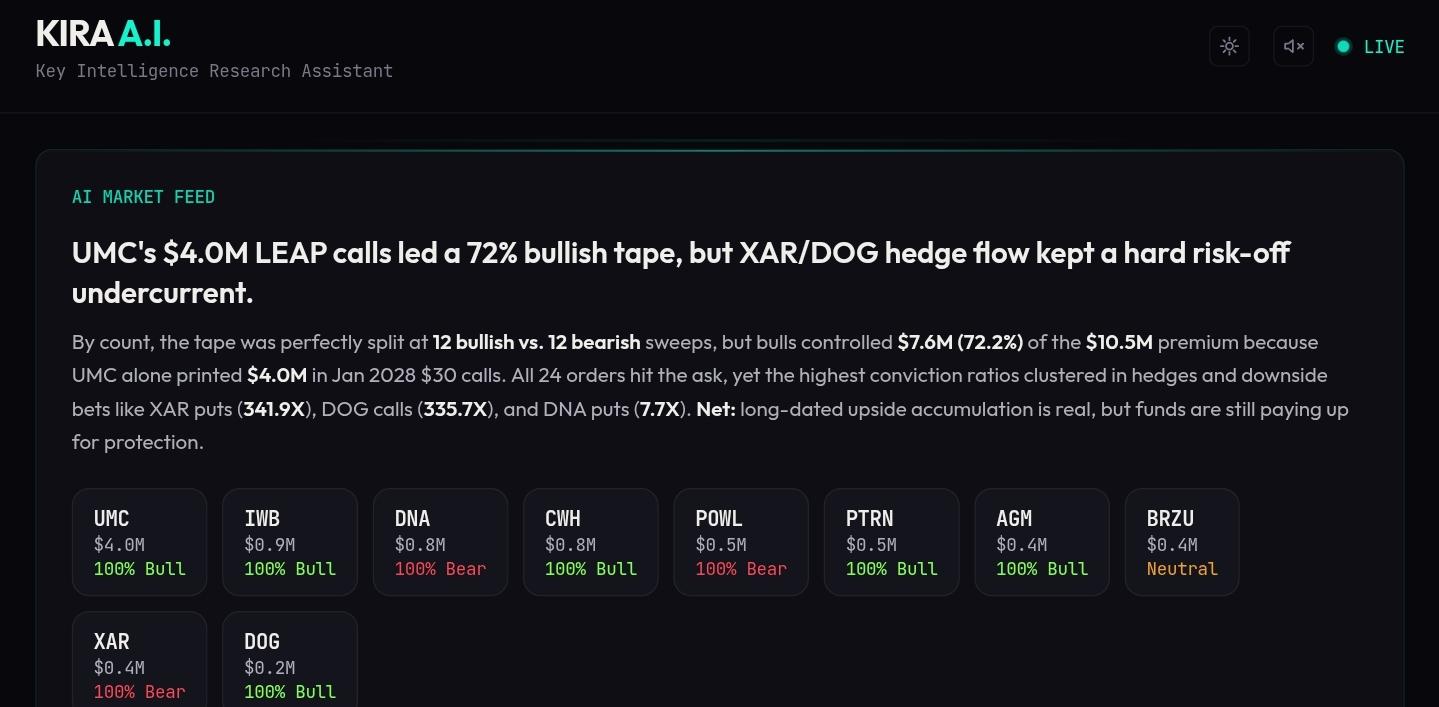
I’m talking about the ability to:
- Identify moves before they even register on a standard chart.
- Target “time-warp” returns that can compress years of gains into days.
- Choose your own risk so you never have to “bet the farm” to see results.
If you still haven’t grabbed your free access, I have to ask… What are you waiting for?
The market isn’t going to slow down for you. The robots running the show today certainly won’t wait for you to catch up.
You can keep doing things the hard way… dealing with the stress, the overthinking, and the emotional roller coaster…
Or you can let AI do the heavy lifting for you.
Claim your FREE access to the AI engine right here (No credit card required)
The proof is waiting inside.
Till the next trade,
Lance Ippolito
AstraZeneca’s $10 Billion Bid for RYTM Is About What Comes After Imcivree

When AstraZeneca floated a $10 billion offer for Rhythm Pharmaceuticals earlier this month, the market treated it as a premium on a revenue story. Rhythm shares jumped 28% to close at $110.68, giving the company a market capitalization of about $7.6 billion. That reaction is understandable. It is also the wrong frame for understanding what AstraZeneca is actually buying.
The commercial anchor here is Imcivree, the brand name for setmelanotide. Third quarter 2026 net product revenue from global Imcivree sales hit $92.1 million, an increase of 29% from the prior quarter, with more than 700 patient start forms filed for acquired hypothalamic obesity as of September 30. That is real, growing revenue. But a $10 billion check for a drug generating roughly $370 million in annualized sales implies the buyer is paying for something beyond the present run rate.
That something is bivamelagon. Bivamelagon is a next-generation melanocortin-4 receptor agonist advancing in clinical development for acquired hypothalamic obesity and Prader-Willi syndrome, both rare neuroendocrine disorders characterized by severe obesity and hyperphagia. Jefferies analysts noted that AstraZeneca’s current offer assigns what they described as minimal valuation to the Prader-Willi program specifically. Analysts at Jefferies, Leerink, and William Blair suggest a bidding war could be brewing and that Rhythm is unlikely to settle for AstraZeneca’s current pitch.
The bidding pressure on Rhythm reflects a broader pattern in obesity drug M&A. Viking Therapeutics’ Phase 3 oral program has already raised the acquisition price Eli Lilly would have to pay for a competing obesity platform.
That disconnect between offer and pipeline value is exactly where the opportunity lives for investors still holding RYTM below the proposed terms. AstraZeneca offered as much as $134 a share in the non-binding proposal, including payments for milestone achievements. The gap between the $110.68 close and $134 is not noise; it reflects genuine uncertainty about whether a deal gets signed and at what price.
The acquisition would be pursued through AstraZeneca’s rare-disease business Alexion, which AstraZeneca agreed to acquire for $39 billion in December 2020 and completed in 2021 to expand beyond its core oncology and biopharmaceutical franchises. Folding Rhythm’s MC4R platform into Alexion gives AstraZeneca a rare genetic obesity franchise at a point when analysts have argued the obesity drug market could approach $100 billion annually by the end of the decade, driven by the commercial success Novo Nordisk and Eli Lilly have demonstrated with their GLP-1 therapies.
Rhythm also carries a third asset: RM-718, a weekly injectable MC4R agonist in clinical development. Alongside bivamelagon, Rhythm is progressing RM-718, further expanding its pipeline of MC4R agonists and metabolic disorder candidates. Three distinct assets, one platform, one acquirer willing to pay a roughly 40% premium versus the pre-report trading level. The competitive dynamic is clearly in Rhythm shareholders’ favor.
For long-term investors, the lesson here extends beyond whether this specific deal closes. Rare-disease platforms with durable regulatory moats and expanding approved indications attract the largest acquirers in pharma at the highest multiples. Rhythm spent years building that platform. AstraZeneca just told you what it thinks it’s worth.