October 28, 2026
Bonus Content: GSK Grew Sales 5% and Still Had £2.1 Billion Left Over
Most traders have never noticed the weird market anomaly that happens at 9:35 AM every morning.
They’re too busy with lagging indicators trying to predict the next move… when the market makers have already set the tone for the trading day.
It’s this weird anomaly that points us to the market maker’s key levels above and below.
And by playing the move within that range…
Regular folks like you have been able to reach for $100 or more (on a $1K stake) over 600 times in the last 2 years.
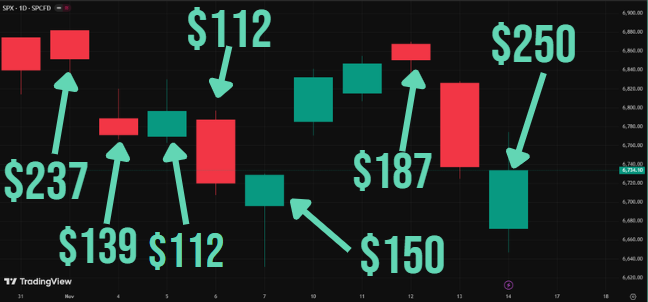
We’ve seen this straightforward approach play out whether the market broke out… broke down… or stayed choppy.
Granted, I can’t make trading guarantees here.
But I’ve opened up the data behind those trades, as well as how you can get in on the very next morning opportunity.
You’ll find the full details right here.
See you in the market.
Chris Pulver
GSK Grew Sales 5% and Still Had £2.1 Billion Left Over

Most companies absorbing a $2.2 billion legal charge manage either the headline number or the guidance. GSK managed both this morning, and the cash flow statement is the real story.
GSK reported Q3 2026 sales of £8.9 billion, up 5% at constant exchange rates, and core operating profit of £3.1 billion, also up 5% at constant exchange rates. Core earnings per share came in at 54.6 pence against a company-compiled analyst consensus of 50.4 pence. That is an 8% beat, in the same quarter that reflects the Zantac settlement charge. The company generated £3.1 billion in cash generated from operations and £2.1 billion in free cash flow during the quarter.
The engine driving those numbers is Specialty Medicines. Specialty Medicines sales rose 15% to £3.9 billion, while vaccine sales fell 2% to £2.6 billion and General Medicines held steady at £2.4 billion. Within specialty, the sub-categories were sharper still: HIV sales reached £2.1 billion, up 10%; Respiratory, Immunology and Inflammation hit £1.1 billion, up 21%; and Oncology contributed £0.6 billion, up 23%. Three recent FDA approvals, Hibsago for chronic hepatitis B, Jideytro in ROS1-positive non-small cell lung cancer, and Jemperli in locally advanced rectal cancer, broaden that pipeline heading into 2027.
Oncology is becoming the decisive growth variable across large-cap pharma, not just at GSK. Johnson & Johnson’s lung cancer data showed how a single strong oncology readout can reframe an entire portfolio’s growth story.
The Zantac settlement is worth understanding clearly. In a September 2024 statement, GSK said it agreed to resolve 93% of U.S. state court Zantac product liability cases, about 80,000 claims, for up to $2.2 billion, with no admission of liability. While the settlement created a large charge when announced, it also aimed to end years of legal uncertainty. That matters for long-term holders. The liability that has shadowed the balance sheet since 2020 is largely closed.
GSK reaffirmed its full-year 2026 guidance at constant exchange rates: turnover growth of 3% to 5%, at the upper half of the range; core operating profit growth of 7% to 9%, also at the upper half; and core EPS growth of 7% to 9%, at the lower half. The company said it remains on track for its 2031 sales outlook of more than £40 billion.
What This Means for Your Portfolio
The case for owning a company like GSK in a long-term, diversified portfolio has never been about exciting growth. It is about durability. Specialty Medicines providing the growth, vaccines providing the breadth, and a cash generation engine capable of funding dividends, buybacks, and pipeline investment simultaneously, that combination is what makes a pharmaceutical holding worth holding through the noise.
GSK declared a 17p dividend for Q3, with 70p expected for the full year 2026. For income-oriented investors, that consistency alongside the reaffirmed guidance makes the thesis straightforward. The stock is not priced for perfection. It is priced for a business that does what it says it will do.
Dividend consistency is only half the income equation for pharma holders. New CMS pricing rules are testing which large-cap pharma dividends are insulated from Medicare reimbursement pressure.
Risks remain real. Vaccine weakness in Shingrix and Arexvy needs watching. The dolutegravir patent cliff between 2028 and 2030 will test the HIV franchise’s next-generation transition. And the Q4 profit weighting in guidance means execution this final quarter matters.
But the headline from this morning is simple: GSK absorbed the largest single legal settlement charge in its recent history, beat estimates by a meaningful margin, and still produced £2.1 billion in free cash flow. That is what a defensive, cash-generative business is supposed to do.
The Wealth Builder Takeaway
The strongest portfolios are built around companies that earn their way through setbacks rather than around them. GSK’s Q3 report is a reminder that cash generation, not just earnings, is what separates a resilient business from a fragile one. When a company can absorb a $2.2 billion charge and still produce £2.1 billion in free cash flow, the income from that stock is not an accident. It is a function of the underlying business model, and that is the kind of model worth owning for years.