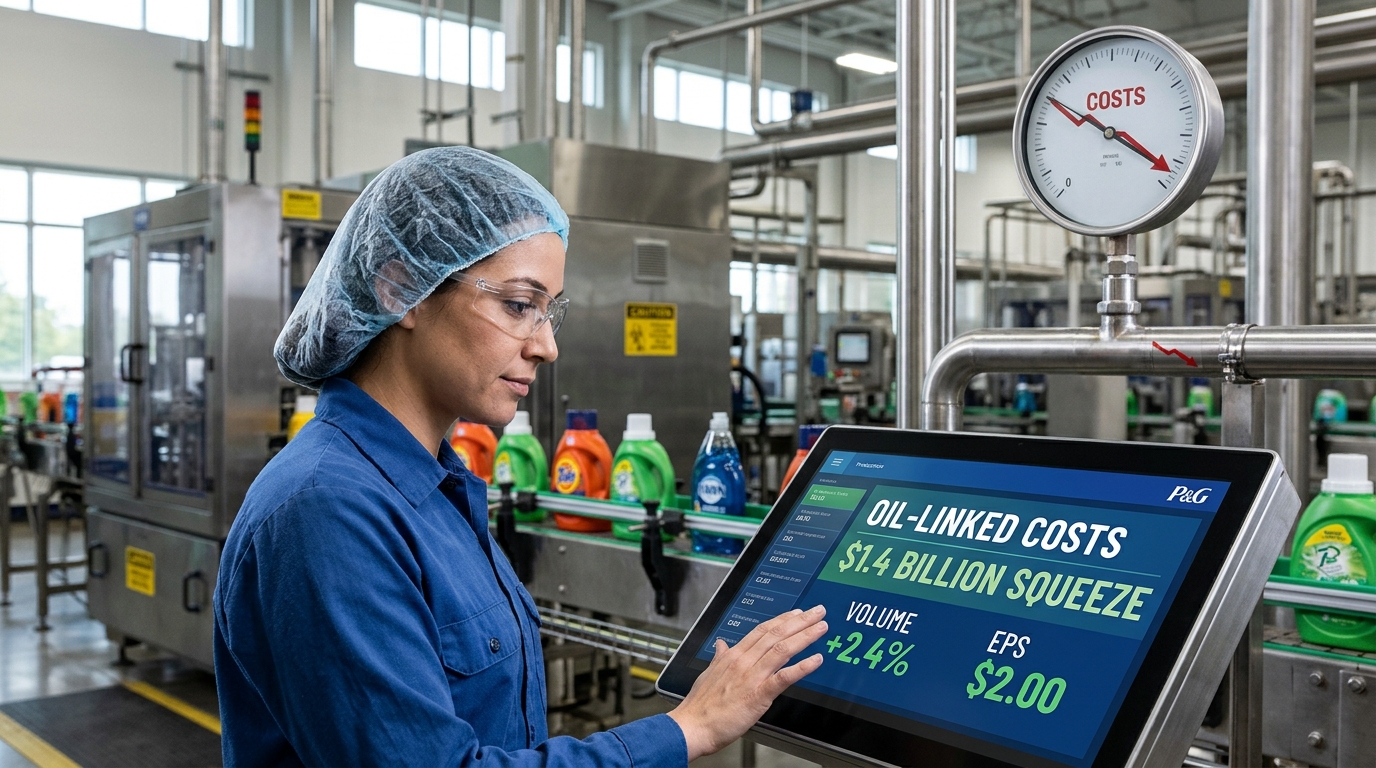
Procter & Gamble delivered a quarter that deserved more credit than markets typically give a 130-year-old soap company. Core EPS came in at $2.00, beating Wall Street’s consensus of about $1.89, on revenue of $23.28 billion. Organic sales grew 4.0% versus the prior year, with volume up 2.4%, pricing up 0.4%, and mix contributing 1.1%. That volume figure matters: it is real demand, not pricing-led revenue that erodes the moment consumers trade down.
All ten product categories and all six geographic regions grew organic sales in the quarter. Greater China organic sales grew 8%, with Pampers up close to 50% and SK-II up 12%, benefiting from near-term competitive dynamics. In North America, organic sales increased 3%, and the U.S. market was also up 3%. Breadth of that kind is not luck; it reflects category leadership built over decades across Tide, Pampers, Gillette, and a dozen other brands consumers reach for without much deliberation.
The Bigger Trend
The problem sits below the revenue line, and management is not minimizing it. CFO Andre Schulten said the company expects materially higher cost headwinds in the next two quarters, with costs staying elevated into the second half of fiscal 2027 because of the duration of higher oil prices. The guidance was discussed with Brent crude trading around $112 per barrel this week. P&G now expects a commodity cost headwind of approximately $1.4 billion after tax from higher raw materials, energy, and transportation costs. Combined with foreign exchange, higher net interest expense, and lower non-operating income, management expects a roughly $1.9 billion after-tax headwind for fiscal 2027, which it said equates to a $0.79 per share drag, an 11% headwind versus fiscal 2026 core EPS.
Core gross margin declined 150 basis points and core operating margin fell 80 basis points, as 250 basis points of productivity improvement was offset by commodity and freight costs as well as demand-creation investments. In Q1, management says the oil cost hit was only partial. The heavier flow-through arrives in Q2 and beyond.
The Investment Case
None of that is a reason to walk away. It is a reason to size the position honestly.
P&G is one of a handful of companies that can raise prices, absorb input shocks, sustain its dividend, and still grow volume simultaneously. The Q1 results prove the first three legs of that stool are holding. The company returned $3.9 billion to shareholders in the quarter, including $2.6 billion in dividends and $1.3 billion in share repurchases. Management maintained its outlook to return about $15 billion to shareholders for the full fiscal year and continues to forecast 85% to 90% adjusted free cash flow productivity.
The annual dividend rate stands at $4.35 per share, yielding roughly 2.8% at current prices. For a company that has increased its payout for decades, that income stream is among the most dependable in consumer staples, and the Q1 earnings beat provides a direct read on its sustainability.
The dividend’s durability depends partly on whether P&G can hold shelf space as retailers push their own labels harder. Grocers are now systematically widening the margin gap between private-label and national brands to steer shoppers away from names like Tide and Pampers.
Building Wealth Around This Idea
Long-term compounders earn the label by delivering through discomfort, not by avoiding it. P&G’s cost squeeze is real and management is saying plainly it gets worse before it gets better. Investors who treat that disclosure as a reason to sell are, in most cases, handing their shares to someone who will hold them through fiscal 2027’s second half and collect the rebound in margins that follows when oil eventually retreats.
The right posture is not to ignore the headwinds but to weigh them against the durability of the franchise. A business that grows volume across every category and every region, in a bifurcated global economy, with Brent above $110, is demonstrating exactly the kind of resilience that justifies a core portfolio allocation. Position sizing should reflect that the next two quarters will carry more cost pressure, which may keep the stock rangebound even as the underlying business performs. That is the entry condition, not an exit signal.
The cost structure P&G is navigating is not company-specific — it is reshaping margins across every business that moves goods. Record diesel prices are dividing companies into those that can recapture freight costs and those that simply absorb them.
Risks to Monitor
The single clearest risk is that oil stays elevated longer than P&G’s current $100-per-barrel planning assumption. Management also said it will be closely watching consumer demand as high fuel and energy costs persist into the fall and winter, a concern that cuts both ways: energy-squeezed consumers may eventually trade down to private-label alternatives even in categories where P&G has historically held firm. Execution on productivity savings, currently running at 250 basis points in the quarter, will determine how much of the $1.4 billion commodity burden P&G can absorb without cutting reinvestment behind its brands.
Daily Wealth Takeaway
The most durable wealth-building opportunities often look uncomfortable in the quarter you buy them. P&G’s volume growth tells you the consumer franchise is sound. Management’s cost warning tells you the next few quarters will be noisy. Understanding the difference between a business problem and a valuation opportunity is the skill that separates long-term compounders from stocks people sell at exactly the wrong time.