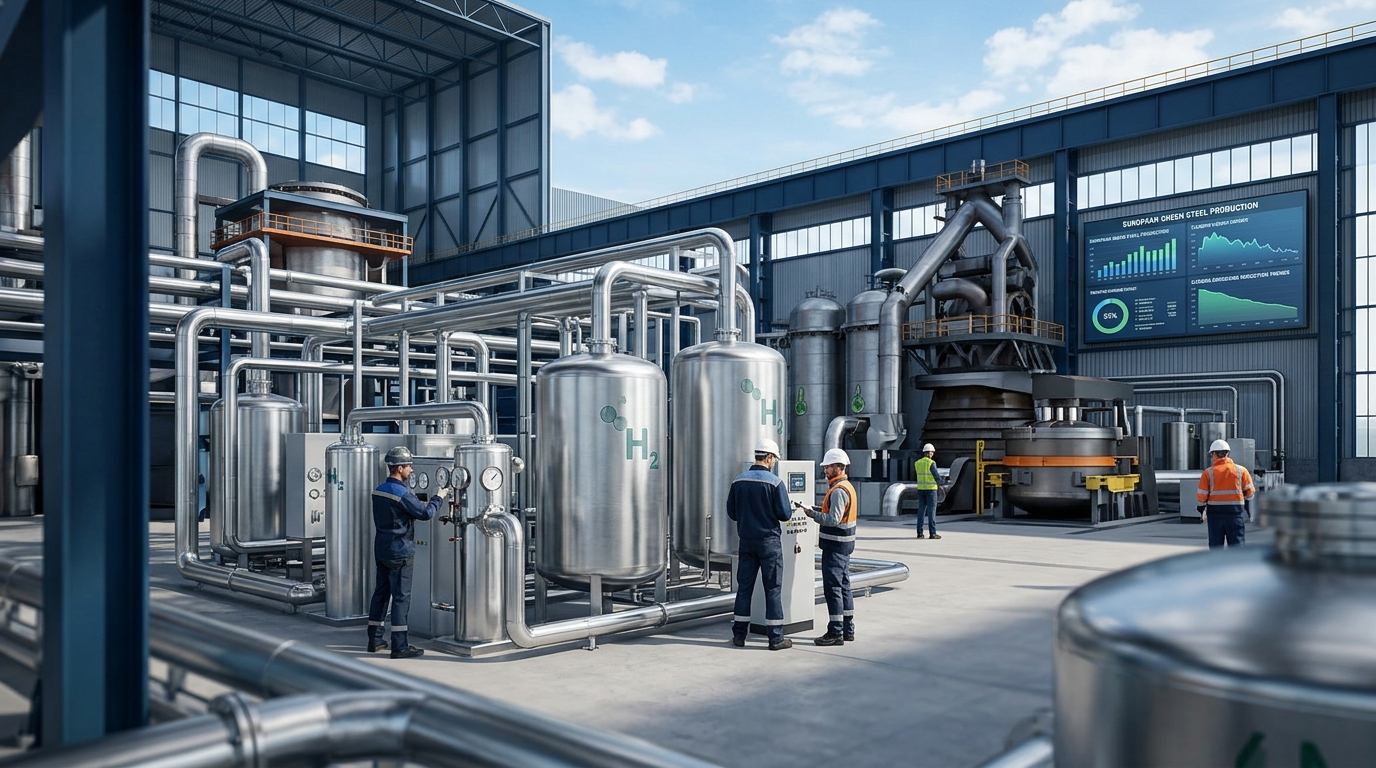
Steel accounts for roughly 7% of global greenhouse gas emissions, and the industry has spent two decades debating whether hydrogen can realistically replace coal. That debate closed in 2026. On January 1, the EU Carbon Border Adjustment Mechanism entered its definitive phase, transforming what was a reporting-only transitional period into a compliance regime with certificate obligations that will reshape steel trade into Europe. The certificate price is not theoretical: the official CBAM certificate price for Q3 2026 is €82.32 per tonne of CO₂e. That figure is now embedded in steel economics moving into Europe.
Where Linde Sits in the Trade
Most coverage of Linde focuses on its electronics or chemicals exposure. The industrial decarbonization angle is more interesting and less priced. Linde has made full-scale installations with hydrogen injection and combustion across steel, glass, aluminium, non-ferrous kilns, and cement. In North America, the work is already past trial stage: in January 2024, Cleveland-Cliffs disclosed it completed a hydrogen injection trial at its Indiana Harbor #7 blast furnace, and said Linde was the hydrogen gas supplier and a critical partner in executing the trial.
In Sweden, the commercial commitment is larger. Linde invested approximately $150 million to build, own, and operate an on-site air separation unit in Boden, northern Sweden, supplying oxygen, nitrogen, and argon to Stegra’s integrated plant, which is designed to reduce carbon emissions by up to 95% compared to traditional steelmaking. Separately, Linde Engineering was awarded an engineering and procurement contract for a pressure swing adsorption unit at the Boden plant to efficiently recover and purify hydrogen from the top gas of the direct reduction iron furnace. Stegra, formerly H2 Green Steel, raised €1.4 billion in fresh equity in 2024 to fund its Boden project and ramp toward first commercial volumes. That funding keeps Linde’s offtake intact.
The Financial Structure Traders Are Missing
Because hydrogen-based direct reduced iron combined with electric arc furnaces generates far fewer emissions than conventional blast-furnace steelmaking, producers using low-carbon technologies face significantly lower carbon costs under the CBAM. That cost wedge is Linde’s operating leverage. The company does not bear steel-price risk; it sells the gas that helps steelmakers reduce embedded emissions and, by extension, their certificate exposure.
The financials reflect a business with structural pricing power. In Q2 2026, sales were $9.29 billion, up 9% year over year, and underlying sales increased 4% with price up 2% and volume up 2%. At June 30, 2026, Linde’s sale-of-gas backlog of large projects under construction was approximately $8.1 billion. That backlog is the key figure: it represents locked-in capital tied to projects already under construction, including industrial decarbonization work.
Technical Levels and the Q3 Catalyst
LIN trades near $500 heading into its next report. Linde is scheduled to report Q3 2026 earnings on October 29, 2026. Analysts expect earnings of $4.52 per share on revenue of $9.16 billion, compared to $4.21 per share on $8.62 billion a year earlier. The stock has beaten consensus in each of its last eight quarters. The question for October 29 is whether management gives any incremental detail on how the CBAM pricing environment is accelerating customer conversations on long-term hydrogen supply agreements.
Scenario Modeling
Bull Case. Stegra reaches commercial output in H2 2026 on schedule. Customer inquiries for long-term hydrogen supply contracts accelerate as CBAM certificate costs bite at €82.32 per tonne. Linde’s sale-of-gas backlog expands past $9 billion by year-end and full-year EPS lands at the top of the $17.70 to $17.90 guide range. LIN holds $500 and extends higher.
Base Case. Stegra faces minor commissioning delays. CBAM adoption drives steady volume growth but margin stays compressed near 29.5% as cost inflation persists. EPS prints at $4.52 in Q3, in line with consensus. Stock consolidates between $475 and $500 while backlog data provides the only fresh catalyst.
Bear Case. A broad industrial production slowdown softens volume across Linde’s manufacturing and chemicals end markets. CBAM policy faces legal challenges from major exporting nations, removing near-term urgency from customer decarbonization commitments. Operating margin slips further below 29%, and the stock revisits the $450 area.
Active Trader Framework
The October 29 earnings call is the event to monitor. Listen specifically for any mention of new long-term take-or-pay contracts tied to green hydrogen or direct reduced iron projects. Margin commentary on the industrial gas segment is the margin-of-safety indicator. Position sizing should reflect that the stock is approaching the upper end of its 52-week range, with event risk concentrated in eight days. Volatility around earnings has historically been contained relative to sector peers, given the contractual nature of Linde’s revenue. Manage accordingly. Preparation and position discipline matter more than the macro call.