October 8, 2026
Bonus Content: Tesco Raised Its Profit Floor. What It Means for Income Investors.
Hi,
Take a look at this…

It’s smaller than a fingertip…
It’s made of glass…
And it’s about to unlock the next wave of AI growth.
Jensen Huang, Nvidia’s CEO, says this “light-speed” device is shattering the limitations of AI… and without it, AI can’t scale.
Google Ventures says it’s the future of AI compute…
And Sequoia Capital – the firm that backed Anthropic and OpenAI – calls it a “holy grail.”
Already, Elon Musk, Mark Zuckerberg, Cathie Wood, and Bill Gates are moving money to prepare for what’s coming…
Yet most Americans have never heard of it.
Wall Street insider Jason Bodner – the same man who called Nvidia at $4.50 – says this device is about to launch a whole new wave of AI winners…
And to prove it, he’s giving away his #1 stock involved with it – for free.
Click here to learn more. (No purchase necessary.)
We have so much to look forward to,
Jeff Brown
Founder & CEO, Brownstone Research
P.S. Stocks tied to this “light-speed” device already surged 133%, 217%, and even 320% – in a few short months. But it’s just getting started. Click here before the mainstream catches on.
Tesco Raised Its Profit Floor. What It Means for Income Investors.
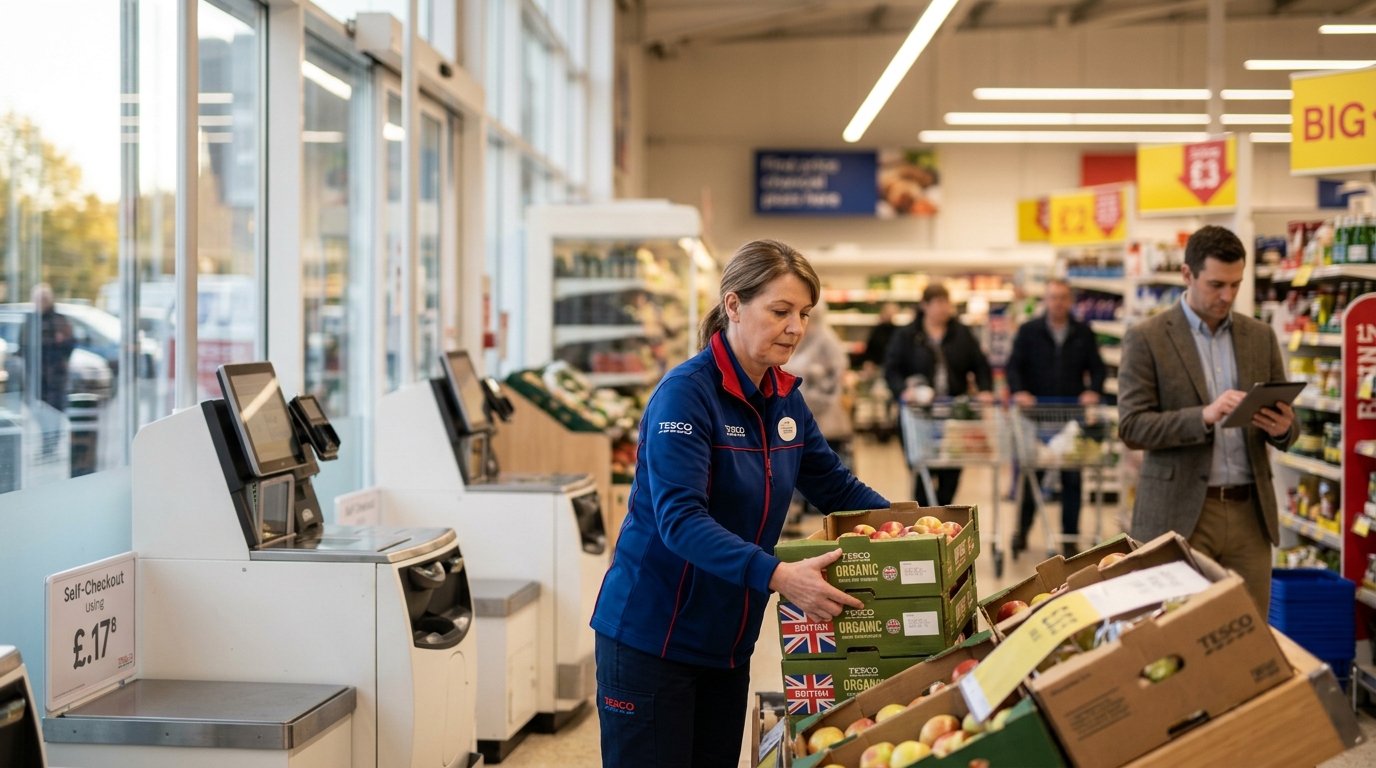
Most investors building a global income portfolio think of UK equities as an afterthought. Tesco’s results this morning offer a reason to reconsider that instinct.
Tesco raised the lower end of its full-year profit guidance and increased its share buyback after first-half adjusted operating profit rose 6.5% to £1.783 billion. That profit figure matters less than what management did with the confidence it produced. Supported by the strength of its balance sheet and sustained strong cash delivery, Tesco increased the size of its share buyback programme for the current year to £950 million, up from £750 million.
The company now expects adjusted operating profit of £3.15 billion to £3.30 billion for 2026/27, compared with its previous £3.0 billion to £3.3 billion range. The upper end is unchanged, but lifting the floor is meaningful: it tells investors that even a softer second half lands inside a tighter, more credible band. Management effectively raised full-year guidance, a move that lifts the midpoint and signals confidence into the Christmas trading period.
The Cash Flow Case
Buybacks only mean something when a business generates the cash to sustain them without borrowing to do it. Tesco clears that bar. Free cash flow increased 21% to £1.57 billion, while adjusted diluted earnings per share rose 12.2% to 17.3p. Since commencing the 2026/27 buyback programme on 16 April 2026 and up until market close on 7 October 2026, Tesco had already bought back £550 million worth of its ordinary shares. The programme runs to April 2027, so the remaining £400 million lands squarely in the months ahead.
Tesco increased its interim dividend by 5.2% to 5.05p per share, while net debt fell by £526 million from the year-end to £10.037 billion. A rising dividend alongside a shrinking share count is the combination income investors should look for: it grows income per share without the company having to grow its total payout at the same pace.
Where the Story Gets Complicated
Not every line in the results pointed up. Booker was weaker, with like-for-like sales declining 2.6% as the wholesale division faced a difficult comparison and continued contraction in tobacco sales. UK like-for-like sales growth slowed to 1.5% for the half, and Tesco said its market share dipped as it lapped unusually strong gains in the prior period.
These are real friction points, not cosmetic ones. The UK grocery market rewards scale, but scale has limits when the cost of defending it rises. Tesco’s message is that it can keep protecting profits through pricing, promotions, and cost control, despite households still feeling pressure and the company flagging uncertainty from geopolitical tensions. That is a defensible position for a grocer with Tesco’s market presence. Whether it holds through a second half that includes a critical Christmas is the open question.
Fitting This Into a Portfolio
Tesco stock rose 1.9% to reach 485p on the news, recovering ground it had lost since its 52-week high of 520.60p. At that level, the stock still sits below its peak, and the buyback provides a mechanical floor beneath the share price as long as management executes.
For investors who want income exposure outside the US, without the volatility that comes with commodity producers or cyclical industrials, a business generating over £1.5 billion in free cash flow annually and actively reducing its share count is worth holding. Position it as a single-digit percentage of a diversified portfolio, treat the dividend as the primary return, and regard the buyback as the compounding mechanism that makes the holding more valuable per share over time.
Daily Wealth Takeaway
A company that raises its guidance floor, grows free cash flow by 21%, and expands its buyback is telling you something specific: that management trusts the cash generation enough to commit more capital to shareholders. That trust, expressed in numbers rather than words, is one of the most reliable signals available to long-term investors.