September 25, 2026
The same day Akamai handed Anthropic an equity stake just to close an $11 billion contract.
Two announcements landed within hours of each other on September 24, 2026. Read separately, each looked like good news. Read together, they offer a more useful signal about where the AI infrastructure cycle actually stands.
THE STARLINK OF ENERGY
This little-known stock could benefit from a major government catalyst this August
A single “Energy Cube” can be delivered by truck… dropped next to a data center, military base, or industrial site… and provide reliable electricity for decades.
Think of it as the “Starlink of Energy.” A government milestone expected this August could shine a spotlight on one little-known company at the center of the Energy Cube story.
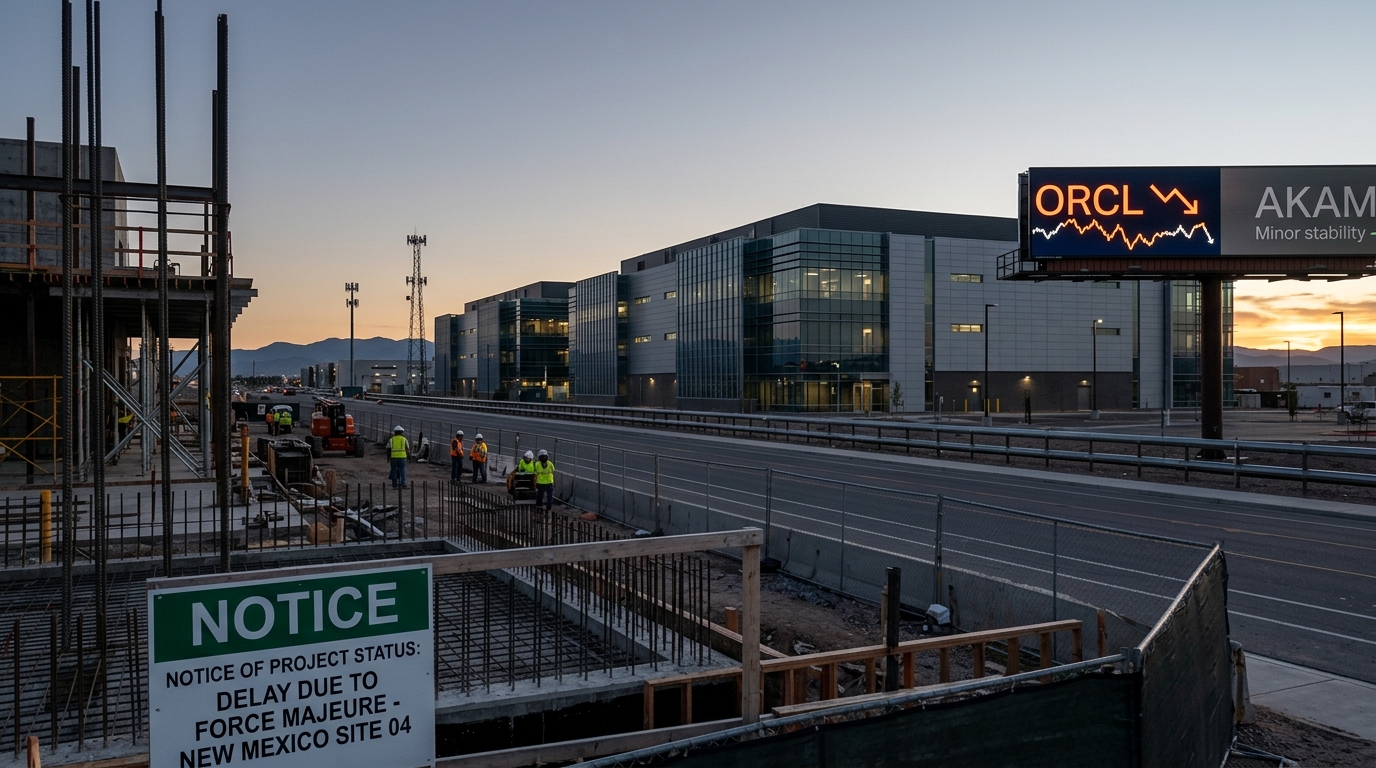
Oracle shares fell about 3.5% after news broke that the company had sent a force majeure notice tied to its New Mexico data center project to protect itself from higher expenses. Bloomberg first reported that Oracle sent the notice to the developer of Project Jupiter, a Stargate data center campus in New Mexico. Force majeure clauses, common in energy and commodities contracts, excuse a party from contractual obligations when events outside its control get in the way. Oracle is not seeking to exit as the campus’s main tenant. Instead, the notice would allow the company to delay payments should the facility miss its 2028 target to come online.
The campus, designed to handle roughly 2.45 gigawatts, is meant to run on gas-powered fuel cells from Bloom Energy, and an Energy Transfer pipeline intended to deliver gas to the site has been delayed nearly six months, to February 1, 2027, after regulators denied permits for the line. If both sides agree that a force majeure event tied to meeting power commitments has occurred, Oracle could win a three-year delay on rent when those payments begin. The company would still owe rent for the full lease term once payments start. Oracle told CNBC the project remains on schedule. The legal paperwork suggests they want protection in case it doesn’t.
Bloom Energy’s role in the project is not a minor detail — it sits at the center of the power delivery risk Oracle is now trying to hedge. The fuel cell supplier has faced its own turbulence this year, with short sellers challenging its backlog figures and a regulatory setback already on the books. Our earlier look at Bloom Energy’s disputed backlog and the earnings pressure building around it laid out why the company’s ability to deliver at scale was already a question mark before Oracle’s legal paperwork surfaced.
The Warrant Hidden in Akamai’s Record Deal
On the same day, Akamai announced an $11.6 billion multi-year agreement with Anthropic, with the transaction providing for potential expansion of the relationship by up to an additional $9 billion. Akamai has issued a warrant to Anthropic, the continued vesting of which is tied to the successful expansion of the relationship, for up to approximately 5% of Akamai’s common stock outstanding.
Most investors can’t see it. But once you do, you can’t unsee it.
There’s something hidden in the stock market.
Most people walk right past it.
But a handful of investors know how to light it up.
And when they do …
The path to gains like 387% … 756% … even 2,770% … appear as clear as day.
Most coverage treated this as an unambiguous win for Akamai. The stock surged. But look at the warrant from Anthropic’s perspective: a customer negotiating an $11.6 billion commitment took equity in its supplier as part of the price. Akamai issued the warrant for the purchase of non-voting convertible Series B Preferred Stock representing 7.7 million shares of Akamai’s common stock on an as-converted basis, at an exercise price of $111.33 per share. Akamai does not expect revenue from the Anthropic agreement in 2026, with revenue expected to begin during the second half of 2027. A customer that large, paying that much, still needed an equity kicker to make the economics work. That is not how deals are structured when capacity is abundant and suppliers have all the leverage.
Understanding why Anthropic has this kind of negotiating leverage requires stepping back to look at the company’s own capital structure and the valuation it has commanded from investors. Anthropic’s confidential S-1 filing earlier this year at a near-trillion-dollar valuation reshaped how the listed AI complex is priced, and it also revealed the financial architecture that gives the company room to demand equity from its vendors. Our breakdown of what Anthropic’s IPO filing means for investors in the listed AI complex is worth revisiting alongside this deal.
The Financing Tell That Precedes Every Late Cycle
Neither event is a crisis. Together they illustrate something investors should be tracking in every AI holding they own: how is the buildout being financed, and who is absorbing the risk?
In the last 18 months, hyperscalers Alphabet, Amazon, Meta, Microsoft, and Oracle moved from almost fully self-funded capex to raising external capital at scale. FactSet estimated that incremental annual debt rose from 9% of capex in FY24 to 32% on a trailing basis by mid-2026, and equity has returned to the funding mix, with Alphabet pricing an $84.75 billion equity raise in June 2026 and Oracle planning to raise about $40 billion of combined debt and equity in fiscal 2027.
Circular financing, interlocking commitments among Nvidia, OpenAI, Oracle and CoreWeave, including vendor equity stakes, take-or-pay compute deals, and debt-funded GPU purchases, can make end-demand look larger and more independent than it actually is, echoing the Lucent and Nortel vendor-financing dynamics of 1999 to 2001. This is precisely the pattern that distinguishes a genuine technology buildout from a late-stage one: not the technology itself, but who ends up holding the financial exposure when timelines slip.
CoreWeave is the clearest live example of this dynamic in the public markets today. The company reported a operating loss larger than most investors expected even as its backlog swelled, and its interest expense is now running ahead of its incremental revenue growth — precisely the kind of financial structure that looks sustainable when rates are low and demand is accelerating, and fragile when either condition changes. A closer read of what CoreWeave’s Q2 results revealed about debt-funded GPU buildouts and the limits of backlog as a safety net puts the circular financing concern in concrete terms.
Nuclear Energy’s Comeback Could Spark Before 2026
Global energy demand is surging and one overlooked power source is quietly returning to the spotlight. New policy support and supply constraints are setting the stage for a surprising shift in the energy markets.
What to Do With This in Your Portfolio
None of this means selling every AI position. Despite the pressure on free cash flow, most hyperscalers have strong balance sheets and even with recent debt issuance, gross leverage remains low. The concern is more surgical. Positions in infrastructure developers like Blue Owl, lease-dependent operators, and debt-heavy neoclouds carry a different risk profile than owning the Nvidias and core hyperscalers of the world.
The practical test for any AI holding: is the company generating cash from the buildout, or is it financing the buildout with promises? Oracle hedging its own lease and Anthropic extracting a warrant from its cloud vendor are both answers to that question. Investors who ask it before the market does will have more options when the cycle turns.
The Wealth Builder Takeaway
Late-stage cycles do not announce themselves. They reveal themselves through contract structures: customers demanding equity, tenants filing force majeure on leases they publicly call on-schedule. Two such signals in a single trading day is not a coincidence worth ignoring. The technology may be real and the long-term demand genuine, but position sizing and exposure to the most leveraged parts of the chain deserve a harder look today than they did a year ago.