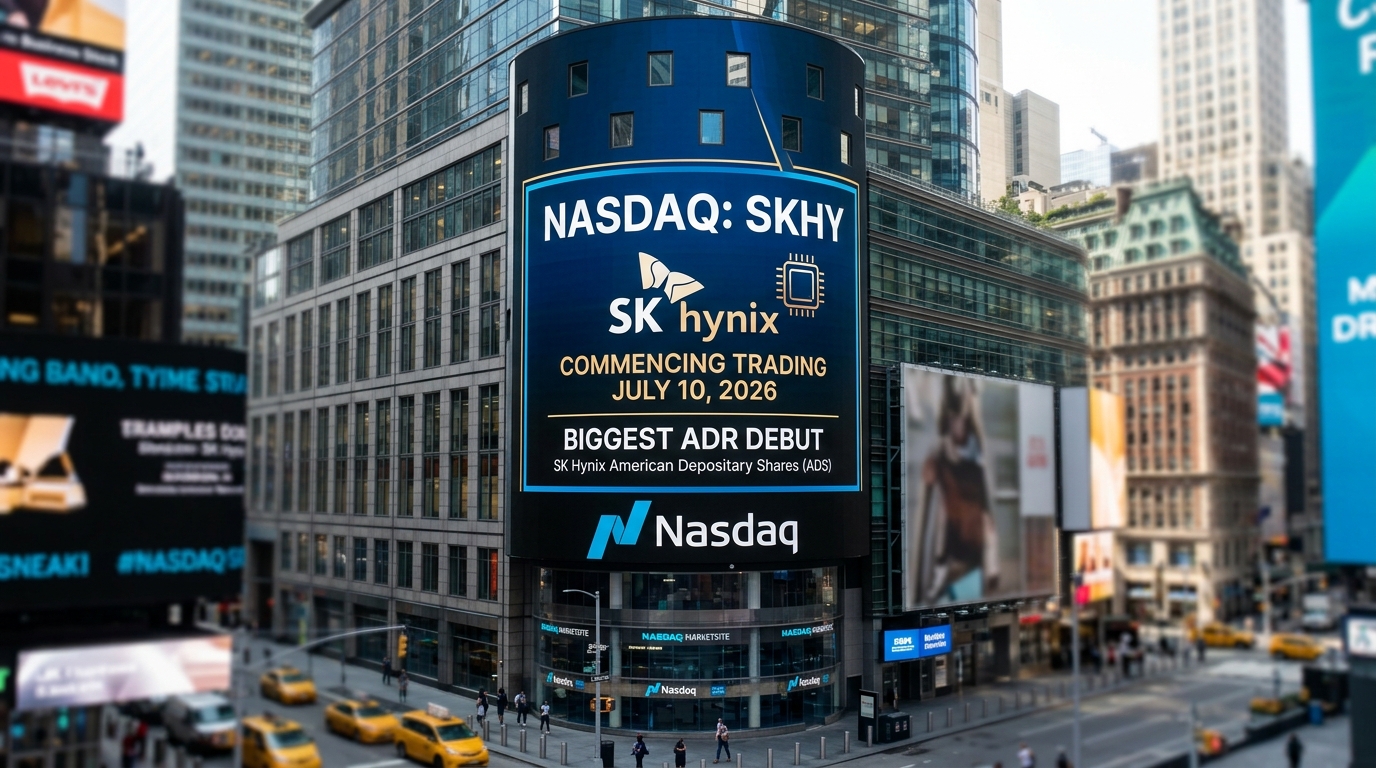
Tomorrow, July 10, 2026, a South Korean chipmaker most American investors have never directly owned will begin trading on the Nasdaq Global Select Market. If things go as planned, the offering could raise about $28 billion (up to roughly $29.4 billion at the top end of the filed range) — large enough to rival or surpass prior record U.S. listings tied to American depositary shares.
The company is SK hynix. The ticker is SKHY. And the timing is not an accident.
What SK Hynix Actually Does
SK hynix is the world’s second-largest memory chipmaker, part of the dominant oligopoly alongside Samsung and Micron. It produces DRAM, NAND flash storage, and — this is the part that matters most right now — High Bandwidth Memory, or HBM.
HBM is specialized, ultra-fast memory used in today’s leading AI accelerators. SK hynix has a roughly 58% global market share in HBM revenue in Q1 2026, according to Counterpoint Research. Samsung and Micron each hold around 21%. In the product that defines the AI hardware cycle, SK hynix is the clear market leader — and has been for years.
That early bet on HBM is the whole story. The company positioned itself before the surge in AI demand, built deep integration with Nvidia, and reaped the rewards: a 72% operating margin in Q1 2026. Yes, 72%.
The Numbers Are Difficult to Ignore
- Q1 2026 revenue: 52.5763 trillion won (operating margin: 72%)
- Q1 2026 operating margin: 72%
- FY2025 revenue: not verified in this article; omitted
- HBM market share: ~58% by revenue (Q1 2026, Counterpoint Research)
- Forward P/E ratio: not verified in this article; omitted
Micron, the closest U.S. comparable, has significantly lower margins. Analyst Han Donghee at SK Securities called SK hynix and Samsung the cheapest stocks in the age of artificial intelligence.
Why List in the U.S. Now?
Here’s the part people skip. This isn’t really about raising capital. SK hynix is not short on cash. What this is about is eliminating what financial analysts call the Korea discount — the persistent gap between how the Korean market values a company like SK hynix versus how global institutional investors would value it if they had direct, frictionless access.
Think about TSMC’s trajectory after it listed ADRs on the NYSE. U.S. access to a major Asian semiconductor giant enabled a sustained re-rating as global capital got a clean entry point.
The offering itself is straightforward: 10 ADRs represent 1 underlying common share. The company is issuing up to about 17.79 million new shares (about 2.5% of shares outstanding) for the ADR listing, and has said proceeds are intended for investments in factories and equipment.
That includes the massive Yongin Semiconductor Cluster in South Korea and an approximately $3.87 billion advanced packaging plant and R&D facility planned in West Lafayette, Indiana.
The Risks Worth Taking Seriously
Memory is cyclical. Always has been. In 2023, SK hynix posted a large operating loss (reported in the trillions of won) as memory prices collapsed. The current upcycle is driven by AI infrastructure spending, which is real and sustained. But if hyperscaler capex cools, or if HBM inventory builds up faster than demand, the revenue line moves quickly.
Samsung is catching up. Samsung says it began mass production of HBM4 and shipped commercial products in February 2026. Nvidia CEO Jensen Huang has also publicly indicated that Samsung, SK hynix, and Micron have been qualified to supply HBM4 for Nvidia’s Vera Rubin platform. SK hynix still leads, but the margin of technological separation is narrowing.
Geopolitical exposure is also real. As a South Korean company, SK hynix carries Korean currency risk, regional geopolitical risk tied to tensions with North Korea, and trade policy exposure that U.S.-listed peers don’t carry to the same degree.
Bull / Base / Bear
Bull: The U.S. listing triggers institutional index inclusion within 30 to 60 days, passive flows create structural buying pressure, and the valuation re-rates from 8x toward the 15x to 20x range that global semiconductor peers command. Analyst consensus targets imply 20% to 47% upside from recent Korean exchange levels.
Base: The listing goes smoothly, SKHY trades at a slight discount to Korean shares initially while U.S. investors get familiar with the name. The stock tracks HBM demand data and Nvidia’s capex outlook closely, moving in line with broader chip sector sentiment.
Bear: A cooling in AI infrastructure spending, Samsung’s HBM4 acceleration, or a memory price correction hits revenue estimates hard. The cyclical risk that Korean investors have always priced in becomes more visible to a new U.S. investor base, and the stock de-rates from its ADR debut price.
What to Watch on Day One
The part that’s genuinely hard to handicap: this is a different kind of listing than most investors have seen. It’s not a startup seeking validation. It’s the dominant supplier in the most critical hardware bottleneck in the AI era, opening itself up to U.S. capital for the first time at a valuation that, on paper, looks significantly cheaper than its American peers.
Whether that gap closes fast, closes slowly, or doesn’t close at all is what makes SKHY worth watching from the open tomorrow.
For informational purposes only.