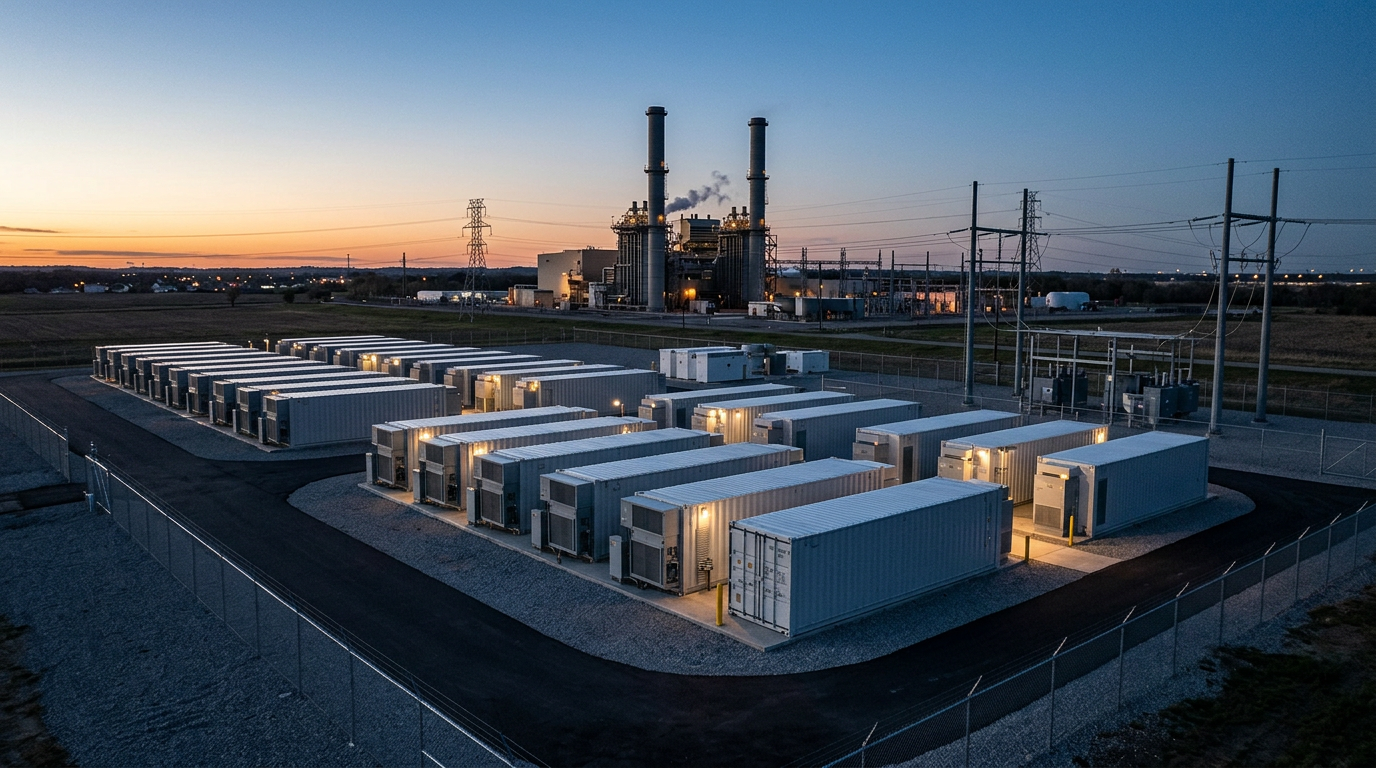
The conversation around energy in 2026 has been dominated by generation – nuclear restarts, natural gas peakers, utility-scale solar. What has been systematically underweighted is the storage layer that makes intermittent generation economically viable. That oversight is beginning to close, and the companies positioned in grid-scale battery storage are starting to show up in institutional flow data in ways that warrant closer analysis.
The Demand Catalyst Is Not Climate Policy – It Is Data Centers
Hyperscaler commitments to 24/7 carbon-free energy have created a procurement dynamic that did not exist three years ago. Microsoft, Google, and Amazon collectively signed over 18 gigawatts of new clean energy offtake agreements in 2025, a significant portion of which require storage pairing to meet around-the-clock load obligations. This is commercial demand with contractual backing – not a policy-dependent thesis.
Fluence Energy (FLNC), one of the largest pure-play grid storage companies in the public markets, reported $1.2 billion in Q2 fiscal 2026 revenue, up 31% year-over-year, with a contracted backlog exceeding $4.8 billion. Gross margins expanded 180 basis points sequentially to 11.4% as manufacturing scale and contract mix improved. The company guided full-year revenue to a range of $4.6–$5.0 billion, representing approximately 28% annual growth at the midpoint.
Vistra and the Hybrid Operator Angle
For investors preferring integrated exposure, Vistra Corp. (VST) has quietly become one of the most discussed names in energy circles. Beyond its nuclear fleet, Vistra operates the largest battery storage portfolio of any U.S. independent power producer – over 6 gigawatts of operating and in-development capacity. The stock has gained approximately 68% over the trailing 12 months, yet forward EV/EBITDA remains near 12x – below comparable utilities with significantly lower growth profiles.
Options Structure and Positioning
FLNC options show an IV rank near 62, elevated relative to its 6-month average, reflecting both earnings uncertainty and sector momentum. The expected move into the next quarterly print is priced at roughly 9.5%. Put/Call skew has shifted notably toward calls in the 30-to-60 day window, with concentrated open interest building at the $25 and $28 strikes for September expiration.
- Bull case: Backlog conversion accelerates; FLNC trades toward $32 on margin normalization
- Bear case: Supply chain delays or project cancellations pressure near-term revenue recognition
- Defined-risk structure: A bull call spread at $24/$30 for September captures upside while capping maximum loss to the premium paid
This is not about the energy transition as an abstract thesis. It is about a specific bottleneck – dispatchable clean power – that has contractual, commercial demand from the fastest-growing segment of the global economy. The revenue is real. The backlog is contracted. The question is whether the market has finished ignoring it.