May 17, 2026
The Power Trade Most People Are Sleeping On
Nuclear, AI demand, and three names worth understanding before the rest of the market catches up
First a note from Oxford Club
By now, you have probably seen the nonstop coverage of SpaceX.
But when I look at this situation as an economist, I see something different.
I see a deeper story developing behind the headlines.
Because while SpaceX grabs the attention, what really stands out to me is Starlink.
That is where the economics begin to get interesting.
Starlink has already built a massive subscriber base. It is already profitable. And if the biggest banks in the world have already moved to secure their position in the SpaceX IPO, I think individual investors need to ask themselves one thing:
What do they know that the public still hasn’t priced in?
The good news is, I believe there may still be time to act.
Not by chasing headlines.
And not by waiting for the mainstream press to connect the dots.
But by looking at the smaller related opportunities that could benefit before June 1.
I’ve laid out the details for you here.
Take a look now while this setup is still early.
Yours for peace, prosperity, and liberty, AEIOU,
Dr. Mark Skousen
Macroeconomic Strategist, The Oxford Club
FEATURED
The Power Trade Most People Are Sleeping On
The grid was not built for this.
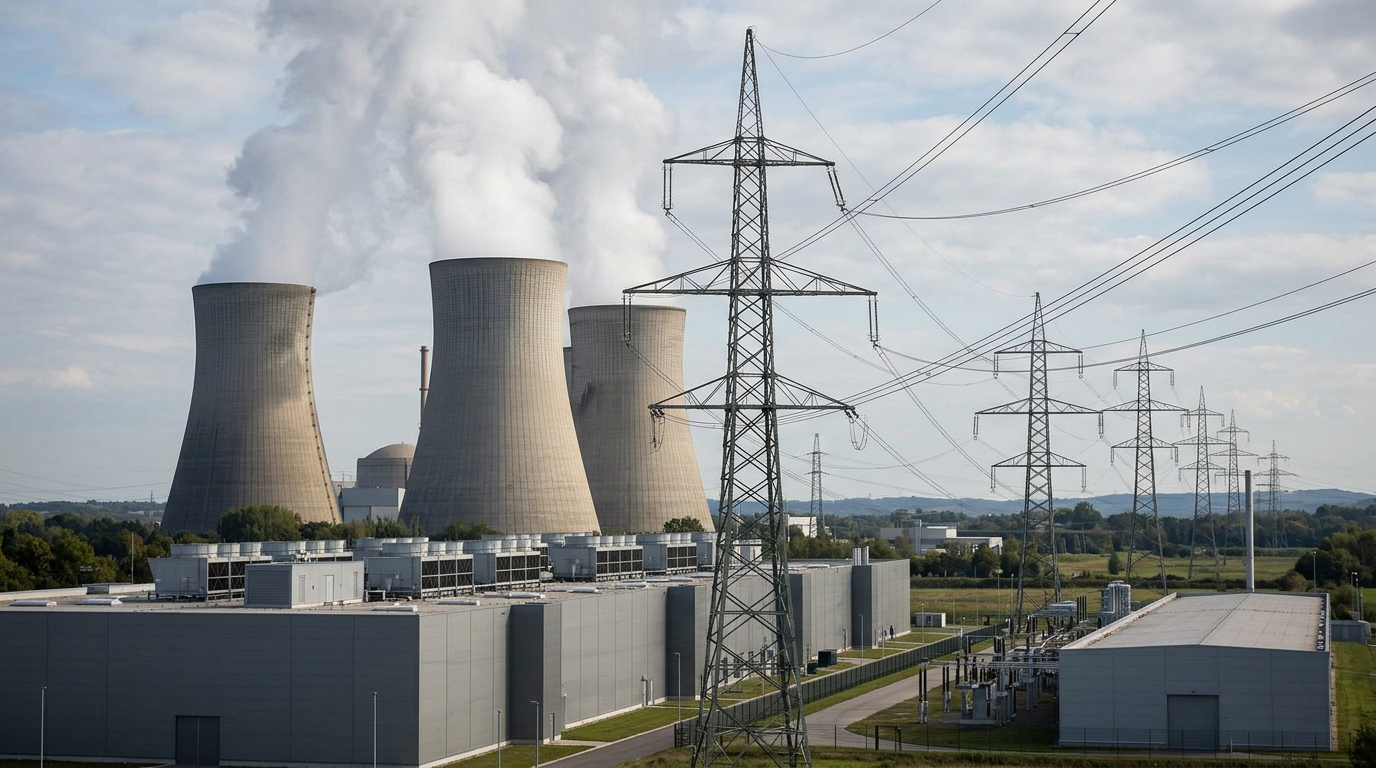
That’s not a metaphor. The physical U.S. power grid — transmission lines, generation capacity, the whole system — was designed around industrial-era demand curves that nobody has seriously stress-tested against what AI infrastructure actually requires at scale. And right now, that gap between what the grid can deliver and what data centers are starting to pull is widening in a way that’s hard to reverse quickly.
FERC projects U.S. data center electricity demand at 35 gigawatts by 2030, up from roughly 19 GW in 2023. BloombergNEF puts it closer to 106 GW by 2035 under more aggressive build-out scenarios. A single AI query uses roughly 10 times the electricity of a standard internet search, according to the Electric Power Research Institute. Multiply that across billions of daily requests and the math gets uncomfortable fast.
Most people overcomplicate options trading.
That’s exactly why this beginner-friendly guide has become one of the most requested resources we’ve shared.
If you haven’t downloaded your free copy of *Simple Options Trading For Beginners* yet, now’s a good time to grab it before the temporary access link expires.
I may charge for this training later on…
But once you download it, your copy is yours to keep.
Wind and solar can’t solve it — they’re intermittent by nature. Natural gas buys time but brings fuel-cost exposure and emissions commitments that hyperscalers are actively trying to get away from. Nuclear is the only source that delivers dense, firm, carbon-free baseload power around the clock. That’s not an opinion. It’s just physics.
What’s interesting is how fast capital started moving once the hyperscalers made their positions known.
GE Vernova is up more than 75% year-to-date through late April 2026. The S&P 500 is roughly flat over that same stretch. That’s not a crowded trade acting like a crowded trade — that’s a sector repricing around a structural shift in who actually controls power access for the next decade of compute. The companies I keep coming back to are CEG, CCJ, and GEV. Each one is a different expression of the same underlying reality.
Constellation Energy (CEG) is the most direct way to own this. Largest nuclear fleet in the U.S., 21 reactors across 16 facilities, and since January 2026 — following the close of its Calpine acquisition at a total enterprise value of roughly $26.6 billion — it’s now the largest private-sector power producer in the world. Q1 2026 revenue hit $11.1 billion, driven largely by the Calpine consolidation. Adjusted EPS came in at $2.74, up $0.60 year-over-year and ahead of expectations. Full-year 2026 EPS guidance stands at $11 to $12 per share, with CEO Joe Dominguez saying base earnings growth “exceeds 20% through 2029.” Free cash flow is guided at $8.4 billion across 2026–2027, then $11.5 to $13 billion in 2028–2029. Microsoft signed a 20-year power purchase agreement to restart the Crane Clean Energy Center in Pennsylvania. Meta followed with a 20-year deal for output from the Clinton Clean Energy Center in Illinois. The stock is down roughly 14% year-to-date and trades around 39x forward earnings — not a value stock, but also not an absurd multiple for what is functionally an AI infrastructure company with a utility cost structure.
One thing I think people are underpricing in the CEG valuation: the Calpine deal didn’t just add natural gas capacity. It brought The Geysers in California — the largest geothermal operation in the U.S. Another source of firm, carbon-free baseload that doesn’t show up clearly in the headline numbers.
The New Arms Race Is Being Built Right Now
Global tensions are accelerating a new kind of arms race powered by advanced technology.
AI, drones, and autonomous systems are becoming central to modern defense strategies. This report reveals five companies positioned to benefit from this shift and what it could mean for investors.
Cameco (CCJ) is how you play the fuel side. One of the world’s largest uranium producers, roughly 230 million pounds under long-term contract, averaging about 28 million pounds in annual deliveries from 2026 through 2030. Spot uranium has been trading near $86 per pound; TradeTech’s long-term indicator was marked at $93 as of March 2026. Cameco recently signed a $2.6 billion supply agreement with India’s Department of Atomic Energy — nearly 22 million pounds through 2035. The structural argument is simple: new uranium supply takes years to bring online, and demand is accelerating. That tightness has legs. Worth noting though — Cameco’s long-term contract book caps near-term realized prices, with 2026 average realized price guidance sitting around CAD 85–89 per pound. It’s not a pure spot-price play.
GE Vernova (GEV) is the longer-duration bet. Its GE Hitachi unit is developing the BWRX-300 — a 300-megawatt factory-built small modular reactor currently under construction at Ontario Power Generation’s Darlington site in Canada, the first SMR under construction in North America, targeting commercial operation by end of 2030. The U.S. and Japanese governments announced up to $40 billion in support for BWRX-300 deployments in Tennessee and Alabama. Q1 2026 revenue was $9.34 billion, beating estimates, with adjusted EBITDA up 87% year-over-year. The stock now trades around 40x NTM EV/EBITDA. That’s a multiple that demands execution.
Here’s where I’d push back on the easy bull case.
The 400 GW federal nuclear target by 2050 — signed into executive orders by Trump in May 2025, which also mandate faster NRC licensing and direct DOE to prioritize nuclear loan programs — would require a construction pace this country hasn’t seen since the 1960s. Executive orders are not build permits. The IEA estimates that tripling global nuclear capacity would require annual investment to climb from roughly $70 billion today to around $210 billion by 2035. The U.S. separately committed $2.7 billion toward domestic uranium enrichment and up to $80 billion for new reactor deployment. That’s real money. But the distance between announced capital and operational megawatts is where most of these stories eventually get complicated.
Uranium price swings, transmission bottlenecks, SMR cost overruns, regulatory timelines — the risks are specific and they’re not small. CEG at 39x forward earnings and GEV at 40x EV/EBITDA are not priced for disappointment.
What I keep coming back to is this: the demand side of this equation is not going away. Data centers are getting built. AI compute is scaling. The power requirement is real and it keeps growing. The question isn’t whether nuclear has a role — it clearly does. The question is whether you’re owning it at the right entry point, in the right vehicle, with a clear understanding of what you’re actually underwriting.
That answer is different for everyone. But ignoring the question entirely feels like the bigger mistake.